Introduction
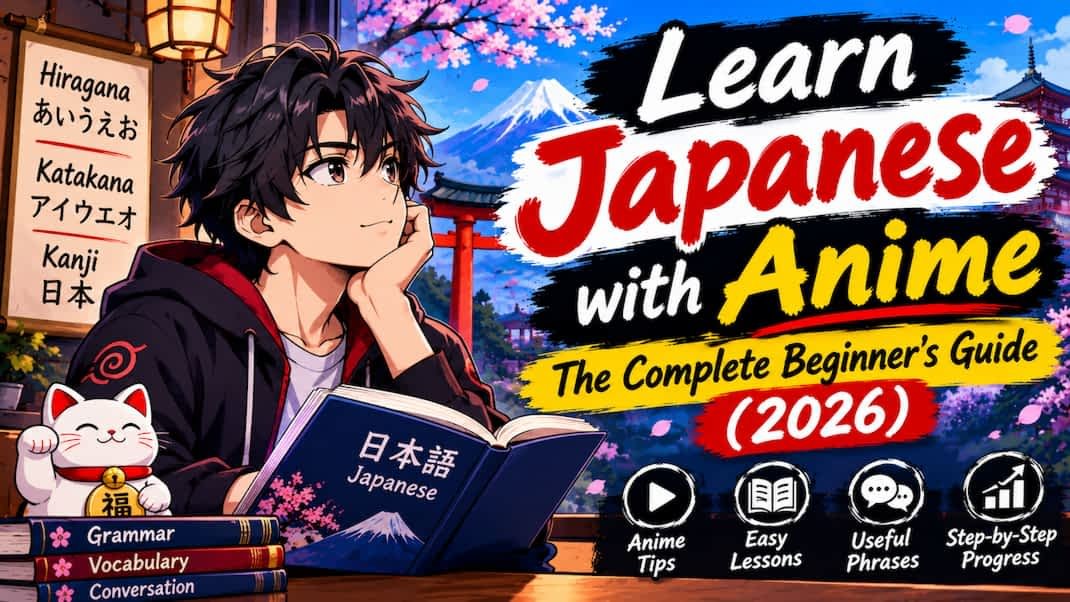
This guide is written for anime fans and complete beginners who want to turn their watch time into language progress. YugenAnime is an anime blog and content site, not a streaming platform, and it does not host videos. Everything below works with whatever legal streaming service you already use.
Why Anime Actually Works for Learning Japanese
Anime gives language learners three things textbooks struggle to deliver: hours of native-speed dialogue, emotional context that makes words memorable, and a reason to keep showing up every day.
When a character shouts “ganbare!” (do your best!) during a climactic match, your brain links the word to a feeling. That emotional link is exactly what makes vocabulary stick. Textbook example sentences rarely create that kind of memory.
Anime also trains your ear for the rhythm of Japanese. Japanese has a steady, mora-timed rhythm that sounds flat to English speakers at first. After a few dozen episodes, your brain starts segmenting the stream of sounds into words without conscious effort.
There is a catch, and this guide is honest about it. Anime Japanese is skewed toward casual, dramatic, and sometimes rude speech. You will learn how heroes talk, not how office workers talk. That is fine as long as you know it — and Section 8 below covers exactly what anime will not teach you.
Language teachers call the sweet spot “comprehensible input”: material where you understand enough to follow along but still meet new words regularly. Beginner anime sits right in that zone. A show like Shirokuma Cafe is simple enough that you catch familiar words, but rich enough that every episode adds a few new ones. That balance is rare in textbooks and common in well-chosen anime.
How We Checked: Our Method for This Guide
Every anime recommendation below was chosen for a specific learning reason: slow and clear dialogue for beginners, repetitive vocabulary for intermediates, or a clear warning when a show is entertaining but too advanced.
Phrase meanings in this guide were verified against standard references: Tae Kim’s Guide to Learning Japanese, a free grammar resource by Tae Kim, creator of the free Tae Kim’s Guide to Learning Japanese, and Tofugu’s “Learn Japanese: A Ridiculously Detailed Guide.” The three writing systems and the 46 basic hiragana characters are standard facts confirmed by Tofugu’s kana materials.
Sample phrases are common everyday Japanese you will hear across many shows, presented as typical examples rather than exact episode quotes. No dialogue was invented. No fluency timelines are promised, because real progress depends on study time, method, and consistency — not on a number we could print here.
The 3 Japanese Writing Systems in 60 Seconds
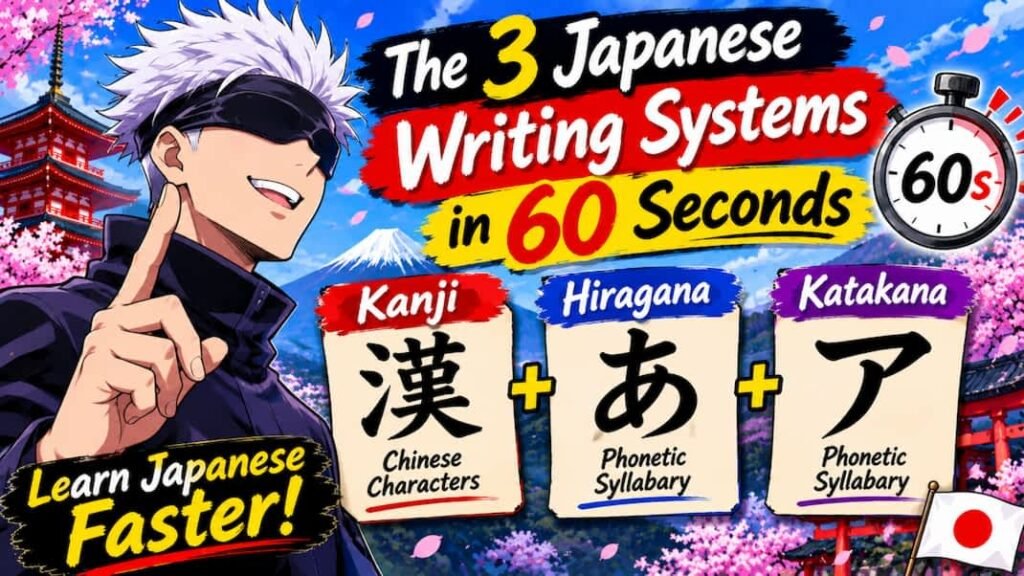
Before your first study episode, you need one piece of background. Japanese uses three writing systems, and anime subtitles will show you all three.
Hiragana is the phonetic alphabet for native Japanese words and grammar. There are 46 basic hiragana characters, and they are the first thing every learner memorizes. When you see soft, curvy characters in subtitles, that is hiragana.
Katakana uses the same 46 sounds but with angular characters. It is used mainly for foreign loanwords — so “anime” itself is written アニメ (anime) in katakana. You will spot katakana constantly in sci-fi and modern-setting shows.
Kanji are the complex characters borrowed from Chinese, each carrying meaning. Anime subtitles are full of them. You do not need to read kanji to start learning from anime, but recognizing a few common ones (like 日 for “day/sun”) makes subtitles far less intimidating.
You do not need to master any of this before starting. Just learn hiragana first — Tofugu’s free guide walks through all 46 — and everything else gets easier from there.
The Best Anime to Learn Japanese, by Level
The biggest mistake beginners make is starting with their favorite show. If your favorite is a fast-talking comedy full of slang, you will understand nothing and quit. Match the show to your level instead.
Each pick below follows the same format: the anime, why it works for learners, what to watch out for, and a sample of the kind of Japanese you will hear.
Beginner Level: Slow, Simple, Everyday Dialogue
Item: Shirokuma Cafe (Polar Bear Cafe)
Source: Slice-of-life anime about a polar bear who runs a cafe.
Best use: Your very first study anime. The dialogue is slow, polite, and full of everyday cafe vocabulary.
Sample usage: You will hear いらっしゃいませ (irasshaimase — “welcome to our shop”) in almost every episode, plus simple exchanges about ordering food and daily life.
Item: Chi’s Sweet Home
Source: Short episodes about a kitten adopted by a family.
Best use: Absolute beginners and younger learners. Episodes are three minutes long, and the vocabulary is small.
Sample usage: Expect simple sentences like ただいま (tadaima — “I’m home”) and おかえり (okaeri — “welcome home”), the standard Japanese homecoming exchange.
Item: Doraemon
Source: Long-running family anime about a robot cat from the future.
Best use: Building core vocabulary. The language is aimed at children, so it stays simple and clear.
Sample usage: Common school-life words repeat constantly: 宿題 (shukudai — homework), 友達 (tomodachi — friend), and the famous どこでもドア (dokodemo doa — “anywhere door”).
Item: My Neighbor Totoro
Source: Studio Ghibli film about two sisters who meet forest spirits.
Best use: Listening practice with clear, slow, warm dialogue. Films work well because you can rewatch a single scene many times.
Sample usage: Gentle everyday phrases like おはよう (ohayou — “good morning”) and ありがとう (arigatou — “thank you”) appear in natural, unhurried conversations. For more films with clear dialogue, see our best anime movies list.
Lower-Intermediate: Natural Speed, Familiar Situations
Item: Kiki’s Delivery Service
Source: Studio Ghibli film about a young witch starting a delivery service.
Best use: Polite everyday Japanese. Kiki speaks politely to customers, which balances the casual speech of most anime.
Sample usage: You will hear すみません (sumimasen — “excuse me / sorry”) used correctly in service situations, plus practical phrases for asking directions and handling deliveries.
Item: Haikyuu!!
Source: Sports anime about a high school volleyball team.
Best use: Repetitive vocabulary that drills itself into memory. Sports anime reuse the same words every episode.
Sample usage: Team shouts like がんばれ (ganbare — “do your best!”) and ドンマイ (donmai — from English “don’t mind,” meaning “shake it off”) repeat so often you will memorize them without trying.
Item: March Comes in Like a Lion
Source: Drama about a professional shogi player dealing with life and loss.
Best use: Emotional, clearly enunciated dialogue at natural speed. Excellent for learners moving past beginner material.
Sample usage: Everyday adult conversations with complete sentences — great for hearing how だ (da) and です (desu) endings actually sound in context.
Intermediate and Up: Fast, Stylized, or Specialized
Item: Demon Slayer
Source: Action anime about a boy hunting demons to save his sister.
Best use: Clear enunciation despite the fantasy setting. Battle anime often pronounce technique names slowly and dramatically, which helps listening.
Sample usage: Formal-sounding declarations like 全集中 (zen shūchū — “total concentration”) teach you how kanji compounds sound when spoken with emphasis.
Item: Naruto
Source: Long-running ninja action series.
Best use: Massive exposure hours. With hundreds of episodes, repetitive ninja and friendship vocabulary becomes automatic.
Sample usage: The famous だってばよ (dattebayo — Naruto’s verbal tic, roughly “believe it!”) is a great lesson in how anime characters use speech quirks you should never copy in real life.
Item: Monogatari Series — advanced only
Source: Dialogue-heavy supernatural series famous for wordplay.
Best use: A long-term goal, not a starting point. The puns and rapid-fire conversations are a workout for advanced ears.
Sample usage: If you can follow a Monogatari conversation without subtitles, your listening is genuinely advanced. Until then, enjoy it as entertainment, not study material.
The 3-Pass Method: How to Watch Anime Actively
Here is the core method of this guide. One episode, three passes, about 45 minutes total. This is what turns watching into studying.
Pass 1 — Watch for meaning (15 minutes). Watch the episode normally with English subtitles. Just enjoy the story and note which scenes had dialogue you wish you understood. No pausing, no studying. Anime fans already do this pass every day.
Pass 2 — Watch for Japanese (20 minutes). Rewatch with Japanese subtitles if your service offers them. Pause whenever you hear a word you recognize or a phrase that repeats. Say it out loud once. Do not look anything up yet — just notice.
Pass 3 — Study five phrases (10 minutes). Pick exactly five phrases from the episode. Write each one down with its meaning (check with a dictionary or grammar reference like Tae Kim’s guide). Say each phrase five times. Five phrases per episode, deeply learned, beats fifty phrases skimmed.
Item: The 3-pass method applied
Source: Any 24-minute episode from the beginner list above.
Best use: Building a daily habit. One episode a day with this method teaches more than a weekend of passive binge-watching.
Sample usage: From a Shirokuma Cafe episode, your five phrases might be いらっしゃいませ (irasshaimase — welcome), 注文 (chūmon — order), お待たせ (omatase — “sorry to keep you waiting”), 美味しい (oishii — delicious), and また来てね (mata kite ne — “come again”).
Why three passes instead of one careful watch? Because your brain cannot enjoy a story and analyze grammar at the same time. Pass 1 satisfies the fan in you. Passes 2 and 3 train the learner. Separating them keeps both fun and study alive.
Shadowing: The Technique That Builds Speaking Speed
Shadowing means speaking along with the audio, a half-second behind the character, mimicking their pronunciation, rhythm, and emotion. It is the single best speaking exercise you can do alone with anime.
Start with short, emotional lines — battle cries, greetings, catchphrases. Pause, repeat the line three times shadowing the character, then move on. Ten minutes of shadowing after your 3-pass episode is enough. Famous anime lines in Japanese, with meaning and romaji, make good first phrases to learn.
Shadowing works because Japanese rhythm is different from English rhythm. English stresses syllables; Japanese gives each mora roughly equal time. Copying a voice actor’s timing trains your mouth in a way reading never will.
One warning: shadow the pronunciation, not the personality. Shouting like an anime protagonist in a real conversation will get you strange looks. The technique builds muscle memory for sounds; your manners should come from the polite phrases in Section 5’s Kiki’s Delivery Service recommendation.
A simple starter routine: pick one 10-second scene, loop it five times, and shadow each loop. By the fifth loop, your mouth will move before your brain translates — that automatic feeling is exactly what fluency is built from. Do this with two scenes a day and your spoken rhythm will change within a month.
What Anime Will Not Teach You (Read This Before You Start)

Honesty matters more than hype. Anime is a powerful supplement, but it leaves real gaps. Knowing them in advance saves you from embarrassing mistakes.
Polite Japanese (keigo). Most anime characters speak plain or casual form. Real adult life in Japan runs on polite form — です (desu) and ます (masu) endings, humble and honorific verbs. If you only learn from shonen heroes, you will sound like a rude teenager in a job interview. Study polite form separately with a grammar guide.
Reading and writing. Listening to anime does not teach you to read kanji or write sentences. Pair watching with kana study from the start, or you will become someone who understands anime but cannot read a menu.
Real conversation skills. Anime dialogue is scripted, dramatic, and uninterrupted. Real conversations have filler words, interruptions, and small talk. Anime gives you vocabulary and listening; real practice with real people gives you conversation.
Regional and gendered speech. Characters often speak in exaggerated styles — samurai speech, delinquent slang, cutesy girl speech. These are fun but not neutral. Learn standard polite Japanese as your base, and treat anime styles as flavor.
None of this means anime is a bad teacher. It means anime is a specialist teacher: unmatched for listening, vocabulary, and motivation, but not a complete curriculum. The learners who succeed pair anime with a grammar resource and kana practice.
Original by YugenAnime: The Anime Episode Study Sheet
This reusable template is original to YugenAnime. Copy it into a notebook or notes app and fill one row per new phrase during Pass 3 of the 3-pass method.
How to use it: After each episode, add up to five rows. The “Checked meaning” column forces you to verify with a dictionary or grammar guide instead of guessing. Review the sheet weekly — phrases you keep forgetting go into a flashcard app.
| # | Phrase heard | What I think it means | Checked meaning | New words in it |
|---|---|---|---|---|
| 1 | ||||
| 2 | ||||
| 3 | ||||
| 4 | ||||
| 5 |
Worked example — one filled row:
| # | Phrase heard | What I think it means | Checked meaning | New words in it |
|---|---|---|---|---|
| 1 | がんばれ!(ganbare!) | “Good luck!” | Imperative “do your best!” — said TO someone | がんばる (ganbaru — to do one’s best) |
Keep every sheet. After a month you will have a personal phrasebook of 100+ phrases, all learned from shows you love, all verified. That collection is worth more than any premade vocabulary list because every entry has a memory attached.
Anime for Learning Japanese: Quick Comparison
Use this table to pick your next study show at a glance. Start at the top and work down as your ear improves.
| Anime | Best for | Speech style | Watch out for |
|---|---|---|---|
| Shirokuma Cafe | Absolute beginners | Slow, polite, everyday | Very little drama — some learners find it too calm |
| Chi’s Sweet Home | Absolute beginners | Tiny vocabulary, short episodes | Aimed at small children; limited grammar |
| Doraemon | Beginners | Simple, clear, family-friendly | Hundreds of episodes — don’t try to watch all |
| My Neighbor Totoro | Beginners | Warm, slow, natural | Film, no TV series — less total study time |
| Kiki’s Delivery Service | Lower-intermediate | Polite service Japanese | Fantasy setting adds some unusual words |
| Haikyuu!! | Lower-intermediate | Repetitive sports vocabulary | Fast commentary in match scenes |
| March Comes in Like a Lion | Lower-intermediate | Clear adult dialogue | Emotional themes; slower pacing |
| Demon Slayer | Intermediate | Dramatic, well-enunciated | Fantasy terms you will never use in real life |
| Naruto | Intermediate | Huge exposure, repetitive | Rough masculine speech — don’t copy the tone |
| Monogatari Series | Advanced only | Fast wordplay and puns | Far too difficult for beginners |
A note on dubs: always study with the original Japanese audio and subtitles. Dubbed anime replaces the very thing you are trying to learn. Our dubbed-anime guide explains the dub landscape, but for study purposes, subs are non-negotiable.
5 Mistakes Beginners Make (and How to Avoid Them)
Mistake 1: Starting with your favorite hard show. Love Death Note? Great show, terrible first study anime — fast, dense, psychological vocabulary. Start with the beginner list, earn your way up.
Mistake 2: Watching passively and calling it study. Enjoying anime is wonderful, but it is not studying. If you never pause, repeat, or write anything down, you are a fan, not a learner. Both are fine — just be honest about which you are being today.
Mistake 3: Copying rude speech. Anime heroes say お前 (omae — rough “you”) and やめろ (yamero — rough “stop it”). These are fighting words in real life. Learn to recognize them; never use them. Default to polite form with real people.
Mistake 4: Skipping kana. “I’ll just use romaji” is the slowest possible path. The 46 hiragana take about a week with Tofugu’s free materials, and they unlock Japanese subtitles, dictionaries, and every textbook ever written.
Mistake 5: Studying alone forever. Anime builds input — listening and vocabulary. Speaking needs output. When you can hold a basic conversation, find a language exchange partner or tutor. Input without output produces understanding without fluency.
Your First 30 Days: A Simple Plan
Week 1 — Foundations. Learn hiragana (Tofugu’s free guide, ~30 minutes a day). Watch Shirokuma Cafe or Chi’s Sweet Home with English subtitles for fun. No pressure.
Week 2 — First 3-pass episodes. Pick one beginner anime. Do the 3-pass method on one episode per day. Fill one Episode Study Sheet per episode. Learn your first 25 phrases.
Week 3 — Add shadowing. Keep the daily episode. Add 10 minutes of shadowing favorite lines after Pass 3. Start a free grammar reference (Tae Kim’s guide) — read one short section per day alongside.
Week 4 — Expand. Move to a lower-intermediate show like Kiki’s Delivery Service or Haikyuu!!. Review all four study sheets. You should now recognize common phrases without subtitles in easy scenes — that moment is your proof the method works.
Thirty days will not make you fluent. It will make you someone who learns a little Japanese every day from shows they love — and that identity is what carries learners through year one.
Frequently Asked Questions
Can you really learn Japanese just by watching anime?
Not by watching alone. Anime is excellent for listening, vocabulary, and motivation, but fluency needs grammar study, kana reading, and speaking practice too. Think of anime as the fun half of a complete study routine, not the whole routine.
How long does it take to learn Japanese with anime?
It depends on daily study time and method, not on episode count. A learner doing the 3-pass method daily with grammar study will progress far faster than someone passively watching hundreds of episodes. Consistency beats volume — one studied episode a day outperforms a weekend binge.
Should I watch with English or Japanese subtitles?
Start with English subtitles to follow the story (Pass 1), then switch to Japanese subtitles for study passes if your service offers them. Japanese subtitles connect the sounds you hear to the kana and kanji you are learning. Avoid romaji subtitles — they slow down real reading skill.
Is the Japanese in anime rude?
Much of it is casual, and some of it is genuinely rough — battle anime especially. Characters use plain form, slang, and insults that would be inappropriate in real life. Learn to understand it, but speak polite form (です/ます) with real people until a teacher tells you otherwise.
Do I need to learn hiragana before starting?
Not before your first episode, but start within week one. Hiragana unlocks Japanese subtitles and dictionaries, and the 46 characters take about a week with free guides. Katakana comes next; kanji can wait until you are comfortable.
What is the best anime to start learning Japanese with?
Shirokuma Cafe for slow polite dialogue, or Chi’s Sweet Home for the simplest possible vocabulary. Both are covered in the beginner section above with exactly why they work. Move up to Haikyuu!! or Kiki’s Delivery Service once easy scenes feel comfortable.
Key Takeaways
- Anime builds listening, vocabulary, and motivation — but only with active watching, not passive binging.
- The 3-pass method (story, Japanese, five phrases) turns one episode into a real study session.
- Match the show to your level: Shirokuma Cafe and Chi’s Sweet Home first, harder shows later.
- Shadow lines out loud to train Japanese rhythm; always study with Japanese audio and subtitles.
- Anime will not teach polite form, reading, or conversation — pair it with kana study and a grammar guide.
- Copy the Episode Study Sheet above and collect five verified phrases per episode.
Pick one anime from the beginner list and try the 3-pass method on a single episode this week. Then browse our Japanese phrase collection to keep building your vocabulary between episodes.