
Inrtoduction
Search “sites like yugenanime,” and you’ll get a messy mix of results: some pointing to other free aggregators, some pointing to Crunchyroll, and a few pointing to forum threads arguing about which option is actually safe.
That mess exists because “sites like YugenAnime” can mean two very different things depending on what you want. If you’re after the same no-login, anime-plus-manga, completely free format, there are several aggregator-style sites that match that feel, though they carry the same legal and safety trade-offs YugenAnime does.
If you want that convenience without the risk, legal platforms have closed the gap a lot in the past couple of years. This guide covers both paths honestly, with a simple framework you can reuse any time a new site pops up claiming to be the next YugenAnime.
What Kind of Site Is YugenAnime, Exactly?
Before looking for something similar, it’s worth being precise about what YugenAnime actually is, because that shapes which alternatives genuinely match it. It’s a free aggregator, meaning it doesn’t produce or license anime and manga itself, it just collects and hosts content pulled from other sources and wraps it in a clean browsing interface.
YugenAnime is a free, no-login anime streaming and manga reading aggregator that doesn’t hold licensing agreements with studios or publishers. Sites that are genuinely “like” it fall into two camps: other unlicensed aggregators with the same format and risks, or legal platforms that copy the convenience without the legal exposure.
That distinction matters because a lot of “sites like YugenAnime” lists online blur the two together, as if a legal platform and an unlicensed aggregator are interchangeable just because both stream anime. They’re not. One operates with permission from rights holders and the other doesn’t, and that single difference drives almost every other trade-off covered in this article, from reliability to malware risk to how long the site will even be around next year.
The Site Safety Tier System Explained
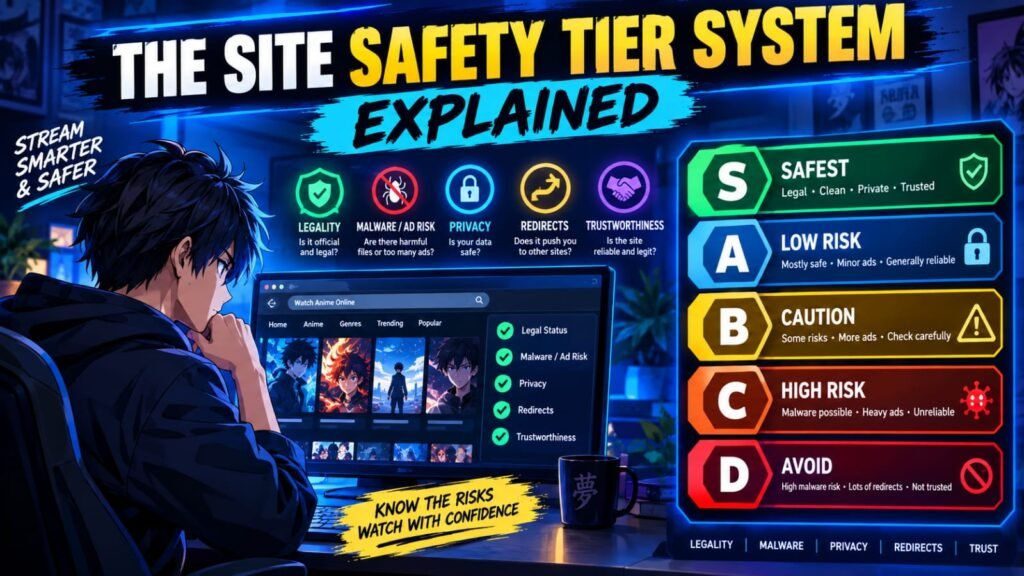
Rather than listing sites and hoping you’ll individually research each one, it’s more useful to sort them into tiers based on how they operate. This system works for any site you encounter, not just the names below, which matters since new aggregator sites appear constantly and old ones disappear just as fast.
Tier 1 sites are fully licensed and safe by design. Tier 2 sites are established, free aggregators that work but carry copyright and ad-related risk. Tier 3 sites are newer, unverified clones that combine both the legal risk and a higher chance of malicious ads or scams.
Tier 1: Licensed Platforms
Tier 1 covers platforms like Crunchyroll, Netflix, HIDIVE, Tubi, and Manga Plus, all of which operate with direct licensing agreements from studios and publishers. These sites don’t need to rotate domains to dodge takedown notices, which is itself a strong signal of legitimacy. You trade a little bit of library breadth or a few ads for a platform that will still exist and work the same way next year.
Tier 2: Established Aggregators
Tier 2 covers long-running aggregator sites that, like YugenAnime, operate without licensing but have existed long enough to build a track record, however imperfect. These sites still carry real copyright risk and ad-related safety concerns, but they’re generally more predictable than a brand-new clone with no history.
Tier 3: Sites to Avoid Entirely
Tier 3 is where most of the real danger sits: freshly launched sites, often with names deliberately similar to popular ones, built specifically to catch overflow search traffic when a well-known site goes down. These are far more likely to run aggressive malware-laced ad networks since they have no reputation to protect and no long-term plan beyond quick ad revenue. If a site looks brand new and promises “the same library as YugenAnime” with a slightly misspelled name, treat that as a hard pass.
Free Aggregator Sites Similar to YugenAnime
If what you actually want is the exact same format YugenAnime offers- free aggregator sites with no login requirement- there are several names that come up repeatedly in this space. It’s worth naming them honestly rather than pretending they don’t exist, while being equally honest about the trade-offs.
Names like Gogoanime, AnimePahe, Aniwatch (formerly HiAnime), and 9anime are commonly cited as sites similar to YugenAnime in format and library. All operate as unlicensed aggregators, so the same legal and ad-safety concerns covered earlier apply to every one of them.
Popular Names You’ll See Mentioned
Gogoanime has been one of the longest-running names in this space, known for a large back catalog and a simple interface. AnimePahe is popular for smaller file sizes and a built-in downloader, which appeals to people with limited data or storage. Aniwatch, which rebranded from HiAnime after earlier takedown pressure, and 9anime round out the names that show up most often in community recommendations. None of these hold licensing agreements, and all of them face the same domain instability discussed throughout this article.
Why These Sites Rotate Domains So Often
The pattern is the same across nearly every name in this category: a domain gets reported, the hosting provider or registrar suspends it, and the operator relaunches under a new extension within days or weeks. This is why you’ll often see the same site name attached to five or six different URLs circulating at once, with only one or two actually live at any given time. If you’re trying to find the “real” version of any of these, a quick search on a forum like Reddit usually surfaces the currently active link faster than guessing.
Legal Streaming Sites With a Similar Browsing Feel
If the appeal of YugenAnime is really the browsing experience rather than the legal gray area, several licensed platforms have gotten close to matching that feel. You lose nothing in terms of usability and gain a site that won’t vanish overnight.
Crunchyroll’s interface is the closest match in terms of searching by genre, season, or popularity without friction, and its free tier means you don’t even need a payment method to start.
Tubi and Pluto TV both run dedicated anime sections with similarly simple, no-fuss browsing, though their libraries skew toward completed series rather than weekly simulcasts. HIDIVE trims the browsing experience down to a smaller, curated catalog, which some people actually prefer over Crunchyroll’s much larger but occasionally overwhelming library. None of these require you to dodge pop-ups or decline a fake “update your player” prompt just to hit play, which on its own is worth the minor trade-offs.
Manga-Focused Sites Like YugenAnime
YugenAnime’s manga reader is a big part of why people like it, so any real comparison needs to cover reading, not just streaming. Manga access has split into the same two camps as anime: unlicensed scan aggregators and official publisher apps.
Manga Plus by Shueisha and VIZ Media are the strongest official alternatives, offering free, legal access to major series close to their Japanese release. Unlicensed scanlation aggregator sites exist in large numbers too, but they carry the exact same copyright and ad-safety risks as anime aggregators.
Aggregator-Style Manga Readers
Scanlation aggregator sites work much like YugenAnime’s manga section: volunteer or unofficial groups scan and translate chapters, then redistribute them through ad-supported readers. These sites often cover more obscure or older series that official platforms haven’t licensed for translation, which is their main appeal over legal readers.
Official Manga Platforms
Manga Plus publishes official Shonen Jump translations for free, often the same day a chapter drops in Japan, though older chapters eventually move behind a “read from the start” paywall. VIZ Media runs a similar structure for its own licensed titles. Between the two, you’ll cover most major ongoing series without touching an unlicensed scan site at all.
How Do You Check If a Site Like This Is Safe Right Now?
Because this entire category of site changes so fast, a static list goes stale within months. What doesn’t go stale is a quick process you can run on any site before trusting it with your clicks.
Check how old the domain is, whether ads redirect you before you can close them, whether the site demands personal information, and what recent forum or Reddit discussions say about it. A site failing two or more of these checks isn’t worth the risk, regardless of how good its library looks.
Start by searching the exact domain name plus the word “safe” or “malware” on a search engine, since community reports tend to surface fast when a site turns bad. Check how aggressively it serves ads: one or two banner ads is normal, but a wall of pop-ups before the video even loads is a clear warning sign.
Pay attention to whether the site asks for anything beyond basic cookie consent, since no legitimate free streaming site needs your email or phone number to let you watch an episode. Finally, run a quick scan with your antivirus software afterward if anything about the visit felt off, just as a routine precaution rather than a sign of panic.
How Do These Options Compare at a Glance?
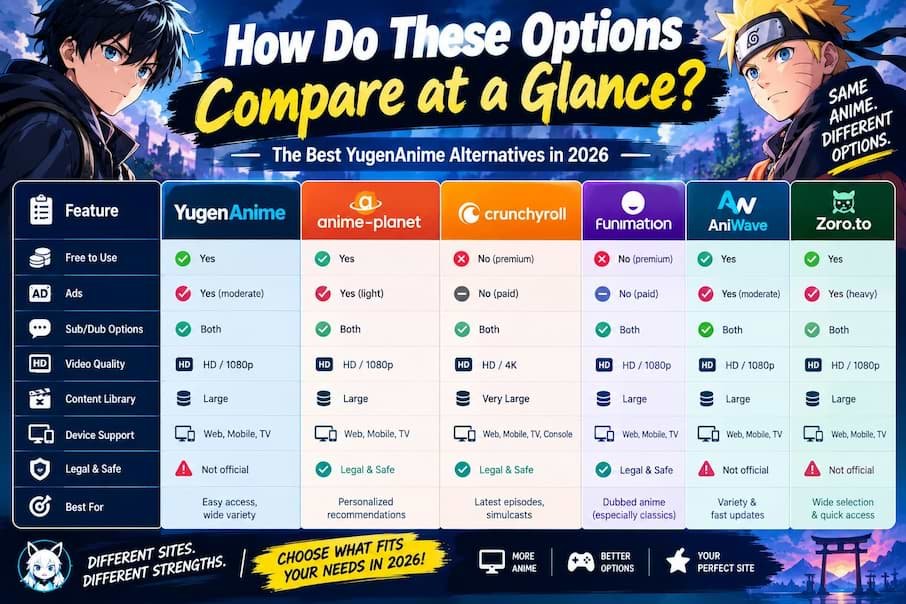
Putting the main categories side by side makes the trade-offs easier to see than reading through each section separately.
| Category | Example Sites | Cost | Legal Status | Main Risk |
|---|---|---|---|---|
| Tier 1, licensed | Crunchyroll, Netflix, HIDIVE | Free or paid | Fully licensed | Minor: ads or smaller library |
| Tier 2, established aggregators | Gogoanime, AnimePahe, 9anime | Free | Unlicensed | Copyright exposure, inconsistent ad safety |
| Tier 3, unverified clones | Newly launched copycat domains | Free | Unlicensed | Highest malware and scam risk |
| Official manga | Manga Plus, VIZ Media | Free with paid option | Fully licensed | Minor: chapter paywall after a few weeks |
The clearest takeaway from this table is that risk rises sharply as you move from Tier 1 to Tier 3, while the actual content on offer doesn’t necessarily improve at the same rate. A brand-new clone site isn’t giving you a better library than an established aggregator, it’s just giving you more risk for the same episodes.
Common Mistakes When Searching for Sites Like YugenAnime
A few predictable mistakes show up again and again when people go looking for alternatives, and most of them are easy to avoid once you know what to watch for.
One frequent mistake is clicking the very first search result without checking whether it’s a Tier 2 established name or a Tier 3 copycat with a nearly identical name and a fresh domain. Another is assuming that because a site looks visually polished, it must be safe, when in reality copycat sites often clone the exact design of a trusted site to borrow its credibility.
People also tend to install a “required” browser extension or media player the site prompts them to download, which is one of the more common ways these sites distribute unwanted software. A less obvious mistake is ignoring country-specific legal risk, since enforcement against individual streamers varies a lot depending on where you live.
Finally, some readers give up on legal options too quickly, assuming they’re all expensive, when free tiers from Crunchyroll, Tubi, and Pluto TV cover a surprising amount of ground.
Frequently Asked Questions
What sites are similar to YugenAnime?
Gogoanime, AnimePahe, Aniwatch, and 9anime are commonly mentioned as similar free aggregator-style sites, while Crunchyroll and Tubi offer a similar browsing feel through fully licensed platforms. Which one counts as “similar” really depends on whether you’re matching the format or looking for a safer substitute.
Is there a safer version of YugenAnime?
Not in the sense of an identical unlicensed site with better safety guarantees, since all aggregator sites in that category share the same basic risks. The actual safer path is switching to a licensed platform like Crunchyroll’s free tier, which offers a comparable browsing experience without the legal or malware exposure.
What happened to YugenAnime?
Sites like YugenAnime regularly face hosting suspensions and domain takedowns tied to copyright complaints, which forces frequent domain changes rather than a single permanent shutdown. If a particular domain stops working, that’s usually the reason rather than the site closing for good.
Are free anime streaming sites illegal?
The sites themselves are generally operating illegally if they host copyrighted content without a license, since that violates copyright law in most countries. Individual viewers typically face lower legal risk than the site operators, but this varies by country and isn’t guaranteed to stay that way. This isn’t legal advice, so check your local laws if you’re genuinely concerned.
What is the most popular anime site besides YugenAnime?
Crunchyroll is generally the most widely used legal anime platform, covering a large share of current simulcasts and a deep back catalog. Among unlicensed aggregators, names like 9anime and Gogoanime have historically drawn large amounts of traffic, though exact popularity shifts constantly as domains change.
Do anime aggregator sites have manga too?
Many do, since bundling manga into the same interface is a common way these sites increase time spent on the page and ad exposure. The manga sections work the same way as the anime libraries, sourced from unofficial scanlation groups rather than licensed publishers, which carries the same copyright concerns.
Conclusion
Finding sites like YugenAnime really comes down to deciding which trade-off you’re willing to accept.
Three things worth remembering: established aggregators like Gogoanime or 9anime match the format closely but carry the same legal and ad-safety risks as YugenAnime itself; brand-new copycat sites are consistently the riskiest tier and worth avoiding outright; and legal platforms like Crunchyroll’s free tier have closed the convenience gap enough that they’re worth trying first.
If you’re currently searching for sites like yugenanime mainly because your usual option went down, testing a Tier 1 platform for a week is a lower-risk next step than chasing another unverified mirror.