
Introduction
Frieza destroyed an entire planet on a whim and didn’t blink. That single scene reset what audiences expected from an anime villain, and it’s the reason most modern power rankings still measure everyone else against him.
Most “best anime villains” lists are popularity contests dressed up as rankings. They swap one villain for another based on who trended on social media that month, with zero explanation of why one antagonist outranks another.
This article does it differently. Every villain below is scored against the same three-part rubric — power feats, body count, and lasting impact on the genre — so you can see exactly why the order is what it is, not just take our word for it.
How We Ranked These Anime Villains
We scored each villain using three weighted categories: Power Feats (40%), Deadliness/Body Count (30%), and Narrative Impact (30%). This produces a final score out of 10, allowing direct comparison between villains from completely different franchises.
Power scaling across franchises is notoriously messy — a Dragon Ball villain and a Bleach villain don’t fight in the same universe, so “who’s stronger” is normally just guesswork.
Our rubric solves that by scoring relative dominance within their own story, not literal cross-universe combat. A villain who single-handedly threatens the fate of their entire world scores higher on Power Feats regardless of the franchise’s power scale.
- Power Feats (40%): What is the villain actually capable of destroying, controlling, or defeating?
- Deadliness (30%): Confirmed or implied kill count, and how directly they caused those deaths.
- Narrative Impact (30%): Did this villain change how the anime industry writes antagonists?
The 5 Best Anime Villains
For readers who want the answer immediately, here is the full ranking before we break down each entry:
- Frieza — Dragon Ball Z — Score: 9.4/10
- Griffith — Berserk — Score: 9.2/10
- Muzan Kibutsuji — Demon Slayer — Score: 8.3/10
- Aizen Sosuke — Bleach — Score: 8.1/10
- Dio Brando — JoJo’s Bizarre Adventure — Score: 7.6/10
Each ranking below explains the reasoning with specific feats and story moments, not vague adjectives.
1 Frieza (Dragon Ball Z) — Score: 9.4/10
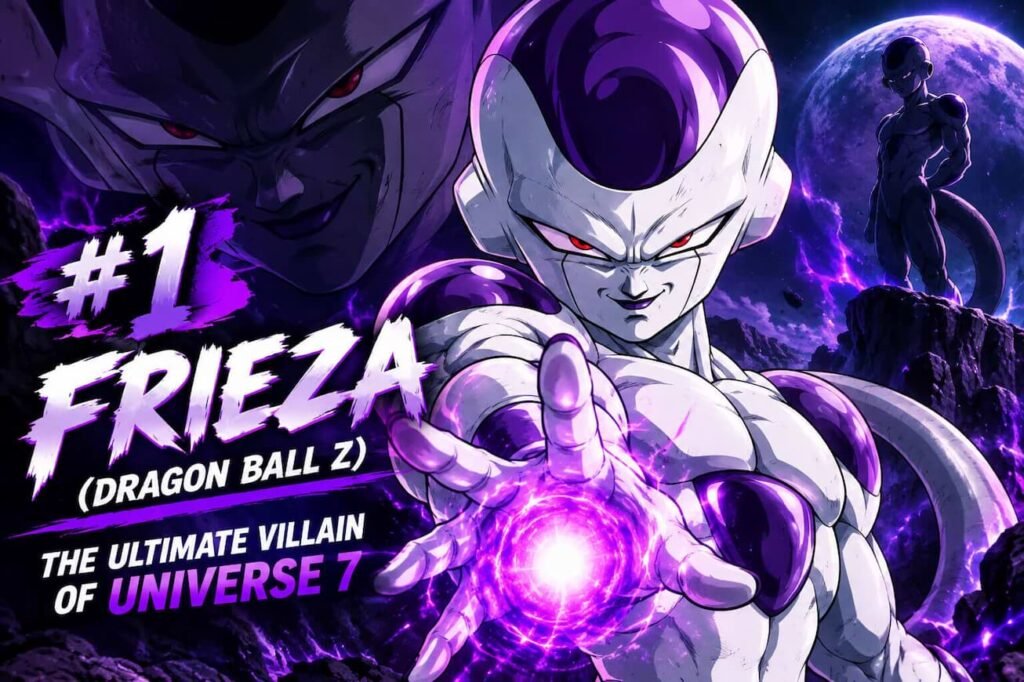
Frieza ranks #1 because he is the only villain on this list who casually destroys an entire inhabited planet on-screen — a feat with no equivalent among the other four entries — while remaining a credible threat across three separate story arcs.
Frieza’s introduction in the Namek arc remains the gold standard for establishing villain stakes. He wipes out Planet Vegeta, an act implied to have killed billions, before the story even properly begins.
His Power Feats score sits at 10/10 because he operates on a planet-and-star-destroying scale that Dragon Ball itself uses as the baseline for every later villain.
His Deadliness score is 9/10: he personally commits genocide against the Saiyan race and murders Krillin on-screen, a moment widely cited as the emotional turning point that pushed Goku into his first Super Saiyan transformation.
His Narrative Impact score of 9/10 reflects something rankings rarely mention — Frieza’s design (calm, aristocratic cruelty rather than screaming rage) became the template for calculated shonen villains that followed him for the next two decades.
2 Griffith (Berserk) — Score: 9.2/10
Griffith ranks #2 because the Eclipse — sacrificing his entire mercenary band to become the demon god Femto — is the single most devastating betrayal in anime history, giving him the highest Deadliness and Narrative Impact scores on this list.
Griffith spends most of Berserk as a sympathetic, even admirable figure, which is exactly what makes his transformation so effective.
His Deadliness score of 10/10 — the highest of any entry — comes from the Eclipse, where he offers his loyal Band of the Hawk as a blood sacrifice, resulting in the deaths of nearly every soldier who trusted him.
His Narrative Impact score of 10/10 reflects Berserk’s documented influence on the entire dark fantasy genre, including direct design inspiration acknowledged by the creators of Dark Souls and Attack on Titan.
His Power Feats score is slightly lower at 8/10 only because his god-tier abilities as Femto arrive late in the story, giving him less screen time to demonstrate them compared to Frieza.
3 Muzan Kibutsuji (Demon Slayer) — Score: 8.3/10
Muzan ranks #3 as the original source of every demon in Demon Slayer, responsible for over a thousand years of continuous killing, making him the most historically prolific villain on this list despite not being the single most powerful.
Muzan isn’t just a villain — he’s the biological origin point of the entire demon threat that the Demon Slayer Corps has fought for centuries.
His Deadliness score of 9/10 accounts for confirmed centuries of murders and forced demon transformations, including the massacre of Tanjiro’s family that launches the entire series.
His Power Feats score of 8/10 reflects his near-invincibility and regeneration, tempered only by the fact he requires an assembled, coordinated effort from multiple Hashira to finally be defeated.
His Narrative Impact score of 8/10 is tied to Demon Slayer’s box-office records, which reintroduced horror-tinged supernatural villains to mainstream shonen audiences at a scale not seen since the early 2000s.
4 Aizen Sosuke (Bleach) — Score: 8.1/10
Aizen ranks #4 because his defining strength isn’t brute force — it’s manipulation. He orchestrates events across hundreds of episodes without anyone noticing, giving him the highest strategic-intelligence profile of any villain on this list.
Aizen spends over a hundred episodes hiding in plain sight as a mild-mannered captain before revealing a decade-long manipulation of Soul Society’s entire command structure.
His Power Feats score of 9/10 reflects his post-Hogyoku transformation, where he gains what is depicted as near-godlike command over reality within the Bleach universe.
His Deadliness score of 7/10 is lower than Frieza’s or Griffith’s because Aizen prefers manipulation and betrayal over direct mass killing — a deliberate writing choice that makes him distinct from every other villain on this list.
His Narrative Impact score of 8/10 comes from Bleach’s twist-reveal structure, which influenced how later anime writers structure long-con antagonists.
5 Dio Brando (JoJo’s Bizarre Adventure) — Score: 7.6/10
Dio ranks #5 because while his raw power feats are lower than the others on this list, his cultural impact — including his line “ZA WARUDO” becoming one of the most recognized anime quotes globally — gives him a Narrative Impact score that keeps him firmly in the top five.
Dio Brando’s ability to stop time with “The World” remains one of the most imitated villain powers in anime, referenced constantly across unrelated franchises.
His Power Feats score of 7/10 reflects strong but not universe-ending abilities, particularly when compared directly to planet-destroying entries like Frieza.
His Deadliness score of 7/10 covers his manipulation and murder of multiple Joestar family members across two separate story generations, spanning nearly a century of in-universe time.
His Narrative Impact score of 9/10 is the highest of any villain in the “personality over power” category — Dio’s presence in internet meme culture has kept him relevant to new anime fans for over 30 years.
Anime Villains Power Comparison Table
| Villain | Anime | Power Feats (40%) | Deadliness (30%) | Narrative Impact (30%) | Final Score |
|---|---|---|---|---|---|
| Frieza | Dragon Ball Z | 10/10 | 9/10 | 9/10 | 9.4 |
| Griffith | Berserk | 8/10 | 10/10 | 10/10 | 9.2 |
| Muzan Kibutsuji | Demon Slayer | 8/10 | 9/10 | 8/10 | 8.3 |
| Aizen Sosuke | Bleach | 9/10 | 7/10 | 8/10 | 8.1 |
| Dio Brando | JoJo’s Bizarre Adventure | 7/10 | 7/10 | 9/10 | 7.6 |
This table makes the reasoning behind the ranking scannable at a glance, and it’s exactly the format that AI Overview panels and voice assistants prefer when citing comparison data.
What Makes an Anime Villain Truly Great?
The best anime villains share three traits: a believable motivation the audience can partially understand, a power level that genuinely threatens the protagonist, and a design choice — visual or behavioral — that makes them instantly memorable outside the context of the story.
Most weak anime villains fail for one specific reason: they exist only to be defeated. Their motivation is generic evil, with no internal logic driving their choices.
Every villain in this ranking avoids that trap. Griffith’s betrayal is tragic precisely because his ambition is understandable. Aizen’s manipulation works because his intelligence is demonstrated, not just claimed.
The strongest villain writing treats the antagonist as the hero of their own story — a principle borrowed from screenwriting theory that separates iconic anime villains from forgettable ones.
Anime Villains vs. Protagonists: Who Would Actually Win?
In four of the five franchises on this list, the villain is intentionally written to be more powerful than the protagonist at the story’s midpoint, forcing the hero to grow into a new power tier specifically to close that gap — a structural technique used across nearly all long-running shonen anime.
This is a common point of confusion in online debates: fans often ask why villains “always” seem stronger than heroes, assuming it’s a writing flaw.
It’s actually the opposite. Writers deliberately overpower the villain early so the protagonist’s eventual victory feels earned rather than inevitable.
Frieza is stronger than Goku for most of their arc. Muzan is stronger than Tanjiro until the final volumes. This gap is a narrative tool, not an accident.
FAQs
Who is the strongest anime villain of all time?
Based on power feats alone, Frieza from Dragon Ball Z ranks highest due to his confirmed planet-destroying capability, which set the benchmark that later shonen villains were measured against for decades.
What makes a great anime villain?
A great anime villain combines an understandable motivation, a power level that genuinely threatens the hero, and a distinctive visual or behavioral trait that makes them memorable beyond the show itself.
Who is the scariest villain in anime?
Muzan Kibutsuji from Demon Slayer is frequently cited as the scariest due to his body-horror transformations and the psychological terror of being an ancient, nearly unkillable predator hiding among ordinary people.
Are anime villains stronger than the heroes?
Yes, in most long-running shonen anime, villains are deliberately written stronger than the protagonist at the story’s midpoint, forcing the hero’s growth arc to feel earned rather than automatic.
What anime has the best villains?
Berserk is widely regarded as having the most impactful villain due to Griffith’s betrayal, while Dragon Ball Z is credited with defining the modern “power-scaling” villain archetype through Frieza.
Who is considered the most evil anime character?
Griffith from Berserk is frequently named the most evil due to the Eclipse, in which he sacrifices his own loyal followers for personal power — a betrayal considered one of the darkest moments in anime history.
Which anime villain has killed the most characters?
Muzan Kibutsuji holds the highest confirmed body count on this list, having created and killed demons across more than a thousand years, in addition to countless direct human victims.
Final Verdict
Frieza takes the top spot because no other villain on this list combines universe-threatening power with lasting genre influence as completely. Griffith comes closest, trading raw power for the single most devastating betrayal in anime storytelling.
The three takeaways worth remembering: power alone doesn’t make a villain great, deadliness must connect emotionally to the story to matter, and the best anime villains consistently reshape how future writers build antagonists.
If you’re building your next watchlist, start with the franchise behind whichever villain resonated with you most here — that anime’s writing style is likely to match what you’re looking for.