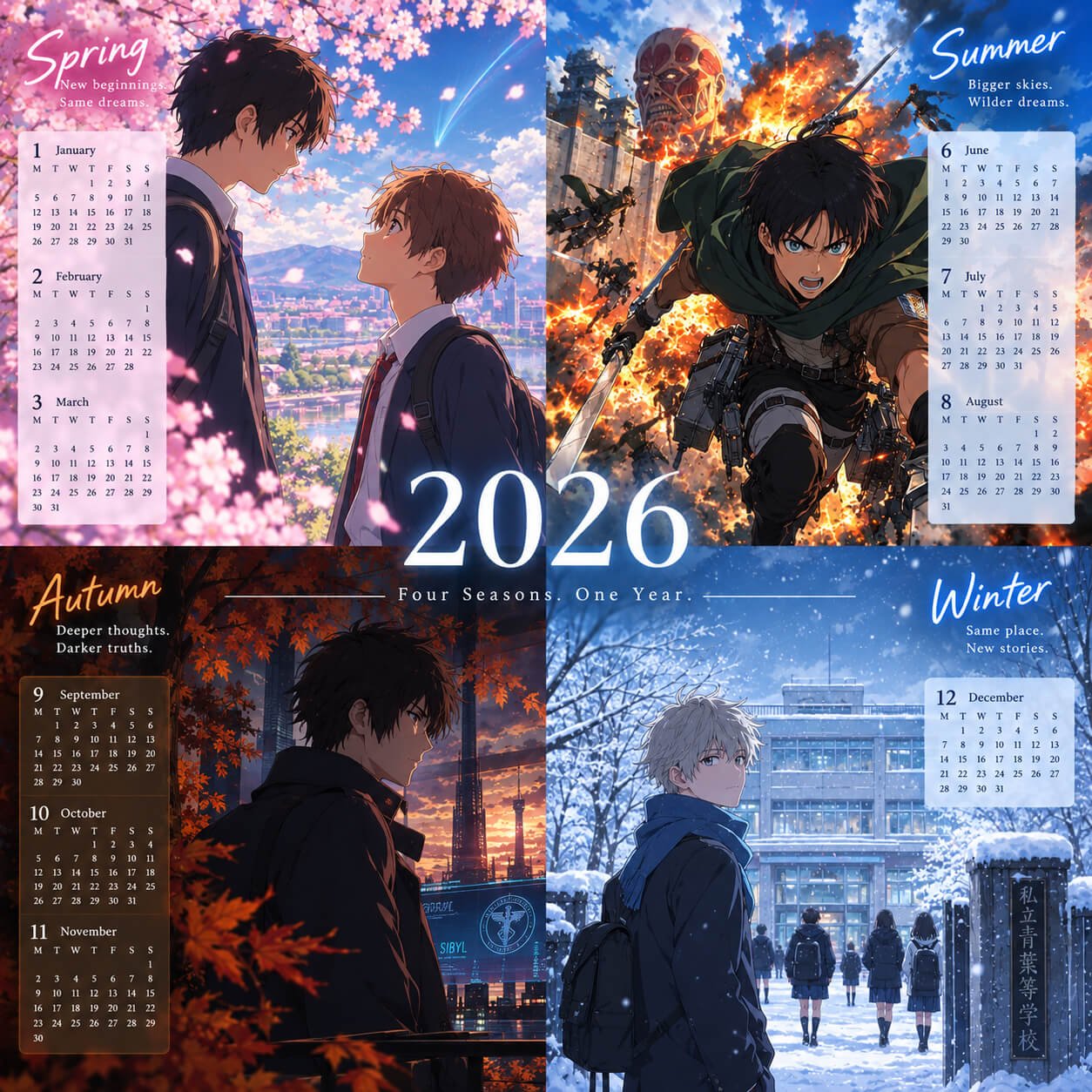
Introduction
If you’ve finished binge-watching your way through 2025’s catalogue and you’re sitting there wondering what’s actually coming next, here’s the truth: 2026 is stacked with anime releases, but nobody just hands you a perfect master list. Studios announce at different times, release dates shift weeks before airing, and half the shows trending on Twitter today won’t have confirmed premiere dates for months. That’s the anime industry—exciting and completely chaotic.
This guide cuts through the noise. You’ll get a real breakdown of what’s confirmed for 2026, when things actually premiere by season, where to find the shows, and the single best way to never miss a premiere again. We’ll also show you how the adaptation pipeline works so you can predict what’s coming years ahead, and walk through the common mistakes that turn excited viewing into burnout.
What’s Really Coming in 2026
We don’t have a complete, locked-in 2026 anime catalog yet. Hundreds of shows are in various stages of announcement: some have premiere dates locked, others have only a season window like “Fall 2026,” and a few have just been greenlit without any timeline. The bulk of concrete information lands 3–6 months before airing.
Anime studios announce titles in waves across 18–36 months. As of now, hundreds of shows are confirmed for 2026 in varying degrees of detail. Tier 1 shows have locked premiere dates; Tier 2 shows have season windows; Tier 3 shows are greenlit but undated. Most reliable information comes directly from studios, not blogs.
How studios announce anime
The reason there’s no “official master list” is structural. Anime production spans multiple studios, production committees, licensing agreements, and broadcast networks. A studio might greenlight a show in January but announce it publicly in June. Streaming platforms negotiate exclusive windows. Directors change. Schedules slip. This isn’t chaos—it’s just how the industry works.
Announcements typically follow this pattern: A studio or production committee decides to greenlight a project. They’ll file it internally, lock a production schedule, and sometimes keep it quiet for months while pre-production starts. Then, at a strategic moment—often a fan event, a magazine reveal, or a streaming platform partnership announcement—they go public. From that public announcement to premiere can be anywhere from 6 months to 3 years.
The three tiers of confirmation
The shows you’re seeing announced now fall into three clarity tiers, and it’s crucial you understand the difference.
Tier 1: Confirmed with premiere dates. These have a specific week or date locked: “October 5, 2026” or “January 9, 2027.” You can mark your calendar with confidence. These are usually announced 2–4 months before airing.
Tier 2: Confirmed with season or quarter only. “Spring 2026” or “Summer 2026.” The studio has greenlit the show, locked production, and scheduled a general timeframe, but the exact week isn’t public yet. Usually revealed 4–8 weeks before the quarter starts.
Tier 3: Announced but no timeline. “In development” or “coming soon.” Could mean 6 months away or 2+ years. Most fans get burned chasing Tier 3 shows as if they’re imminent. Don’t do that. Focus on Tier 1 and 2.
The practical reality: Check back in December for spring confirmations, March for summer, June for fall, and September for winter. If a show isn’t on that list by then, it’s probably Tier 3.
Anime by Season: When to Watch
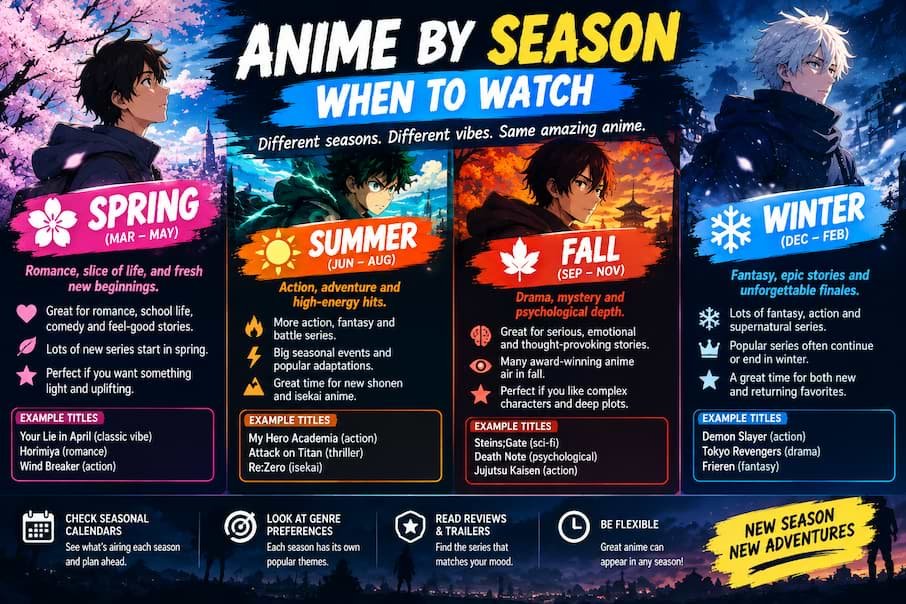
Anime releases cluster into four seasonal windows: winter (Jan–Mar), spring (Apr–Jun), summer (Jul–Sep), and fall (Oct–Dec). Each season typically has 30–50 new shows across all genres and budgets. Knowing when things air helps you plan what to watch when.
Anime premieres in seasonal blocks. Spring (Apr–Jun) favors slice-of-life and romance. Summer (Jul–Sep) is action and adventure. Fall (Oct–Dec) gets prestige projects and thrillers. Winter (Jan–Mar) is diverse and front-loaded. Most shows premiere in the first two weeks of each quarter.
Spring 2026
Spring traditionally launches slice-of-life, romance, and school-themed shows. The season lands during the northern hemisphere’s spring, and creators lean into that mood.
Look for established franchise continuations (sequels to popular shows that ended in winter) and new properties adapted from manga and light novels. You’ll see a mix of 12-episode series and split-course (shows that run 12 episodes, take a break, then air 12 more months later).
Most spring shows premiere between April 1 and April 15, with a secondary wave in May for delayed productions. If a spring show hasn’t premiered by May 20, production trouble likely happened—check the studio’s Twitter for updates.
Summer 2026
Summer is blockbuster season. Action, adventure, and high-budget spectacle dominate because more casual viewers tune in during the break. Schools are out in much of the world, and streaming platforms know people have time.
Expect the year’s biggest continuation arcs (shows that started in spring continuing into summer), plus brand-new action series and isekai adaptations. Summer 2026 will likely feature anime tied to summer movie releases—sometimes the film releases before the series, sometimes after, sometimes they’re simultaneous.
Premiere window: July 1–15 is peak. Stragglers air through mid-August.
Fall 2026
Fall is when prestige projects land. Many studios release their most ambitious original works and high-profile manga adaptations in autumn because the market sees it as awards-season for anime. The season also captures holiday viewership in December.
Fall is historically the strongest season for seinen (adult male) anime and darker genres like psychological thrillers and complex dramas. Expect serious adaptations, horror, and romance shows aimed at older audiences. Animation budgets tend to be higher here because studios treat fall as their showcase.
Premiere window: October 1–15 is busy. November premieres are common for delayed shows.
Winter 2026–2027
Winter runs January–March and sets up the annual cycle. Post-holiday, viewers return in January, so studios front-load the season with popular-appeal shows. Winter gets new years’ beginner-friendly shows, continuations from fall, and anything that missed earlier slots.
Winter also captures New Year viewing traditions in Japan and parts of Asia. It’s the workhorse season—not flashy, but reliable and diverse.
Premiere window: Most shows hit between January 1 and January 15. February and March pick-ups are normal.
Manga and Light Novel Adaptations
The 2026 pipeline is dominated by manga and light novel adaptations. Very few fully original anime greenlit today will air in 2026. If you want to know what’s coming before it’s even announced, follow which manga series just got an adaptation greenlit.
The manga-to-anime pipeline takes 18–36 months. Popular manga series get announced for adaptation, then air 1–3 years later. Tracking serializations in Jump magazines, light novel bestseller lists, and official studio announcements tells you what’s coming years ahead.
How source material becomes anime
Here’s the practical pipeline. A manga series runs for 50+ chapters and builds an audience. A publisher or production committee decides an anime adaptation will boost manga sales (because anime famously increases source material sales 2–5x). The announcement usually goes: comic magazine serialization → author social media statement → studio reveal → character designs and trailer → premiere date. This entire process takes 18–36 months from announcement to air.
The reason: Anime production is slow. Voice acting, animation, editing, music composition, and post-production takes time, especially if a show is aiming for quality. A 13-episode season (the standard) takes 6–9 months to produce once storyboards are locked.
What’s being adapted now
In practical terms, if you’re reading popular manga right now, you’re probably reading the source material of 2026–2027 anime shows. Conversely, if a new anime premieres and you love it, the manga usually ran 1–3 years ahead. This means:
Light novels getting adapted cluster around isekai and fantasy adventure. A light novel series gets an anime deal, and studios often adapt one or two books per season, creating natural multi-season commitments. If a light novel has 10+ books published and is selling well, an anime is likely greenlit somewhere.
Manga in Weekly Shonen Jump (and similar weekly publications) adapt on an 18–24 month lag. If something’s been serializing in Jump for 2+ years and has strong reader reception, an anime announcement is statistically likely within the next year.
Older manga that ended serialization sometimes get anime adaptation years later as studios license existing IP. These are less predictable, but fan campaigns and anniversary years often trigger them.
You’ll see 2–3 original anime per season. Studios prefer the safety of existing fanbase from source material adaptation over betting on new ideas.
Where to Watch New Anime
The big five platforms for new anime in English are Crunchyroll, Netflix, Amazon Prime Video, Hulu, and Hidive. Most shows land on one primary platform per region, and simulcast windows (releasing episodes weekly alongside Japan) are now standard. Check your region’s platform for which shows are confirmed—they announce exclusives months ahead.
Crunchyroll carries the most simulcast anime globally. Netflix has exclusive originals and high-budget adaptations. Regional availability varies; check your platform’s app 2–3 months before each season. Simulcast means new episodes air weekly, same week as Japan.
Streaming platforms and simulcasts
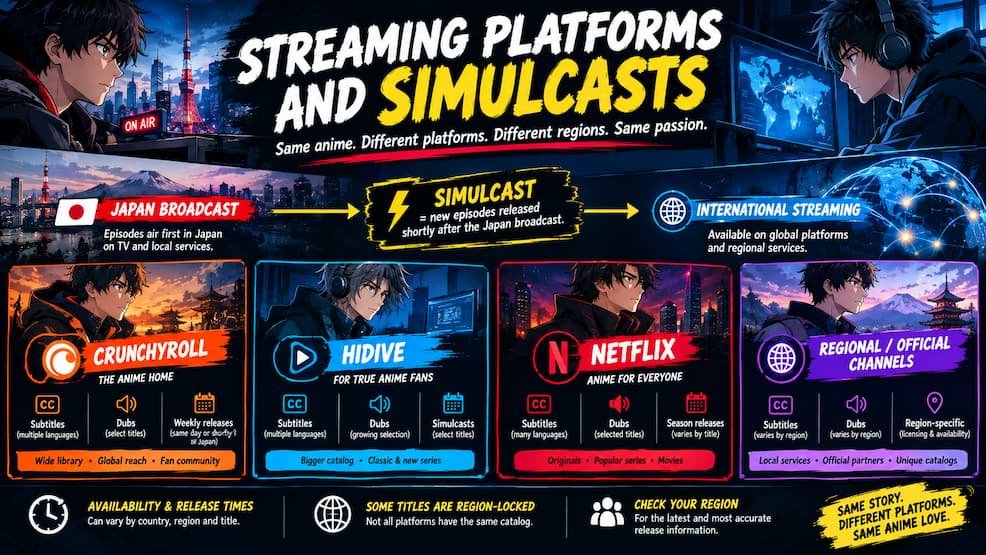
Streaming rights are regional and contractual nightmares. A show might be on Crunchyroll in North America but Netflix in Europe and a local broadcaster in Japan simultaneously. There’s no one-size-fits-all answer, which is why you must check your region’s platform directly.
Crunchyroll is the largest anime streaming platform globally and owns most simulcast rights. They simulcast the majority of seasonal anime and offer both dubbed (English voice acting) and subbed (English subtitles) versions. If you’re watching new anime, this is your default.
Netflix has aggressively acquired anime licenses in the past three years, especially originals and high-budget adaptations. They’ll have several 2026 exclusives that won’t be on Crunchyroll.
Amazon Prime Video has a smaller but growing anime library. Some exclusive shows land here, especially if the production committee has a relationship with Amazon Studios.
Hulu is US-focused and carries simulcasts alongside Crunchyroll content in some cases, depending on licensing agreements.
Hidive is the scrappy challenger—smaller library, but they license niche shows and fan-favorite productions that other platforms pass on.
Regional availability
Beyond streaming: Some shows simulcast on TV networks’ official apps and websites, especially in Japan and parts of Asia. And yes, unofficial sites exist—but they’re inconsistent, often have quality issues, and the licensing is murky at best.
The practical tip: Sign up for platform email alerts 2–3 months before each season. Crunchyroll and Netflix announce their licensed shows for the upcoming quarter in December, March, June, and September. Put those shows on your watchlist when they’re confirmed, not when they premiere. Set a reminder on your phone for the premiere date of each show you’re genuinely excited about.
How do you track releases yourself?
Stop relying on blogs to tell you what’s coming. Use MyAnimeList’s seasonal calendar, follow studio Twitter accounts, and set reminders for premiere dates. This takes 10 minutes per season and gives you the freshest info 3–6 months before airing, instead of relying on articles that are days or weeks old by the time you read them.
MyAnimeList’s seasonal chart (updated weekly) and studio Twitter accounts are your primary sources. AniChart.net gives a visual overview. Set phone calendar reminders 1–2 weeks before premiere to catch delays. Check your streaming platform’s app for what they’ve licensed in your region.
Best tools and sources
MyAnimeList Seasonal Calendar. Visit myanimelist.net and navigate to the seasonal chart for each upcoming season. It updates in real-time as studios announce shows. Filter by genre, episode count, source type (manga, light novel, original), or studio. This is the single best source—not perfectly complete, but 95% accurate and always current.
Studio Twitter accounts. Major studios (MAPPA, ufotable, Kyoto Animation, Wit Studio, CloverWorks, etc.) announce new shows on their official Twitter before fansite aggregators pick them up. Follow 5–10 major studios, and you’ll catch announcements days or weeks early.
AniChart.net. A visual calendar of the upcoming season. Less detail than MyAnimeList but excellent for a quick overview of what premieres each week and which platform carries it.
Crunchyroll’s official blog. They announce their licensed titles for the upcoming season in their news section. Check it in December, March, June, and September.
Your streaming platform’s app. Netflix, Amazon Prime, and Crunchyroll let you add upcoming shows to a “Watchlist” or “Notify Me” list. They’ll alert you when the show becomes available.
Setting up reminders
For shows you’re genuinely excited about, add the premiere date to your phone’s calendar the moment the date is announced. Don’t rely on memory. This takes 30 seconds and saves the disappointment of forgetting a premiere.
Join focused communities like r/anime on Reddit. The subreddit has weekly seasonal discussion threads where fans and industry people post real-time updates. It’s noisy, but current.
The key: Do this in real-time, not the week before a premiere. Premiere dates shift. Episodes get delayed. If you bookmark a blog post to check a week before the show airs, you might miss a studio announcement about a 2–3 week delay.
Common mistakes fans make
The biggest mistakes are treating “announced” as “airing soon,” assuming simulcast availability without checking your region, ignoring mid-production delays, and overcommitting to 15+ shows per season. Here’s what actually happens and how to avoid burnout.
Don’t assume announced shows air in 2026—they might be 18+ months away. Verify regional availability before premiere. Check for delays 1–2 weeks before air date. Watch 4–6 shows per season instead of 15–20. Drop shows guilt-free if they don’t land by episode 3.
Overcommitting and burnout
The biggest mistake is watching too many shows at once. You’ll see a seasonal chart with 40 anime, get excited, add 15 to your watchlist, and by week 3, you’ve dropped half. Watching 20 new shows simultaneously is exhausting. Most people finish maybe 4–6 per season.
Pick 4–6 shows per season and be selective about it. Read first-episode reactions from critics you trust. Check whether the show’s production company has a track record (did their last anime finish on time and look good?). Ask yourself: “Would I rather watch this or spend time on my other hobbies?” Be honest.
Quality over volume. Five genuinely good shows beats twenty mediocre ones.
Ignoring delays and date shifts
A show scheduled for April 5 might delay to April 19 or May 3. This happens constantly. Animation takes time. Studios won’t air incomplete episodes. Check for delays 1–2 weeks before premiere, not the day before. Follow the studio’s Twitter during production if you’re really invested.
Another mistake: Assuming your region gets simulcasts on the same schedule as Japan. A show might air in Japan on Saturday but not hit Crunchyroll until Wednesday. That’s not a delay—it’s normal. But if a show is supposed to hit Wednesday and it’s Thursday with no upload, check the streaming service’s status page or the studio’s announcement.
What genres dominate 2026?
2026 sees heavy investment in isekai (parallel world) and magic-school shows, more high-budget shounen action, and a surge in psychological thrillers adapted from popular manga. Romance anime is steady. Historical settings are niche. Studio resources flow toward what sold commercially in 2024–2025, so expect more of what worked.
Isekai dominates 2026 (expect 8–12 per season). Magic schools and academia are strong. Action and psychological thrillers are getting bigger budgets. Romance and slice-of-life are steady but not explosive. Sports anime are minimal. If you hate isekai, you’ll be filtering heavily.
Isekai and fantasy
Isekai remains the safest commercial bet for light novel adaptation. It’s the default anime subgenre: reincarnation, transported-to-another-world, gaming-world mechanics, villainess stories. Expect 8–12 isekai per season across all quality levels. Not all are good, but they’re numerically unavoidable.
Magic schools and academy settings are proliferating in the wake of Jujutsu Kaisen’s success. Shows with training arcs, combat schools, and magical academies are bankable. Expect several 2026 series set at these locations.
Action and thrillers
Psychological thrillers adapted from seinen manga are getting bigger budgets. Studios see these as prestige projects and awards contenders. Darker, more cerebral shows are getting production investment.
Shounen action (the mainstream “young male audience” action genre) gets steady investment. A few new shounen manga adaptations plus continuations of ongoing series.
Romance and slice-of-life are consistent year to year but not experiencing explosive growth. These genres are profitable but less flashy than action.
Sports anime are sparse for 2026. Major sports anime typically get announced far in advance. If nothing’s announced yet for 2026, expect very few.
Why does this matter? If you hate isekai, 2026 will test your patience. You’ll scroll past 30 shows to find 10 you’re interested in. Match your expectations to market realities.
Should you wait for reviews before watching?
This is genuinely a personal choice, but there are signals that help you decide faster without waiting weeks for critic consensus.
First episodes reveal a lot about animation quality and production stability. If episode 1 looks rough or feels rushed, quality might decline. Check critical takes from reviewers you trust by episode 2–3, then decide if you’ll continue. Don’t wait weeks for consensus—form your own opinion.
First-episode signals
A show’s first episode is a window into its production quality and budget. High animation quality, smooth frame-rate, detailed backgrounds, and fluid character movement suggest the studio allocated serious resources. Rough animation, off-model characters (characters looking weirdly drawn compared to design sheets), and choppy movement suggest budget constraints or production trouble.
This isn’t a perfect predictor. Some shows intentionally use limited animation for stylistic reasons. Some rough first episodes improve as production catches up. But generally: if a show looks polished in episode 1, it’s a good sign. If it looks rushed or unfinished, be cautious.
Check reviews from critics you follow after the first episode airs. By episode 2–3, you’ll have enough information to know if you want to continue. Don’t wait for week 12 consensus if you’re bored by episode 3—just drop it and watch something else.
Community feedback vs. personal taste
Reddit’s r/anime and fan communities will have hot takes by episode 2. Some are useful (pointing out pacing issues, animation problems). Some are hyperbolic (one plot twist didn’t land, so “this show is ruined”). Take aggregated feedback seriously but trust your own experience.
If 100 people say a show is bad but the premise appeals to you, watch it anyway. Taste is personal. If a show has major technical problems everyone mentions, that’s worth knowing before you invest time.
FAQs
What anime is definitely coming out in 2026?
As of late September, hundreds of anime are confirmed for 2026 in various stages. The ones with locked premiere dates are definite; those with only season windows might shift dates. For the most current list, check MyAnimeList’s seasonal calendar or your streaming platform’s app—they update weekly as studios confirm details. Look for Tier 1 shows (locked dates) rather than Tier 3 (announced but undated).
When is [popular anime] releasing in 2026?
Check the anime’s official studio Twitter account first. That’s the primary source. Then verify on MyAnimeList and your streaming platform’s app. If it’s not on those platforms yet, it either hasn’t been announced for a specific season or it’s not coming to your region. Avoid fan wikis with unverified dates—they’re often outdated.
Which anime adaptations are coming in 2026?
Popular manga series that finished serialization in 2023–2024 are prime candidates for 2026 adaptation announcements. Light novels with 5+ published books and strong sales are usually greenlit. Check MyAnimeList’s “Upcoming Anime” section filtered by “Source: Manga” or “Source: Light Novel” to see what’s been greenlit. The adaptation lag is 18–36 months from announcement.
Where can I watch new anime in 2026?
Crunchyroll carries the largest volume of simulcast anime. Netflix has exclusive releases. Your region determines availability—check your Crunchyroll, Netflix, Amazon Prime, Hulu, or Hidive app directly. Most platforms announce their licensed 2026 shows in December, March, June, and September. Add shows to your watchlist when they’re announced, not at premiere.
How do I track anime release dates?
Use MyAnimeList’s seasonal calendar (myanimelist.net, updated weekly) and follow your favorite studios on Twitter. AniChart.net gives a visual overview. Set phone calendar reminders 1–2 weeks before premiere dates. Join r/anime on Reddit for weekly discussion threads. Your streaming platform’s app also tracks upcoming releases.
What genres are trending in 2026 anime?
Isekai dominates (expect 8–12 per season). Magic schools and academia are strong. Psychological thrillers and action are getting bigger budgets. Romance and slice-of-life are steady. Sports anime are minimal. Studio resources follow commercial success, so expect more of what sold in 2024–2025.
Conclusion
Here’s what you actually need to do: Stop waiting for a blog post to tell you what’s coming. Use MyAnimeList’s seasonal calendar right now, follow your favorite studios on Twitter, and add premiere dates to your phone calendar as they’re announced. That’s your entire system. You’ll know what’s coming 3–6 months ahead, you’ll catch delays before they surprise you, and you won’t miss anything worth watching.
Second takeaway: Expect 2026 to be heavy on isekai and action. If that’s your jam, great. If not, set realistic expectations. You’ll find excellent shows, but you’ll need to filter through more noise. Pick 4–6 per season and be picky.
Third takeaway: Watch your streaming platform’s announcements in December, March, June, and September. These quarterly info-dumps tell you exactly what’s licensed in your region and where to find it. Spend 10 minutes per quarter checking those announcements, and you’re ahead of 90% of viewers.
2026 has plenty of upcoming anime worth your time. Use these tools, and you’ll stay current without relying on outdated articles.
1 thought on “Upcoming Anime 2026: New Series & Release Dates”