
Introduction
You finished the last episode, the credits rolled, and now you want to keep going — in the manga. But the anime never tells you which chapter it stopped on, and every site you check seems to give a different number. Going in blind risks two bad outcomes: re-reading pages you already watched, or accidentally skipping ahead into spoiler territory.
There’s no universal formula for manga chapter-to-anime episode matching, because studios compress source material differently for every series. But there is a reliable method you can apply to any show, whether it’s a decade-old classic or something airing this week. That method — plus the two traps that ruin it — is what this guide covers.
Why Episode Numbers and Chapter Numbers Never Line Up

An anime episode doesn’t correspond to a fixed number of manga chapters. One episode might compress four chapters into 20 minutes; another might stretch a single chapter across two full episodes for pacing or budget reasons.
This is a studio production decision, not a rule. Fast-paced action arcs often get compressed to save runtime, while emotional or slower arcs sometimes get padded with extra scenes, flashbacks, or original material not found in the source.
That’s why searching “how many chapters per episode” gives you a range, not a constant. The only reliable way to find your exact stopping point is to check episode-by-episode, using verified sources — not assume a pattern holds across an entire series
The 4-Step Method to Find Your Exact Chapter
This method works for almost any adapted series, including ones without a dedicated fan community yet.
Step 1 — Check the Series’ Fan Wiki First
Most ongoing and completed anime have a Fandom or dedicated wiki with an episode list. Many episode pages note the “adapted from” chapter range directly in the infobox or trivia section.
This is usually your fastest lead, but treat it as a starting point, not final confirmation — wikis are community-edited and can contain outdated or incorrect entries.
Step 2 — Cross-Reference with MAL or AniList Episode Notes
Sometimes list source chapters in episode-level details or user-submitted notes, especially for popular series.
Cross-checking two independent sources catches cases where one wiki page is simply wrong.
Step 3 — Confirm with a Recent Community Thread
Search Reddit or a series-specific forum for “[anime name] ends at chapter” and sort by recent posts. Communities tend to self-correct errors quickly, and recent threads reflect the latest confirmed consensus — especially important for series still airing.
Step 4 — Verify Against Official Volume Release Dates
If a chapter number still seems off, check the official publisher’s release schedule. Official volume tables of contents confirm exactly which chapters are bundled together, which helps you double-check numbering against what you plan to read or buy.
Watch Out — Filler Episodes Have No Chapter at All
Before you apply the method above, confirm the episode you stopped on is actually canon. Filler episodes are anime-original content that doesn’t exist in the manga at all — so searching for “which chapter does this filler episode cover” will send you in circles.
Signs an episode is likely filler:
- It’s not listed in the wiki’s “adapted from” column, or the field is blank.
- The plot doesn’t affect the main story, and character designs look slightly different from the source style.
- Dedicated filler-list sites flag it explicitly for that series.
If your last-watched episode is filler, the correct move is to trace backward to the last confirmed canon episode and start your chapter search from there instead.
Numbering Confusion: Chapters vs. Volumes vs. Scanlations
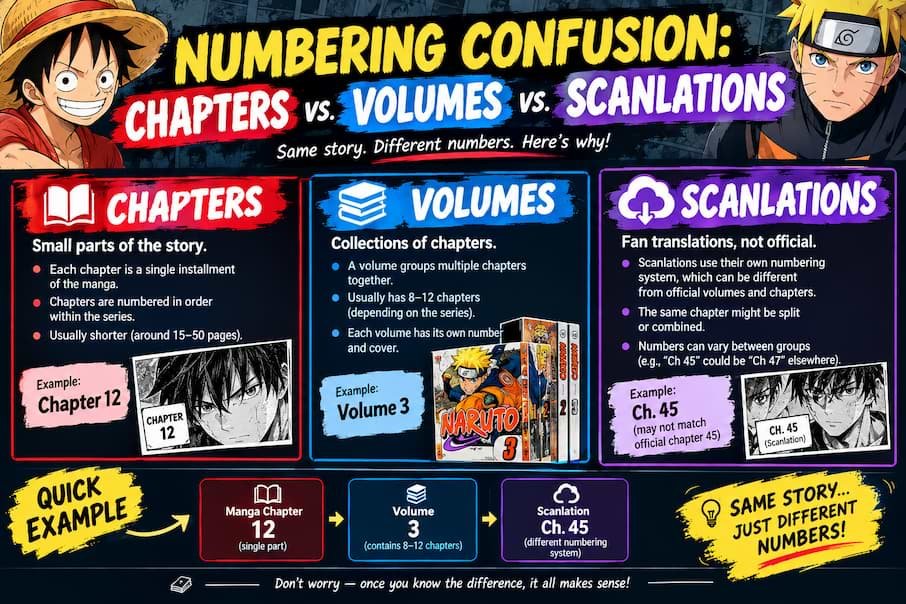
Even after finding the right chapter number, readers often land on the wrong page because “chapter 145” doesn’t always mean the same thing across sources.
Officially licensed releases sometimes renumber, split, or merge chapters compared to how they originally ran in serialization. Older fan-translated (scanlation) releases may use a numbering system that predates the official one, especially for long-running series with a history of unofficial translations before licensing.
This matters most if you’re buying physical or digital volumes — a chapter number pulled from an old fan forum might not match the table of contents in the official book you purchase. Always confirm against the official release’s own table of contents when in doubt, not just a remembered chapter number.
Illustrative Example: Applying the Method
To see the method in action, imagine a hypothetical shonen series, “Series X,” currently airing its third season. Here’s how the four steps would play out:
A viewer finishes episode 40 and checks the fan wiki, which lists the episode as adapting up to “around chapter 210” — a rough estimate, not exact. Cross-referencing MAL’s episode notes narrows it to “chapter 208–211.” A same-week Reddit thread confirms chapter 211 as the final page shown on screen. Finally, checking the official publisher’s release calendar confirms chapter 211 sits at the very end of the most recently released volume — a clean, spoiler-free starting point.
FAQs
How do I know what chapter the anime left off on?
Check the series’ fan wiki for an “adapted from” note on the final episode, then confirm with MAL or AniList episode metadata and a recent community thread. Relying on just one source risks outdated or incorrect information, especially for currently airing series.
Is there a website that tracks manga chapters to anime episodes?
No single universal database covers every series reliably. Fan wikis cover this partially for popular titles, which is why cross-referencing multiple sources works better than trusting one tracker alone.
How many manga chapters does one anime episode usually cover?
It varies widely — anywhere from part of one chapter to four or more, depending on studio pacing decisions for that specific arc. There’s no fixed ratio, so always verify per-episode rather than estimating from an average.
Can I skip straight to the manga after finishing the anime?
Yes, once you’ve confirmed your last-watched episode was canon (not filler) and identified the correct chapter using the four-step method. Skipping the filler-check step risks either missing story content or accidentally re-reading it.
What’s the difference between filler and canon in terms of manga chapters?
Canon episodes adapt actual manga chapters and will have a source chapter listed on wikis or tracker sites. Filler episodes are anime-original and have no manga equivalent at all, so searching for a matching chapter for filler content won’t return a result.
Why do different sites list different chapter numbers for the same episode?
Sources can disagree due to outdated wiki edits, differences between fan-translated and official chapter numbering, or genuine ambiguity when an episode ends mid-chapter. Cross-checking against the official publisher’s release is the most reliable tiebreaker.
Conclusion
Matching a manga chapter to an anime episode isn’t guesswork once you have a repeatable process: verify with a wiki, cross-check with a tracker site, confirm with a recent community thread, and double-check against the official release when numbers seem off.
Three things to remember: there’s no fixed chapter-per-episode ratio, filler episodes have no chapter equivalent at all, and chapter numbers can shift between fan translations and official releases.
Your next step: pick the episode you last watched, confirm it’s canon, and run it through the four-step method above before you start reading.
1 thought on “Manga Chapter to Anime Episode: Find the Exact Match”