
Introduction
A single 23-minute anime episode can cost anywhere from roughly $80,000 to well over $300,000 to produce, and that gap isn’t random.
It comes down to the studio, the schedule, how much animation gets outsourced overseas, and whether a streaming platform is footing part of the bill.
If you’ve ever wondered how much it costs to make one anime episode, or why some episodes look gorgeous while others look like a slideshow, the answer lives in the budget. This article breaks down exactly where that money goes, who gets paid what, and why even popular anime studios often operate on razor-thin margins.
What One Episode Really Costs
Most TV anime episodes fall somewhere between $100,000 and $200,000 to produce, based on figures that have circulated in industry reporting for years. Higher-profile shows with dense action, lots of CGI, or international streaming deals attached can push well past that.
A typical TV anime episode costs roughly $100,000 to $200,000. Prestige shows, Netflix originals, and heavily animated action series can run $250,000 to $500,000 or more per episode, while low-budget or filler-heavy episodes sometimes come in under $100,000.
That range exists because “anime” isn’t one industry with one price tag. A slow-paced slice-of-life show with static shots costs far less to animate than a mecha series with constant movement. Think of it like comparing a low-budget indie film to a studio blockbuster; both are movies, but the similarities mostly end there.
What makes anime pricing unusual is how the cost gets split. A chunk goes to the studio handling production, another chunk goes to freelance animators paid per drawing, and a slice goes to the production committee that actually financed the show. We’ll unpack each of those pieces next.
Why Anime Budgets Are So Hard to Pin Down

Unlike Hollywood films, anime studios rarely publish detailed budgets, and production committees have every incentive to keep numbers private. That secrecy is intentional, not accidental, because it protects negotiating leverage with networks, streamers, and merchandise partners.
Anime budgets stay hidden because most shows are funded by production committees (groups of investors including publishers, toy companies, and streaming platforms) who don’t disclose financial terms. Public figures you see online are usually estimates from interviews, leaked documents, or informed industry guesses, not official statements.
Another complication is that episode costs aren’t fixed across a season. Studios often front-load budget into the first and last episodes, the ones most likely to hook viewers or deliver a satisfying finale, while middle episodes get less time and money. This is sometimes called “banking” episodes, where early footage gets reused later to save on animation hours.
Currency fluctuation adds another layer of confusion. Most reported figures originate in Japanese yen, and conversions to dollars shift depending on when an article was written. A figure that looked like $150,000 per episode in 2019 might translate differently today simply because of exchange rate movement, not because production costs actually changed.
The Four Cost Buckets Behind Every Anime Episode
Rather than treating “anime budget” as one mysterious number, it helps to split it into four buckets that every episode passes through. Each bucket has its own cost drivers, and understanding them explains why two episodes with similar runtimes can cost wildly different amounts.
Every anime episode’s budget breaks into four parts: pre-production (planning and storyboards), animation production (the actual drawing and compositing), post-production (sound, music, editing), and overhead (the production committee’s cut and studio profit margin). Animation production usually eats the largest share.
Pre-Production and Planning Costs
Before a single frame gets drawn, a team works out the script, storyboards, character design sheets, and voice casting. This phase is relatively cheap compared to animation itself, but it sets the pace for everything downstream. A rushed pre-production schedule is one of the biggest reasons episodes later end up looking unfinished or relying on still frames.
Directors and writers get paid here, along with voice actors who record dialogue in advance of animation. Voice acting in Japan, known as seiyuu work, is typically paid per session rather than as a flat salary, and veteran actors command noticeably higher rates than newcomers.
Animation Production Costs
This is where most of the money goes. Key animators draw the critical poses and movements, in-between animators fill the gaps to create smooth motion, and digital painters add color. Backgrounds, CGI integration, and compositing all happen in this stage too.
A huge amount of this work gets outsourced to studios in South Korea, China, and the Philippines to stretch limited budgets further. That’s not a secret in the industry; it’s standard practice, and it’s part of why anime can produce impressive visuals despite modest overall spending compared to Western animated series.
Post-Production, Sound, and Dubbing
Once animation is locked, the episode moves into sound design, music scoring, and final editing. Composers get paid to score original tracks, sound engineers mix dialogue with effects, and editors assemble the final cut for broadcast.
International dubbing, when it happens, is usually a separate cost handled later by a licensing company rather than the original Japanese studio. That means dubbing expenses typically don’t count toward the per-episode figure most articles quote.
Overhead and the Production Committee Cut
Finally, a portion of every episode’s budget covers studio overhead, equipment, software licenses, and a margin for the production committee that financed the show. This is the least visible bucket but arguably the most important, because it determines whether a studio can survive to make another season.
Production committees often prioritize recouping costs through merchandise, Blu-ray sales, and streaming licensing rather than the broadcast itself, which barely breaks even in many cases.
How Costs Compare Across Anime Budget Tiers
Not every anime gets the same budget, and the gap between tiers is larger than most fans assume. Comparing them side by side makes the “how much does it cost to make one anime episode” question much easier to answer honestly.
Low-budget TV anime can cost under $100,000 per episode, standard TV anime runs $100,000 to $200,000, prestige and streaming originals often hit $250,000 to $500,000, and theatrical films cost dramatically more per minute than any TV episode, often totaling tens of millions of dollars for a feature.
| Budget Tier | Typical Cost per Episode | Example Context |
|---|---|---|
| Low-budget/quick-turnaround TV anime | $80,000–$120,000 | Simplified animation, heavy reuse of footage |
| Standard TV anime (weekly broadcast) | $100,000–$200,000 | Most seasonal shows fall here |
| High-end/prestige TV anime | $200,000–$350,000 | Dense action, name-brand studios |
| Netflix/streaming original anime | $250,000–$500,000+ | Global release, higher production values |
| Theatrical anime film | Total budget often $10M+ | Feature-length, big-screen quality |
Low-Budget vs Standard TV Anime
The difference between a cheap episode and a standard one usually comes down to animation density. Cheaper episodes lean on still shots, pan-and-scan camera tricks over static art, and recycled footage from earlier episodes. Standard episodes still use these tricks occasionally, but far less noticeably.
Netflix and Streaming Originals
Streaming platforms reportedly pay more upfront to secure exclusive or day-and-date global rights, which can translate into bigger per-episode budgets than a typical Japanese TV broadcast deal. The tradeoff is that studios sometimes give up long-term licensing revenue in exchange for that higher guaranteed payment, a structure some industry voices have criticized as shortsighted for the animators involved.
Theatrical Films vs TV Episodes
Film budgets aren’t really comparable to episode budgets because the math works differently. A two-hour film might cost what ten TV episodes combined would cost, but the per-minute spend is typically far higher since films get longer production windows, bigger animation teams, and theatrical-quality detail that a weekly TV schedule simply can’t support.
Why Anime Is Cheaper Than Western Animation
It’s a common talking point that anime is “cheap” compared to American animation, and there’s truth to it, though the comparison is more nuanced than a single number suggests. The core difference is labor cost and animation technique, not a lack of effort or skill.
Anime tends to cost less than Western animation because of lower average labor rates in Japan’s animation pipeline, heavy use of overseas outsourcing, and animation techniques (like limited frame rates and still-shot compositions) that reduce the number of drawings needed per second of footage.
Western animated series, particularly big-budget streaming or network shows, often pay animators union wages with benefits, which raises baseline costs significantly. Japanese anime studios, by contrast, frequently rely on freelance and subcontracted labor paid per completed cut, a system that keeps studio overhead lower but has drawn serious criticism for underpaying individual animators.
Anime also uses animation techniques built around budget constraints rather than despite them. Long static shots with moving mouths, dramatic zoom-ins on still frames, and reused “stock” footage for transformations or recurring scenes all reduce the number of new drawings required. These aren’t laziness; they’re decades-old industry workarounds for doing more with less.
Where the Money Actually Goes: Animators vs Studios
Here’s the uncomfortable part of this topic: even when an anime is a massive hit, the people drawing it often see very little of that success. Studios and production committees typically profit from licensing, merchandise, and streaming deals long after the animators who made the show have moved on to other projects.
Individual animators, especially in-betweeners, are often paid per completed drawing rather than a salary, and reports have long suggested this system results in very low income for entry-level animators. Studio profit, when it exists, comes mainly from downstream revenue, not the broadcast episode itself.
Key animators, who handle the most important poses and movements, are generally paid better than in-betweeners, since their work requires more experience and artistic judgment. Directors and series composers sit higher still in the pay structure, often receiving royalties or bonuses tied to a show’s broader success.
This uneven distribution is part of why labor conditions in the anime industry have been a persistent topic of concern among journalists and animators themselves. A studio can produce a beloved, profitable series while the junior staff who animated it struggle financially, and that contradiction is baked into how the industry’s payment system works.
Common Mistakes People Make Estimating Anime Costs
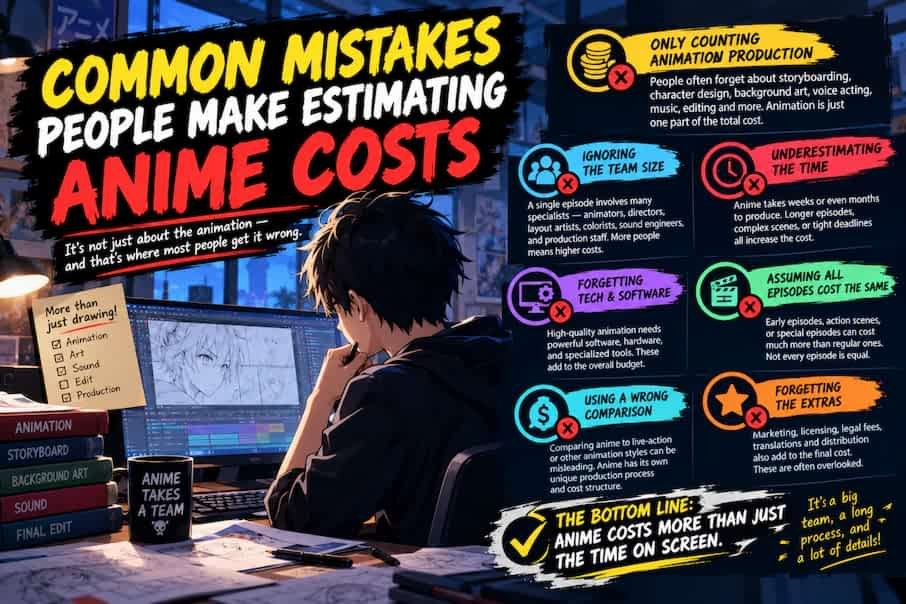
A lot of the numbers floating around online are either outdated, mistranslated, or stripped of context, which leads fans to draw the wrong conclusions. Knowing the common errors helps you read future budget claims with a more critical eye.
The biggest mistakes are treating one leaked figure as universal, confusing total series budgets with per-episode costs, ignoring currency conversion timing, and assuming higher animation quality always means a bigger budget rather than better time management.
One frequent error is grabbing a single anonymous figure, often from a forum post or old interview, and applying it to every anime ever made. Budgets vary wildly by genre, studio, and era, so one data point from a 2015 interview tells you almost nothing about a 2026 Netflix original.
Another mistake is confusing total series costs with per-episode costs. A headline claiming “this anime cost $5 million” might refer to an entire 12-episode season, which actually lines up with a normal per-episode range once you divide it out, not some shocking outlier.
People also forget that animation quality depends heavily on production scheduling, not just raw money. A well-managed studio with a realistic deadline can produce better-looking episodes on a modest budget than a rushed studio with more money but impossible timelines. Time, in this industry, is often as valuable as cash.
How Studios Try to Profit Despite Thin Margins
If episodes barely break even on broadcast revenue alone, you might wonder how any studio stays in business. The answer is that the broadcast episode functions more like an advertisement for everything else a franchise can sell.
Studios and production committees typically profit from Blu-ray and digital sales, merchandise, video games, mobile apps, and streaming licensing fees rather than the TV broadcast itself, which often serves mainly to build an audience for those other revenue streams.
Merchandise sales, including figures, clothing, and collectible cards, can dwarf a show’s original broadcast run earnings. Popular franchises sometimes generate more revenue from a single merchandise wave than from an entire season’s production committee payout.
Streaming licensing has become an increasingly important revenue stream too, especially for shows picked up internationally. A series that underperforms domestically can still become profitable once foreign streaming deals and dubbing rights get factored in, which is part of why some shows get unexpected second seasons years after their original run ended.
Frequently Asked Questions
How much does it cost to make an entire anime series?
A standard 12-episode anime season typically costs somewhere between $1.2 million and $3 million in total, based on per-episode estimates multiplied across a season. Longer-running series or those with heavier CGI and action content can push well beyond that, especially if the show airs for multiple consecutive seasons without a production break.
Why is anime cheaper to produce than American cartoons?
Anime generally costs less because of lower average labor rates, extensive overseas outsourcing, and animation techniques designed to reduce the number of drawings needed per second, such as limited frame rates and reused footage. American animation, particularly union-backed productions, tends to carry higher baseline labor costs built into every episode.
How much do anime animators get paid per episode?
Pay varies enormously by role. In-between animators are often paid per completed drawing, which can add up to very low overall income for entry-level workers, while key animators and directors earn considerably more. There’s no single flat rate per episode since so many freelancers contribute to one episode’s completion.
How much does a Netflix original anime cost per episode?
Reports suggest Netflix and similar streaming platforms often pay above the industry average per episode, sometimes in the $250,000 to $500,000 range, in exchange for exclusive or simultaneous global release rights. Exact terms of these deals are rarely made public.
How long does it take to produce one anime episode?
Production timelines vary, but many TV anime episodes take several months of combined work across pre-production, animation, and post-production, even though only one episode airs each week. Studios typically work on multiple episodes simultaneously, which is why a delayed episode or schedule slip can cascade into visible quality drops later in a season.
Do popular anime actually make money for the studio?
Not always, at least not directly from the broadcast itself. Many studios earn their real profit from merchandise, Blu-ray sales, and streaming licensing rather than the original TV airing, which means a critically beloved show can still leave the animation studio with thin margins while other companies in the production committee profit more.
Conclusion
The honest answer to how much it costs to make one anime episode is that it depends heavily on the show, but $100,000 to $200,000 is a reasonable baseline for standard TV anime, with prestige and streaming originals often running $250,000 or more.
Three things matter most here: budgets split across four distinct cost buckets, streaming deals have pushed some per-episode costs higher, and the people actually drawing the show often see the smallest share of the profit.
If you’re researching this topic further, look for recent industry interviews rather than older forum posts, since costs have shifted with streaming’s growing role in anime financing. Treat any single number you find online as a snapshot of one show’s situation, not a universal rule for the entire industry.
1 thought on “How Much Does It Cost to Make One Anime Episode?”