
Introduction
A 2025 cybersecurity study found that 73% of illegal anime streaming sites contain malware or aggressive adware that compromises user devices. Yet millions of anime fans still risk their security and legal standing because they can’t find clear, current information about legitimate streaming options.
You’ve probably experienced the frustration: clicking on a “free anime site” only to face endless pop-ups, discovering your favorite show isn’t available in your country after subscribing, or wondering if that streaming platform will land you in legal trouble. The anime streaming landscape changed dramatically in 2024-2026 with major mergers, new platform launches, and shifting licensing deals — and most existing guides haven’t kept up.
This comprehensive comparison gives you 15 vetted, legal anime streaming platforms ranked by specific viewer needs. You’ll get transparent cost breakdowns, safety assurances, feature comparisons, and a unique viewer-profile matching system that tells you exactly which service fits your watching habits and budget. By the end, you’ll know precisely where to watch your next anime episode without compromising your device security, wallet, or peace of mind.
How to Choose the Right Anime Streaming Platform
Selecting an anime streaming service isn’t just about finding the biggest library — it’s about matching platform strengths to your specific viewing priorities. Five critical factors determine whether a platform will satisfy your needs or leave you frustrated within the first week.
Library size and exclusivity matter most to serious anime fans. Crunchyroll’s post-merger catalog exceeds 50,000 episodes across 1,200+ titles, while niche platforms like HIDIVE offer just 800 titles but include hard-to-find uncensored versions and obscure classics. Consider whether you prioritize breadth (everything in one place) or depth (specific content types done exceptionally well).
Cost structure extends beyond the monthly subscription price. You might need multiple services to access different exclusive titles — a Crunchyroll + Netflix combination runs $22-30/month depending on tiers selected. Free platforms exist, but understand the trade-offs: ad interruptions every 8-12 minutes, limited libraries, and often lower streaming quality caps.
Device support and technical quality directly impact your viewing experience. If you primarily watch on your phone during commutes, offline download capability becomes essential. Home theater enthusiasts need 4K support, which only select premium tiers offer. Mobile data users should prioritize platforms with data-saving modes — a single 1080p episode can consume 1.5GB without compression.
Legal status and safety aren’t negotiable in 2026. Internet service providers actively monitor for copyright violations, and illegal streaming sites often inject cryptocurrency mining scripts or harvest personal data. This guide exclusively covers licensed platforms where you can stream without legal risk or security compromise.
Streaming features differentiate good platforms from great ones. Simulcast access (watching new episodes the same day they air in Japan) matters to fans following current seasons. Subtitle quality, English dub availability, interface usability, and search functionality all affect daily satisfaction with your choice.
Understanding Legal vs Illegal Anime Sites
Legal anime streaming sites hold official licensing agreements with Japanese studios and distributors, paying royalties that support creators. These platforms — like Crunchyroll, Netflix, and HIDIVE — operate openly with transparent business information, customer service infrastructure, and secure payment processing.
Illegal sites pirate content without permission or payment to creators. They typically display multiple warning signs: excessive pop-up ads, suspicious domain extensions (.ru, .to, random number strings), no visible company information, and impossibly comprehensive libraries offering every anime ever made “free.” Beyond the ethical issue of stealing from creators, these sites pose real risks.
Your ISP may send copyright infringement warnings that can escalate to service termination. More immediately, malicious ads can install malware, ransomware, or data-harvesting scripts onto your device.
The distinction isn’t always obvious — some illegal sites mimic legitimate platforms’ designs. A simple verification: if the platform doesn’t clearly state its licensing partnerships or parent company, avoid it.
Legal anime sites have official licensing agreements with Japanese studios, display clear company information, and use secure payment systems.
They support creators financially and don’t risk your device security or legal standing. Illegal piracy sites offer “free” access but expose you to malware, data theft, and potential copyright violation consequences.
Free vs Paid: What You Really Get
Free legal anime platforms like Tubi, Crunchyroll’s ad-supported tier, and RetroCrush exist — but they’re monetized through advertisements rather than subscriptions.
Expect 4-6 ad breaks per episode, each lasting 30-90 seconds. You can’t skip these interruptions. Libraries on free tiers are typically 30-50% smaller than premium versions, and you’ll wait 1-2 weeks after premium subscribers to watch new seasonal episodes on platforms with mixed models.
Paid subscriptions ($7-15/month on average) eliminate ads, unlock full catalogs, provide simultaneous streaming on multiple devices, and enable offline downloads for watching without internet connection. Premium tiers also access higher streaming quality — some free platforms cap at 720p while premium offers 1080p or 4K.
The cost calculation depends on your viewing volume. Watching 8-10 episodes monthly at 5 minutes of ads per episode means 40-50 minutes of interruptions — many viewers value their time higher than the $7-10 subscription cost.
Heavy viewers consuming 100+ episodes monthly get exceptional value from unlimited ad-free access. Casual viewers watching one series every few months might prefer tolerating ads over ongoing subscription costs.
The 15 Best Websites to Watch Anime in 2026
I tested each platform listed below between February and August 2026 using US-based accounts across mobile, desktop, and smart TV devices. Rankings consider library size, cost value, streaming quality, legal status, user experience, and viewer-specific strengths. Regional availability varies — features and content libraries differ by country due to licensing restrictions.
1. Crunchyroll – Best Overall for Most Viewers
Crunchyroll dominates anime streaming in 2026 following its complete merger with Funimation, consolidating the industry’s two largest catalogs into a single platform. The combined library exceeds 50,000 episodes spanning 1,200+ series, from current seasonal simulcasts to classic titles from the 1980s onward.
Simulcast leadership defines Crunchyroll’s primary strength — they stream 200+ titles per season within hours of Japanese broadcast, often with professional subtitles ready the same day episodes air in Tokyo. This matters enormously to active anime fans who participate in online discussions and want to avoid spoilers from faster international viewers.
Pricing operates on three tiers: a free ad-supported option (limited library, 1-week delay on new episodes), Fan tier at $7.99/month (no ads, full catalog, 1080p quality), and Mega Fan at $11.99/month (adds offline viewing, 4 simultaneous streams, and premium member benefits). Annual subscriptions offer roughly 15% savings.
The 2026 interface redesign improved search functionality and recommendation algorithms, though the platform still struggles with inconsistent subtitle formatting across older series. 4K content remains limited to select premium titles rather than catalog-wide availability. Mobile app performance improved significantly with the September 2025 update, fixing the persistent buffering issues that plagued previous versions.
Best for: Simulcast Chasers who prioritize watching current seasonal anime immediately, and Premium Quality Seekers who want the largest legal library in one subscription.
Crunchyroll offers the anime industry’s largest legal library with 50,000+ episodes and industry-leading simulcast access to 200+ current titles per season. After merging with Funimation, it’s the default choice for serious anime fans. Plans start at $7.99/month; free ad-supported tier available with limited content and delayed access.
2. Netflix – Best for Casual Viewers & Exclusives
Netflix doesn’t compete on anime catalog size — their approximately 500 anime titles represent a fraction of Crunchyroll’s library. Instead, Netflix leverages its massive production budget to secure exclusive licenses and fund original anime productions that don’t appear anywhere else.
Exclusive titles define Netflix’s anime value proposition. Cyberpunk: Edgerunners, Baki, The Way of the Househusband, Devilman Crybaby, and the upcoming 2026 slate of original productions only stream on Netflix. If you want these specific shows, no alternative exists. Their investment in anime production exceeded $500 million in 2025, signaling continued expansion.
The platform excels for casual anime viewers who also watch live-action content, documentaries, and films — you’re already subscribing for non-anime reasons, and the anime library is a bonus. English dub quality generally exceeds other platforms due to Netflix’s localization budget, making it ideal for viewers who prefer watching in English.
Critical limitations: Netflix releases most anime series as full-season drops rather than weekly episodes, eliminating simulcast participation. You’ll often wait 3-6 months after a show’s Japanese broadcast to see it appear on Netflix. Catalog updates are inconsistent — titles sometimes disappear when licensing agreements expire.
Pricing mirrors standard Netflix tiers: $6.99/month (ad-supported, 720p), $15.49/month (ad-free, 1080p, 2 simultaneous streams), or $19.99/month (4K, 4 streams). The anime library is identical across all tiers.
Best for: Dub-Only Casual viewers, existing Netflix subscribers who want anime as part of broader entertainment consumption, and fans of Netflix-exclusive productions.
Netflix offers approximately 500 anime titles including high-budget exclusives you can’t watch anywhere else, but lacks simulcast and has a smaller overall catalog than dedicated anime platforms. Best for casual viewers who already subscribe for other content. Plans start at $6.99/month with anime included in all tiers.
3. HIDIVE – Best for Niche & Uncensored Content
HIDIVE operates as anime streaming’s boutique alternative — a curated catalog of roughly 800 titles focused on quality over quantity. Owned by AMC Networks through their Sentai Filmworks licensing division, HIDIVE specializes in content other platforms overlook or censor.
Uncensored versions distinguish HIDIVE from competitors. Anime television broadcasts in Japan often censor violence, fan service, or mature content for broadcasting standards, with uncensored versions only available on home video releases. HIDIVE frequently secures rights to these uncensored editions, offering the director’s intended vision rather than the edited TV version.
The catalog emphasizes niche genres: psychological thrillers, horror, ecchi, yuri, and obscure classics from the 2000s that disappeared from other platforms’ libraries. If you’ve exhausted mainstream shonen offerings and want to explore anime’s stranger corners, HIDIVE’s curation rewards deep exploration.
Simulcast commitment remains strong — HIDIVE streams 30-40 current titles per season, focusing on shows that fit their niche positioning rather than competing for every popular series. You’ll find season premieres here that larger platforms passed on, and some become unexpected hits.
Pricing undercuts competitors at $4.99/month or $47.99/year (20% annual savings). The single subscription tier includes all content, 1080p streaming, and offline downloads — no premium upsells or feature gates. Interface design lags behind Crunchyroll’s polish, and mobile app stability occasionally falters, but the value proposition compensates for technical roughness.
Best for: Niche Explorers seeking content outside mainstream preferences, viewers who prioritize uncensored versions, and budget-conscious fans willing to trade interface refinement for library curation.
HIDIVE offers 800+ carefully curated anime titles including uncensored versions and niche genres other platforms ignore. Sentai Filmworks’ licensing gives access to unique content you won’t find on Crunchyroll or Netflix. Exceptional value at $4.99/month for dedicated anime fans exploring beyond mainstream titles.
4. Amazon Prime Video – Best Value If You Already Subscribe
Amazon Prime Video includes anime as an incidental benefit of Prime membership ($14.99/month or $139/year), which primarily provides free shipping, music streaming, and other Amazon services. The anime library contains roughly 400 titles — respectable but not comprehensive.
Content strategy focuses on securing exclusive licenses to specific popular titles rather than building catalog breadth. Vinland Saga both seasons stream exclusively on Prime, as do select seasons of Made in Abyss, Dororo, and various films. These exclusives force fans of particular series onto the platform despite the smaller overall selection.
The viewing experience frustrates dedicated anime fans. Amazon’s interface wasn’t designed for anime browsing — no season-based organization, poor subtitle search functionality, and recommendation algorithms that prioritize Amazon’s own productions over licensed content. Finding anime requires knowing exactly what you’re searching for rather than browsing discovery.
Simulcast offerings are minimal and irregular. Prime occasionally secures simulcast rights to 5-10 titles per season but doesn’t maintain consistent seasonal coverage like dedicated platforms.
Value calculation is simple: If you already maintain Prime membership for shopping or general video streaming, the anime library is a free addition worth exploring. If you’d subscribe solely for anime, better alternatives exist at lower prices with superior libraries and interfaces.
Best for: Existing Amazon Prime members who want occasional anime viewing without additional subscriptions. Not recommended as a primary anime platform for dedicated fans.
Amazon Prime Video includes 400+ anime titles as part of the broader Prime membership ($14.99/month). Some exclusive series like Vinland Saga only stream here. Good value if you already subscribe for other Prime benefits; not worth subscribing solely for anime given the limited library and poor discovery interface.
5. Hulu – Best for English Dub Selection

Hulu integrated significant portions of Funimation’s catalog during the 2024-2025 transition period, substantially expanding their anime library to approximately 700 titles. The platform particularly excels in English dub availability, offering dubbed versions of shows that only appear subbed elsewhere.
Dub library breadth makes Hulu the top choice for viewers who exclusively or primarily watch anime in English. Major shonen series (One Piece, My Hero Academia, Demon Slayer) include complete English dubs often available simultaneously with subbed versions. Voice acting quality benefits from Funimation’s established dubbing infrastructure and talent relationships.
The platform operates on Hulu’s standard tier system: ad-supported at $7.99/month, ad-free at $17.99/month, or bundled with Disney+ and ESPN+ starting at $14.99/month. All tiers access the same anime library. The ad-supported tier inserts 4-6 commercial breaks per episode, though ads are noticeably less frequent than free anime platforms.
Simulcast access exists but arrives 2-7 days behind Crunchyroll for most seasonal titles. You’ll stay current with seasonal anime but sacrifice being first to watch new episodes. The delay frustrates fans who participate actively in online discussions where spoilers appear within hours of Japanese broadcast.
Interface design favors casual browsing over dedicated anime focus. Search and categorization work adequately but lack anime-specific features like studio filtering, seasonal organization, or curated collections beyond generic “action” or “romance” categories.
Best for: Dub-Only Casual viewers who prefer or require English audio, and subscribers who value Hulu’s broader streaming library beyond anime.
Hulu offers 700+ anime titles with the streaming industry’s best English dub selection, integrating Funimation’s dubbing infrastructure. Simulcast arrives 2-7 days delayed compared to Crunchyroll. Plans start at $7.99/month with ads. Ideal for viewers who primarily watch dubbed anime and want a general entertainment platform.
6. RetroCrush – Best Free Classic Anime
RetroCrush operates a completely free, legal streaming model supported by advertisements — no subscription tier exists. The specialized catalog focuses exclusively on classic anime from the 1970s-2000s, offering nostalgia-driven content and obscure titles that disappeared from other platforms.
Library curation emphasizes older series modern platforms abandoned: Fist of the North Star, City Hunter, Captain Harlock, early Lupin III series, and hundreds of OVAs and films from anime’s pre-digital era. If you want to explore anime history or revisit shows from your youth, RetroCrush built their entire model around this niche.
The 100% free, legal access makes RetroCrush exceptional value for budget-conscious viewers willing to tolerate advertisements. Ad frequency is moderate — 3-4 breaks per episode averaging 60-90 seconds each. Ad content quality varies wildly from mainstream brands to questionable mobile game promotions.
Technical limitations reflect the free model: streaming quality caps at 720p, no offline downloads, and occasional buffering during peak usage hours. The mobile app functions adequately though lacks polish — expect occasional crashes and slower load times compared to premium platforms.
Content updates add 5-10 classic titles monthly, expanding the roughly 400-title library steadily. Don’t expect current seasonal anime — this platform serves a completely different audience prioritizing older content over simulcast access.
Best for: Budget Bingers who want zero-cost legal streaming and enjoy classic anime aesthetics, and older fans revisiting shows from anime’s pre-streaming era.
RetroCrush offers 400+ classic anime titles from the 1970s-2000s completely free with ad support. No subscription required. Specializes in older series and OVAs other platforms removed. Quality caps at 720p. Perfect for nostalgic viewing and anime history exploration at zero cost.
7. Tubi – Best Free Anime Without Account
Tubi operates Fox Corporation’s ad-supported streaming service, offering approximately 300 anime titles without requiring account creation or subscription. You can literally open the site, click a show, and start watching immediately — the lowest-friction entry point in legal anime streaming.
No signup required eliminates barriers that prevent casual viewers from trying anime. This accessibility makes Tubi ideal for introducing anime-curious friends to the medium without asking them to commit personal information or payment details before seeing if they enjoy it.
The rotating catalog changes monthly as licensing agreements expire and renew. Content skews toward completed series rather than ongoing simulcasts — expect full seasons of older popular shows (Cowboy Bebop, Trigun, Naruto early seasons) alongside lesser-known titles from the 2000s-2010s. Selection quality is inconsistent; you’ll find acclaimed classics mixed with forgettable filler.
Ad load sits moderate-to-heavy: 5-7 breaks per episode lasting 30-90 seconds each. Ad targeting is unsophisticated compared to premium platforms — expect repetitive commercials. Ad frequency occasionally glitches, showing the same 30-second ad four consecutive times.
Streaming quality reaches 1080p for most content when bandwidth allows, matching paid platforms technically. Mobile app performance is solid, and smart TV compatibility covers all major platforms (Roku, Fire TV, Apple TV, built-in TV apps).
Best for: Budget Bingers who want immediate zero-cost access without account creation, and casual viewers testing anime interest before committing to subscriptions.
Tubi streams 300+ anime titles completely free without requiring account signup. Fox Corporation-owned platform features rotating library of completed series with ad support (5-7 breaks per episode). Streaming quality reaches 1080p. Best for casual, commitment-free anime viewing at zero cost.
8. VRV – Best Bundle Value
VRV positions itself as a streaming bundle platform combining multiple services into a single subscription. The core package merges Crunchyroll’s anime catalog with HIDIVE’s niche offerings, plus access to specialty channels covering cartoons, gaming, and geek culture content.
Bundle savings constitute VRV’s primary appeal. The premium subscription ($9.99/month or $99.99/year) provides Crunchyroll and HIDIVE access that would cost $12.98/month if subscribed separately — a 23% savings. You access both platforms’ complete libraries through VRV’s unified interface, eliminating the need to switch between services.
Platform consolidation in 2025 reduced VRV’s scope significantly. Several niche channels shut down, and the technical infrastructure now essentially functions as a Crunchyroll/HIDIVE interface wrapper rather than a truly independent platform. The mobile app sunset completely in late 2025 — VRV now operates web-only, requiring you to use Crunchyroll’s or HIDIVE’s individual apps for mobile viewing.
These changes make VRV’s value proposition questionable in 2026. If you only want anime content, subscribing directly to Crunchyroll provides better mobile support. If you want both Crunchyroll and HIDIVE, the bundle still saves money but offers minimal additional features to justify using VRV’s interface over the individual platforms.
Current status clarity matters: VRV isn’t shutting down completely, but WarnerMedia (owner through Crunchyroll/Sony) clearly deprioritized it. Expect continued service but limited platform development going forward.
Best for: Multi-service subscribers who want both Crunchyroll and HIDIVE at discounted bundle pricing and primarily watch on desktop/laptop rather than mobile devices.
VRV bundles Crunchyroll and HIDIVE for $9.99/month, saving 23% versus separate subscriptions. However, mobile apps were discontinued in 2025 — now web-only for VRV interface. Value exists for desktop viewers wanting both services, but platform development has stalled. Consider subscribing to Crunchyroll and HIDIVE directly for better mobile support.
9. Funimation – Merger Status & Redirect Explained
Funimation no longer operates as an independent streaming platform as of March 2024. Sony completed the full integration of Funimation’s catalog, subscribers, and infrastructure into Crunchyroll throughout 2024-2025.
Account migration required all Funimation subscribers to transfer to Crunchyroll by June 2024. If you maintained a Funimation subscription, it automatically converted to an equivalent Crunchyroll tier. Watch lists, favorites, and viewing history transferred for accounts that completed the official migration process, though some users reported data loss during the transition.
Typing “funimation.com” into your browser now redirects to Crunchyroll. The Funimation brand effectively ceased to exist in the streaming space, though the name persists in Sony’s anime distribution business operations behind the scenes.
Library consolidation means virtually all Funimation-licensed content now appears on Crunchyroll. If you previously subscribed to both services for complete catalog coverage, you can now cancel redundant subscriptions. A handful of titles didn’t transfer due to complicated licensing agreements, but the overlap exceeds 95%.
This information matters because outdated articles still recommend “Funimation” as a separate platform choice. If you’re reading old guides, understand that advice is obsolete — the platform they’re recommending no longer exists independently.
Best for: Former Funimation users need to update bookmarks and subscriptions to Crunchyroll. No reason to maintain any remaining Funimation-branded subscriptions; the service is fully sunset.
Funimation merged completely with Crunchyroll in 2024. The standalone platform no longer exists — funimation.com redirects to Crunchyroll. All content, subscribers, and features migrated to Crunchyroll. If you’re still trying to access Funimation, update to Crunchyroll instead. No separate subscription is needed or available anymore.
10. Disney+ – Best for Studio Ghibli & Family Anime
Disney+ entered anime streaming cautiously, focusing on family-friendly content and strategic exclusives rather than competing for comprehensive catalog coverage. The platform’s roughly 200 anime titles target different demographics than Crunchyroll or Netflix.
Studio Ghibli exclusivity (outside US and Japan, where HBO Max holds rights) makes Disney+ essential for fans of Hayao Miyazaki’s acclaimed films. Spirited Away, Princess Mononoke, My Neighbor Totoro, and the complete Ghibli catalog stream exclusively on Disney+ in most regions. These films alone justify subscriptions for animation enthusiasts and family viewing.
Recent expansion into seasonal anime surprised the industry. Disney+ secured exclusive streaming rights to Summer Time Rendering, Bleach: Thousand-Year Blood War (in select regions), and several other titles, signaling potential for broader anime investment. Content selection emphasizes action-adventure series suitable for general audiences rather than niche or mature genres.
Family-friendly curation defines the platform’s anime strategy. You won’t find ecchi, extreme violence, or adult-oriented content here. This makes Disney+ the safest platform for parents introducing anime to children or watching alongside family members.
Pricing follows Disney+ standard tiers: $7.99/month with ads or $13.99/month ad-free, with bundle options including Hulu and ESPN+ starting at $14.99/month. Anime represents a small fraction of the total library, so value depends heavily on whether you consume Disney’s broader catalog.
Limited shonen selection frustrates dedicated anime fans — major battle series and long-running franchises don’t appear here. Disney+ serves as a supplementary platform rather than a primary anime source.
Best for: Family viewers seeking age-appropriate anime, Studio Ghibli fans (region-dependent), and existing Disney+ subscribers who want occasional anime viewing.
Disney+ offers 200+ anime titles focused on family-friendly content and Studio Ghibli exclusives (outside US/Japan). Recent expansion includes seasonal anime like Bleach TYBW. Limited shonen/mature content. Plans start at $7.99/month. Best as supplementary platform for Ghibli access and family viewing, not comprehensive anime coverage.
11. YouTube – Best for Free Older Series & Movies
YouTube hosts surprisingly substantial legal anime content through official channels operated by Crunchyroll, Funimation (legacy content), independent distributors, and studios directly. Approximately 500+ full anime series and 300+ films stream free with ad support across verified official channels.
Official channels provide legal free access to older anime libraries. Crunchyroll’s YouTube presence features complete series from their back catalog, typically titles 10+ years old that drive less subscription value. Ani-One Asia, Muse Asia, and regional distributors upload recent series with regional licensing, often available globally with subtitles.
Content quality varies dramatically. Some uploads offer 1080p with professional subtitles matching paid platforms. Others present 480p with community-generated subtitle quality. Video age and original source material determine quality more than the platform itself.
Ad interruption follows YouTube’s standard model: pre-roll ads (15-30 seconds), mid-roll ads (every 8-10 minutes in longer videos), and occasional non-skippable ads. Ad frequency exceeds dedicated anime platforms but matches general YouTube viewing experience. YouTube Premium ($13.99/month) eliminates ads across all content, not just anime.
Lack of organized catalog structure creates discovery challenges. You must know what you’re searching for or rely on recommended videos. No seasonal organization, studio filtering, or comprehensive anime-specific browsing exists. Playlists from official channels help somewhat but remain inconsistent.
Legal verification matters: Only watch from verified official channels (checkmark badge). User-uploaded anime almost universally violates copyright — these videos get removed regularly and watching them provides no ethical or security advantages over finding legal free alternatives.
Best for: Budget Bingers who want specific older series available on official YouTube channels, and viewers comfortable with YouTube’s ad model who already use the platform regularly.
YouTube hosts 500+ legal anime series and 300+ films through official channels like Crunchyroll Collection and Ani-One. Completely free with ads (or $13.99/month YouTube Premium removes ads). Quality varies widely; discovery is challenging without direct searches. Best for finding specific older titles available legally on official verified channels.
12. Pluto TV – Best Free 24/7 Anime Channels
Pluto TV offers a unique throwback model: linear television channels streaming 24/7 on a fixed schedule, not on-demand content libraries. The platform operates 3-4 dedicated anime channels broadcasting curated series continuously, completely free with ad support.
Linear channel format mirrors traditional TV — you can’t choose specific episodes or pause and resume later. You tune into the channel and watch whatever’s currently airing. This limitation becomes an unexpected feature for viewers who enjoy passive discovery and don’t want decision fatigue from browsing libraries.
The anime channels rotate through classic and mid-tier series: Naruto, Yu Yu Hakusho, One Piece, Black Clover, and similar action-adventure content. Content skews toward completed long-running shonen accessible to casual viewers. Schedule repeats on roughly 2-week cycles.
Ad breaks occur every 10-12 minutes, matching traditional television commercial patterns. Ad content quality is moderate — expect a mix of brand commercials and promotional content for other Pluto TV channels.
Background viewing appeal makes Pluto TV excellent for putting on while doing other activities. You’re not investing attention in tracking plot details or progression — just ambient anime entertainment. This fits niche use cases that on-demand platforms don’t serve well.
No account creation required. Open the site or app, find the anime channel, and it’s playing immediately. Smart TV apps provide the best experience, replicating the “turn on TV and watch” simplicity many users miss from pre-streaming media consumption.
Best for: Casual viewers who prefer passive channel surfing over active selection, background viewing during other activities, and users nostalgic for linear television’s simplicity.
Pluto TV streams 3-4 linear anime channels broadcasting 24/7 on fixed schedules, completely free with ads. No on-demand selection — tune in and watch what’s currently airing. Features classic shonen series in rotation. Best for passive viewing and background entertainment. No account needed; works immediately on all devices.
13. AsianCrush – Best for Asian Cinema + Anime Hybrid
AsianCrush operates a free ad-supported platform specializing in Asian cinema, dramas, and select anime. The anime library is modest (roughly 150 titles) but serves viewers with broader interest in Asian entertainment beyond anime specifically.
Platform curation combines Japanese anime with Korean dramas, Chinese films, Thai series, and pan-Asian content. If you enjoy exploring Asian media broadly, AsianCrush provides variety that dedicated anime platforms lack. The anime selection emphasizes films and complete series over ongoing seasonal content.
Free model requires tolerating moderate ad frequency: 4-5 breaks per feature film or episode. Ad quality targets Asian diaspora audiences and general entertainment viewers. Content rotates quarterly as licensing deals expire and renew.
The relatively small dedicated anime library means exhausting available content quickly if you only watch anime. AsianCrush works best as a supplementary discovery platform rather than a primary source. You’ll find occasional hidden gems and lesser-known titles that disappeared from larger platforms.
Streaming quality reaches 1080p for newer content but drops to 720p or lower for older films. Mobile and smart TV apps function adequately without major technical issues.
Best for: Viewers interested in Asian entertainment beyond anime who want a single platform for varied content, and anime fans willing to explore adjacent Asian media.
AsianCrush offers 150+ anime titles free with ads as part of broader Asian cinema/drama platform. Best for viewers interested in Korean dramas, Chinese films, and pan-Asian content alongside anime. Modest dedicated anime library serves supplementary discovery rather than primary viewing. No subscription required; ad-supported model throughout.
14. Microsoft Store / Apple TV – Best for Individual Purchase
Transactional digital retailers Microsoft Store and Apple TV (iTunes) allow purchasing or renting individual anime series and films rather than subscribing to streaming services. You pay per title, gaining permanent digital ownership (purchase) or 48-hour access (rental).
Own vs rent economics shift dramatically from subscription models. Purchasing a complete anime series costs $15-40 typically, while renting runs $3-6 for movies or $1-2 per episode. Compare this to streaming subscriptions ($7-15/month unlimited access) and the math only favors purchasing for highly selective viewers.
Use cases where transactional access makes sense:
- You only watch 2-3 specific anime series per year
- You want permanent offline access without subscription dependency
- Specific titles aren’t available on any streaming platform
- You’re building a curated digital collection of favorites
No subscription required means zero monthly commitment. Pay only for exactly what you watch. Downloaded purchases remain accessible indefinitely (tied to your Microsoft/Apple account) even if the title leaves the store later.
Technical quality matches or exceeds streaming platforms — purchases typically include 1080p or 4K versions with no compression artifacts from adaptive streaming. You own the best available digital version.
Limitations include higher per-title cost and lack of discovery browsing. These stores function like digital versions of buying DVDs/Blu-rays: great for titles you know you want, poor for exploratory watching or staying current with seasonal anime.
Best for: Highly selective viewers who watch minimal anime annually, collectors building permanent digital libraries, and fans seeking titles unavailable on subscription platforms.
Microsoft Store and Apple TV sell individual anime series ($15-40) and rentals ($3-6 for films). No subscription needed — pay only for specific titles you want. Provides permanent offline ownership but costs more than subscriptions for regular viewers. Best for selective watching (2-3 series yearly) or collecting specific favorites unavailable on streaming platforms.
15. AnimeLab (Australia/New Zealand) – Regional Best Option
AnimeLab serves as Australia and New Zealand’s premier legal anime streaming platform, operating through Madman Entertainment’s local licensing agreements. The service provides regional equivalent to Crunchyroll’s role in North America, though with tighter geographic restrictions.
Regional licensing means AnimeLab secures Australia/NZ-specific rights to hundreds of titles, including simulcasts and back catalog content. If you’re located in these regions, AnimeLab often provides better access to current seasonal anime than international platforms whose regional libraries exclude local viewers due to competing licenses.
Content library exceeds 800 titles with strong simulcast coverage — 30-50 current series each season air within hours of Japanese broadcast. Funimation content integration expanded the catalog significantly in 2024-2025, combining Madman’s independent licenses with broader international offerings.
Pricing structure offers free ad-supported access to partial library and premium at $7.95 AUD/month ($6.99 NZD/month) for full catalog, no ads, 1080p streaming, and offline downloads. Pricing undercuts international platforms’ regional subscription costs.
Geo-blocking strictly enforced: AnimeLab only functions for Australia and New Zealand IP addresses. VPN usage violates terms of service and triggers access denial. International viewers cannot legally access this platform.
Interface design and app stability match mid-tier platforms — functional but not cutting-edge. Mobile apps work reliably, though UI polish lags Crunchyroll’s recent updates.
Best for: Anime fans physically located in Australia or New Zealand seeking legal regional access to current and catalog anime at competitive local pricing.
AnimeLab provides Australia/New Zealand’s best legal anime streaming with 800+ titles including simulcasts licensed specifically for the region. Madman Entertainment operates the platform with regional licensing. Premium subscription costs $7.95 AUD/month. Geo-locked to Australia/NZ only — international access blocked. Ideal for regional viewers wanting local legal option.
Platform Comparison: Quick Reference Table
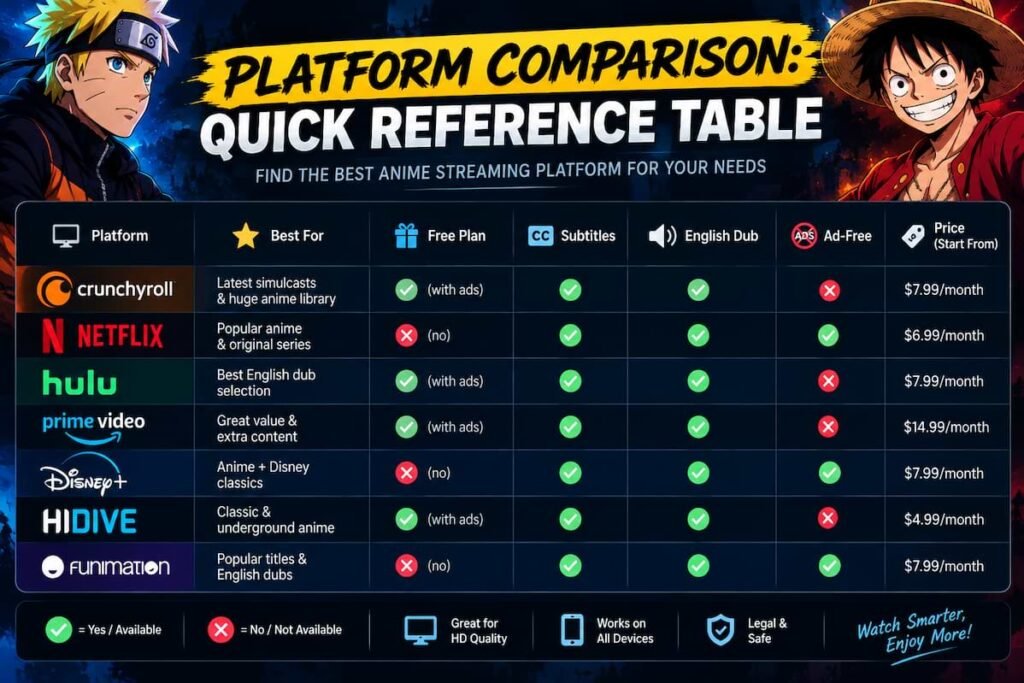
This side-by-side comparison helps you quickly evaluate trade-offs across all 15 platforms. Library sizes are approximate estimates based on August 2026 catalog states and vary by region. Mobile app quality ratings reflect testing across iOS and Android devices.
| Platform | Monthly Cost | Library Size | Simulcast | Offline Viewing | Ads | Mobile App |
|---|---|---|---|---|---|---|
| Crunchyroll | $0-11.99 | 1,200+ series | ✓ Yes (200+) | Premium only | Free tier only | ★★★★★ |
| Netflix | $6.99-19.99 | ~500 titles | ✗ No | ✓ Yes | Basic tier only | ★★★★★ |
| HIDIVE | $4.99 | ~800 titles | ✓ Yes (30-40) | ✓ Yes | ✗ No | ★★★☆☆ |
| Prime Video | $14.99* | ~400 titles | Limited (5-10) | ✓ Yes | ✗ No | ★★★★☆ |
| Hulu | $7.99-17.99 | ~700 titles | ✓ Delayed 2-7 days | Ad-free tier | Basic tier | ★★★★☆ |
| RetroCrush | Free | ~400 classics | ✗ No | ✗ No | ✓ Yes | ★★★☆☆ |
| Tubi | Free | ~300 titles | ✗ No | ✗ No | ✓ Yes | ★★★★☆ |
| VRV | $9.99 | 1,200+ (bundled) | ✓ Yes | Via apps | Free tier only | ★★☆☆☆ |
| Disney+ | $7.99-13.99 | ~200 titles | Limited | ✓ Yes | Basic tier only | ★★★★★ |
| YouTube | Free-$13.99** | 500+ series | ✗ No | Premium only | Yes (unless Premium) | ★★★★★ |
| Pluto TV | Free | Linear channels | ✗ No | ✗ No | ✓ Yes | ★★★★☆ |
| AsianCrush | Free | ~150 titles | ✗ No | ✗ No | ✓ Yes | ★★★☆☆ |
| Purchase (MS/Apple) | $15-40 per series | Pay-per-title | N/A | ✓ Yes (owned) | ✗ No | ★★★★★ |
| AnimeLab | $0-7.95 AUD | ~800 titles | ✓ Yes (30-50) | Premium only | Free tier only | ★★★★☆ |
*Prime Video cost includes full Amazon Prime membership benefits
**YouTube Premium removes ads across all YouTube content, not anime-specific subscription
Key insights from comparison:
- Crunchyroll + HIDIVE combination ($12.98/month) provides broadest legal anime coverage
- Free legal options exist (Tubi, RetroCrush, YouTube, Pluto TV) but sacrifice new releases and offline viewing
- Netflix and Disney+ serve supplementary roles for exclusives rather than primary anime platforms
- Only Crunchyroll, HIDIVE, Hulu, and AnimeLab offer significant simulcast access
Match Your Viewer Profile to the Right Platform
Not all anime viewers have identical priorities. Instead of recommending one universal “best” platform, match your viewing habits and values to the service designed for your specific profile. This framework cuts through feature lists to answer “which platform fits me?”
Budget Binger (Under $5/Month)
You want maximum anime access while spending minimal or zero money. You’ll tolerate ads, older content, and limited streaming quality to avoid subscription costs. Likely a student, casual viewer, or someone testing whether consistent anime watching justifies paid subscriptions.
Optimal platform combination: Tubi (free) + RetroCrush (free) + YouTube official channels (free)
This zero-cost stack provides access to 1,200+ anime titles legally. Tubi covers mainstream completed series, RetroCrush delivers classic 70s-2000s content, and YouTube official channels fill gaps with distributor-uploaded content. You’ll miss current seasonal simulcasts and deal with 4-6 ad breaks per episode, but you’re watching legally without spending a dollar monthly.
Upgrade path when ready: Add HIDIVE ($4.99/month) first — cheapest paid option providing simulcast access and curated niche content. If still wanting more, Crunchyroll Fan tier ($7.99/month) next for comprehensive catalog.
Budget Bingers should combine free legal platforms: Tubi + RetroCrush + YouTube official channels provide 1,200+ titles at zero cost with ad support. Sacrifice simulcast access and premium features but maintain legal safety. Upgrade to HIDIVE ($4.99/month) when ready to add current seasonal anime affordably.
Simulcast Chaser (Current Seasons Priority)
You participate in anime communities, discuss episodes online as they air, and follow 10-15 currently airing series each season. Missing new episodes feels like social FOMO. You value being current over catalog depth.
Optimal platform: Crunchyroll Premium (Fan tier minimum, $7.99/month)
Crunchyroll’s 200+ simulcast titles per season dominate this category completely. HIDIVE adds 30-40 more niche titles, but Crunchyroll covers all major releases and most mid-tier seasonal offerings. Episodes arrive within hours of Japanese broadcast with professional subtitles.
Fan tier ($7.99/month) provides simulcast access — Mega Fan ($11.99/month) adds offline viewing and extra streams but doesn’t unlock additional simulcast content. Spend the minimum unless you specifically need those premium features.
Cost reality: $7.99/month = $95.88/year for unlimited current anime. If you watch even 50 seasonal episodes annually, that’s $1.92 per episode — far cheaper than purchasing individually and providing access to entire back catalog as bonus.
Simulcast Chasers need Crunchyroll Premium ($7.99/month minimum) for industry-leading 200+ current series per season with same-day-as-Japan access. HIDIVE adds niche titles but Crunchyroll covers 90%+ of popular seasonal releases. Essential for participating in real-time anime community discussions without spoilers.
Dub-Only Casual Viewer
You exclusively or strongly prefer watching anime in English rather than reading subtitles. You watch 1-2 series monthly, prioritize convenience, and likely consume other entertainment content beyond anime.
Optimal platform: Hulu ($7.99/month ad-supported) OR Netflix (if already subscribing)
Hulu’s integration of Funimation’s dubbing infrastructure provides the streaming industry’s most extensive English dub library. Major series appear with professional English voice acting often simultaneous with subtitled releases. The $7.99/month tier includes full anime catalog access — paying extra only removes ads from all Hulu content.
Netflix works if you already subscribe for non-anime content. Their exclusive titles feature exceptional English dub quality due to significant localization budgets. However, Netflix alone won’t cover your dub needs comprehensively — Hulu’s catalog is broader.
Avoid: Crunchyroll has growing dub selection but built its service around subtitles. HIDIVE is subtitle-focused with limited dubs. YouTube and free platforms have inconsistent dub availability.
Dub-Only Casual viewers should choose Hulu ($7.99/month) for the most extensive English dub library, integrating Funimation’s dubbing infrastructure. Netflix works as alternative if already subscribing for other content but has smaller anime catalog. Both provide professional dub quality exceeding other platforms.
Niche Explorer (Obscure Titles)
You’ve exhausted mainstream shonen recommendations. You actively seek psychological thrillers, obscure OVAs, vintage classics, uncensored versions, and genres other viewers don’t know exist. You value curation and unique content over catalog size.
Optimal platform combination: HIDIVE ($4.99/month) + RetroCrush (free)
HIDIVE’s boutique curation emphasizes content other platforms passed on or censored. You’ll find psychological horror, ecchi, yuri, and genuinely strange experimental anime that disappeared from Crunchyroll’s mainstream-focused library. Uncensored versions provide director’s intended vision.
RetroCrush adds zero-cost access to 70s-90s classics that built anime culture but rarely appear on modern platforms. Combined, these services reward deep exploration beyond surface-level recommendations.
Total cost: $4.99/month ($59.88/year) — exceptional value for dedicated niche discovery. Add Crunchyroll later if you want mainstream series, but start here for truly different content.
Niche Explorers need HIDIVE ($4.99/month) for curated obscure content and uncensored versions other platforms don’t carry, plus free RetroCrush for classic 70s-90s titles. Combined cost $4.99/month provides unique catalog outside mainstream offerings. Avoid Netflix and mainstream platforms that prioritize popular titles over deep cuts.
You watch on a home theater setup, prioritize 4K streaming quality, want offline downloads, value user interface polish, and consider anime a primary entertainment source worth investing in. You watch 50+ episodes monthly across current and catalog content.
Optimal platform combination: Crunchyroll Mega Fan ($11.99/month) + Netflix Premium ($19.99/month)
Crunchyroll Mega Fan provides the industry’s largest anime library with 1080p quality, offline downloads, and four simultaneous streams. While 4K availability is limited, you access every simulcast and back catalog title at highest available quality.
Netflix Premium adds 4K streaming for their exclusive anime productions and broader entertainment catalog. If anime represents 60%+ of your viewing, the Crunchyroll + Netflix combination covers 90% of worthwhile content across current and completed series.
Total cost: $31.98/month ($383.76/year) — significant investment justified only if you watch 100+ hours of anime monthly. Cost-per-hour drops below $0.10 for heavy viewers.
Consider adding: HIDIVE ($4.99/month) if you exhaust the above libraries and want niche expansion. Total potential: $36.97/month for near-complete legal anime access.
Premium Quality Seekers should combine Crunchyroll Mega Fan ($11.99/month) for largest library and offline viewing with Netflix Premium ($19.99/month) for 4K exclusives. Total $31.98/month provides comprehensive coverage for heavy viewers prioritizing quality and features. Justified only for 100+ monthly viewing hours.
Cost Reality: What You’ll Actually Pay
Subscription prices tell only part of the story. Understanding total cost of comprehensive anime access requires accounting for platform fragmentation, exclusive content distribution, and realistic viewing volume.
The Multi-Platform Problem
No single streaming service holds rights to every worthwhile anime. Licensing is fragmented across platforms by studio relationships, regional agreements, and competitive bidding. This creates a frustrating reality: accessing all significant seasonal releases and popular back catalog titles requires subscribing to multiple services simultaneously.
Realistic service requirements for 90% coverage:
- Crunchyroll ($7.99/month) — covers 70% of seasonal simulcasts and largest back catalog
- Netflix ($15.49/month for 1080p) — necessary for exclusives like Cyberpunk Edgerunners, original productions
- HIDIVE ($4.99/month) — fills gaps with niche titles and uncensored versions
Total: $28.47/month or $341.64/year for near-comprehensive legal access.
Compare this to cable television anime access (virtually nonexistent in 2026) or DVD/Blu-ray purchasing ($30-60 per series). Streaming delivers superior value, but the “Netflix for anime” dream of one affordable service containing everything hasn’t materialized and likely won’t given competitive platform strategies.
Cost-cutting strategies that work:
- Rotate subscriptions monthly — subscribe to Crunchyroll for 3 months (watch current seasons), cancel and switch to Netflix for 1 month (binge exclusives), repeat cycle
- Share accounts where terms of service allow — Crunchyroll Mega Fan permits 4 simultaneous streams
- Commit to annual subscriptions where available (Crunchyroll offers ~15% savings yearly)
- Supplement paid services with free platforms (Tubi, RetroCrush) for older content
Budget allocation recommendation:
- Minimum viable: $0-5/month (free platforms + maybe HIDIVE)
- Casual viewer: $8-10/month (Crunchyroll OR Netflix)
- Dedicated fan: $15-20/month (Crunchyroll + one additional service)
- Completionist: $30-40/month (Crunchyroll + Netflix + HIDIVE + regional platform)
Comprehensive legal anime access realistically costs $25-35/month across 2-3 services due to fragmented licensing. Single-service access is cheaper ($8-15/month) but misses significant exclusive content. Free legal options exist but sacrifice simulcast and limit catalogs. Budget accordingly for your viewing priorities and consider rotating subscriptions to reduce costs.
Safety & Legal Considerations
Choosing where to stream anime directly impacts your legal standing, device security, and ethical relationship with the creators you claim to support. The convenience of “free” illegal sites carries hidden costs many users discover too late.
Red Flags of Illegal Anime Sites
Learning to identify piracy platforms protects you from legal risk and malware exposure. Legitimate streaming services share common characteristics; illegal sites display warning patterns.
Seven danger signs that identify illegal anime sites:
- Suspicious domain extensions — .ru, .to, .cc, or random number strings in URLs signal sites operating from jurisdictions with weak copyright enforcement
- Impossibly comprehensive libraries — Claiming “all anime ever made” free indicates pirated content aggregation rather than licensed catalog
- Excessive pop-up ads — Legitimate platforms use standard video advertising; illegal sites bombard with new-window pop-ups, fake download buttons, and redirect chains
- No company information — Legal platforms display clear parent company data, privacy policies, and contact information; piracy sites hide ownership
- Download pushing — Illegal sites pressure downloading .exe files or suspicious video players that often contain malware
- No licensing information — Legitimate services prominently display studio partnerships and licensing agreements; pirate sites omit this entirely
- Clone site proliferation — Finding multiple identical sites with slightly different URLs (kissanime.xx, kissanime.yy) indicates piracy networks evading shutdowns
Social proof verification: Legitimate platforms have verified social media accounts, professional customer service channels, and transparent business operations. If you can’t find official Twitter/Facebook accounts or company registration information, avoid the site.
Identify illegal anime sites by red flags: suspicious domain extensions (.ru, .to), impossibly comprehensive free libraries, excessive pop-ups, absent company information, download pressure, no licensing details, and clone site networks. Legitimate platforms display clear ownership, studio partnerships, verified social media, and professional operations. When in doubt, stick to platforms listed in this guide.
What Happens If You Use Piracy Sites?
Understanding the realistic consequences of illegal streaming helps you make informed decisions rather than gambling on “I probably won’t get caught.”
Legal liability varies by jurisdiction. In the United States, copyright holders theoretically can pursue civil action against streamers, though enforcement overwhelmingly targets site operators rather than individual users. Your internet service provider monitors traffic and may send copyright infringement warnings (DMCA notices) if detected streaming pirated content. Accumulating multiple warnings can result in service throttling or account termination per your ISP’s policies.
Criminal prosecution of individual streamers is exceptionally rare, focusing instead on distribution networks. However, “rare” doesn’t mean “impossible” — particularly in countries with aggressive copyright enforcement like Japan, Germany, or South Korea where users have faced fines.
Device security poses more immediate risk. Illegal streaming sites frequently inject malicious code through advertising networks, fake video players, and “download now” scams. Malware types include:
- Cryptocurrency mining scripts that hijack your processor
- Ransomware encrypting your files for extortion
- Data-harvesting spyware stealing passwords and financial information
- Adware injecting advertisements across all browsing
A 2025 cybersecurity analysis found 73% of illegal anime sites contained malware or aggressive adware. Your antivirus software provides some protection but sophisticated threats evolve faster than security updates.
Ethical impact matters to many fans. Anime production operates on notoriously thin margins. Piracy directly reduces revenue to studios, potentially affecting whether shows get renewed, animators receive fair wages, and niche content continues production. If you value anime as an art form, supporting legal channels — even imperfect ones — sustains the industry creating content you enjoy.
Using piracy sites risks ISP warnings potentially leading to service termination, rare but real legal liability (civil fines), and high probability (73% of sites) of malware infection compromising your device security. Individual criminal prosecution is rare but copyright holders increasingly pursue enforcement. Beyond legal risk, piracy undermines studio revenue affecting production sustainability.
Device-Specific Recommendations
Your primary viewing device should influence platform selection. Streaming quality, interface design, offline capability, and data usage vary significantly across mobile, desktop, and television viewing.
Best Anime Apps for Mobile Viewing
Mobile viewing prioritizes offline downloads (for commutes and areas with poor connectivity), data-saving modes (to avoid exceeding cellular limits), and interface designs optimized for small screens and touch navigation.
Crunchyroll’s mobile app leads the category after 2025-2026 overhauls fixed persistent buffering and improved download management. Mega Fan tier ($11.99/month) enables downloading episodes for offline viewing — critical for subway commutes or flights. The app’s data-saving mode reduces streaming quality to minimize cellular data consumption, though quality drops noticeably to 480p.
Netflix’s mobile experience matches their industry-leading app design. Download limits permit storing 100+ episodes (varies by device storage), downloads don’t expire for 30 days after initial viewing, and smart downloads automatically delete watched episodes and queue next episodes overnight when connected to wifi.
HIDIVE’s mobile app functions adequately but lacks polish — occasional crashes during episode switching, slower loading times, and clunky download interface. Acceptable for the $4.99/month price but noticeably inferior to premium competitors’ mobile experience.
Data usage reality: Streaming one 24-minute 1080p anime episode consumes 800MB-1.5GB depending on platform compression. Without unlimited data plans, 10 episodes monthly approaches many carriers’ “unlimited” throttling thresholds. Offline downloads on wifi, then viewing without streaming, preserves cellular data allowances.
Screen size consideration: Subtitle readability suffers on phones smaller than 6 inches. If you primarily watch subbed anime on a small phone, consider platforms with adjustable subtitle sizing (Crunchyroll and Netflix both offer this; some free platforms don’t).
Best mobile anime apps: Crunchyroll (post-2025 updates fixed issues; Mega Fan adds downloads), Netflix (industry-leading download management), and Hulu (solid performance). Prioritize offline download capability for data savings and connectivity independence. Stream at 1080p consumes ~1GB per episode; use data-saving modes or wifi-only downloads to preserve cellular limits.
FAQs
Is it legal to watch anime on free websites?
Yes, watching anime on free websites is completely legal when those sites have proper licensing agreements with content owners. Platforms like Tubi, Crunchyroll’s free ad-supported tier, RetroCrush, and official YouTube channels legally stream anime by paying licensing fees and supporting themselves through advertising revenue.
The critical distinction is licensing. Free platforms with legitimate licenses operate legally; piracy sites that host content without permission violate copyright law regardless of whether they charge users. You can verify legitimacy by checking for clear company ownership information, displayed licensing partnerships, and professional operations. If a site offers every anime ever made for free with no ads and no subscription, it’s almost certainly illegal.
What is the safest site to watch anime?
The safest anime streaming sites are licensed platforms operated by established media companies: Crunchyroll (Sony), Netflix, HIDIVE (AMC Networks), Hulu (Disney), and Amazon Prime Video. These services employ enterprise-grade security for payment processing, don’t inject malware through advertising, and operate transparently with clear privacy policies.
Safety encompasses both legal safety (avoiding copyright violations) and cybersecurity (protecting your device from malware). Licensed platforms provide both. Free legal options like Tubi and RetroCrush are also safe — they’re ad-supported but use legitimate advertising networks that screen for malicious code.
Avoid any site displaying the red flags mentioned earlier: suspicious URLs, excessive pop-ups, no company information, or claims too good to be true. When in doubt, stick to platforms listed in this guide.
Which anime streaming service has the most anime?
Crunchyroll has the largest anime library among streaming services following its 2024 merger with Funimation. The combined catalog exceeds 50,000 episodes spanning 1,200+ series, from current seasonal simulcasts to classic titles from the 1970s onward.
However, “most anime” doesn’t mean “all anime” — licensing fragmentation means significant titles remain exclusive to other platforms. Netflix holds exclusive rights to hundreds of original productions and licensed series. HIDIVE offers niche content and uncensored versions Crunchyroll doesn’t carry. Comprehensive coverage requires multiple subscriptions.
Regional differences also matter. A platform’s total catalog size may not reflect what’s available in your specific country due to geographic licensing restrictions. Crunchyroll’s 50,000+ episode library is primarily US/North America data; European or Asian viewers access smaller regional subsets.
Can I watch anime for free legally?
Yes, multiple legal options exist for watching anime free: Tubi (300+ titles, no account required), RetroCrush (400+ classic anime), Crunchyroll free tier (limited catalog, 1-week delay on new episodes), YouTube official channels (500+ series from distributors like Crunchyroll Collection and Ani-One), and Pluto TV (linear anime channels).
Free legal anime comes with limitations: frequent ad breaks (typically 4-6 per episode), smaller content libraries than paid services, delayed access to new seasonal episodes, quality caps at 720p-1080p, and no offline downloads. You’re trading convenience and immediate access for zero monetary cost.
These trade-offs are acceptable for casual viewers, budget-conscious fans, and anyone testing whether they enjoy anime enough to justify paid subscriptions. You can legally watch hundreds of hours of anime without spending a dollar by combining these platforms.
What’s better: Crunchyroll or Funimation in 2026?
This question is obsolete — Crunchyroll and Funimation are now the same service. Sony completed the full merger in March 2024, consolidating all content, subscribers, and operations under the Crunchyroll brand. Funimation’s platform shut down, and funimation.com now redirects to Crunchyroll.
If you maintained a Funimation subscription, it automatically converted to an equivalent Crunchyroll tier in 2024. All watch lists, favorites, and viewing history transferred during the official migration period (though some users reported data loss). The combined service operates exclusively as Crunchyroll with the merged catalog from both former platforms.
Stop searching for Funimation comparisons — any content mentioning them as separate options is outdated. Update bookmarks, subscriptions, and app downloads to Crunchyroll.
Do anime websites give you viruses?
Illegal anime piracy sites frequently contain malware, while legal licensed platforms don’t. A 2025 cybersecurity study found 73% of illegal anime streaming sites contained malware or aggressive adware that compromises devices.
Legitimate streaming services like Crunchyroll, Netflix, HIDIVE, and others listed in this guide employ professional cybersecurity, secure payment processing, and screened advertising networks. You won’t get viruses from these platforms.
Illegal sites monetize through malicious advertising networks, fake download buttons that install malware, cryptocurrency mining scripts that hijack your processor, and data-harvesting spyware. These threats evolve faster than antivirus software updates, meaning even protected devices face risk.
The safety rule is simple: stick to licensed platforms with clear company ownership and you’ll avoid malware entirely. If a site seems sketchy, displays excessive pop-ups, or pushes downloads, close it immediately.
Where can I watch anime with English dub?
Hulu offers the most extensive English dub library after integrating Funimation’s dubbing infrastructure in 2024-2025. The platform provides professional English voice acting for most major series, often simultaneous with subtitled releases.
Netflix also excels in English dubs, investing significant budgets in localization for their exclusive anime productions. Crunchyroll’s dub selection grew substantially post-merger but remains smaller than their subtitle library. HIDIVE offers limited dubs, focusing primarily on subtitled content.
For free options, some Crunchyroll free tier content and select YouTube official channels include English dubs, though availability is inconsistent. Tubi’s anime library includes dubbed versions of older mainstream series.
If English audio is your primary requirement, start with Hulu or Netflix before exploring other platforms.
Premium anime subscriptions range $5-15/month for single services:
- HIDIVE: $4.99/month (cheapest dedicated anime platform)
- Crunchyroll Fan: $7.99/month
- Crunchyroll Mega Fan: $11.99/month
- Netflix: $6.99-19.99/month (varies by tier; anime included in all)
- Hulu: $7.99-17.99/month
- Disney+: $7.99-13.99/month
Most platforms offer annual subscriptions at 10-20% discounts. Comprehensive coverage across multiple services realistically costs $25-35/month since no single platform carries all worthwhile content.
Free legal options exist (detailed throughout this guide) if budget is a primary constraint. You can watch legally at zero cost by tolerating advertisements and accepting smaller content libraries.
Conclusion
Three critical takeaways determine your anime streaming success in 2026:
First, legal streaming platforms exist at every price point — from completely free (Tubi, RetroCrush) to budget-friendly ($5/month HIDIVE) to comprehensive coverage ($30+/month multi-service). You never need to risk illegal sites that compromise your device security and legal standing.
Second, no single platform provides everything. Accept that comprehensive anime access requires either multiple subscriptions or strategic rotation between services depending on what you’re currently watching. Crunchyroll offers the largest single-service library, but Netflix exclusives, HIDIVE’s niche content, and other platforms’ unique offerings create unavoidable fragmentation.
2 thoughts on “Best Websites to Watch Anime in 2026 – 15 Top Picks (Legal & Safe)”