Introduction
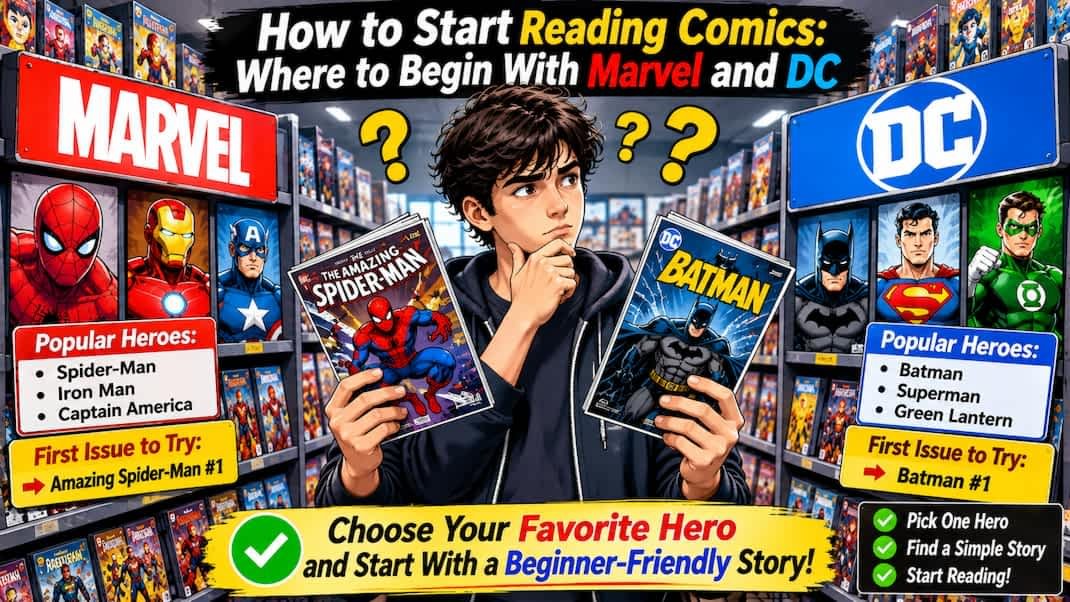
To start reading comics, pick one character or genre you already like, choose a self-contained story with a clear starting point, and read it through a legal source such as print, a publisher app, or a library. Skip decades of continuity and begin with a single book.
This Shinigami AE guide to starting comics is written for new readers, teens and adults alike, who want a clear first step into Marvel, D,C or independent books. It covers where to begin, reading order, legal online options,ns and a picker you can reuse.
A comic is a story told in sequenced illustrated panels, usually with dialogue in speech balloons and short captions. The English Wikipedia article on comic books covers the format in more depth.
Comics come from many places, including American publishers such as Marvel Comics and DC Comics, Japanese manga, and independent creators. No single book is the right first step for everyone, which is why this guide starts with choice before it names any titles.
Key Takeaways
- A good first comic is a self-contained story about a character you already know, not issue one of a decades-long run.
- Marvel and DC both offer entry points that need no background, and each publisher runs an official digital service.
- Collected editions give a complete story in one volume, which suits most beginners better than single issues.
- Reading order means panel order on the page and publication order within a story, and both are quick to learn.
- Legal reading options include print, publisher apps, and library lending, and availability varies by title and region.
How We Checked the Titles and Advice in This Guide
Shinigami AE keeps a title or fact in this guide only when it can be traced to a publisher, an encyclopedia, media, or a comics database.
Creators, publication years, a nd publisher names follow publisher catalog pages and the Grand Comics Database, a volunteer-run index of comics. Format terms follow the English Wikipedia article on comic books.
The source types used, in order of preference:
- Publisher pages: Marvel Comics and DC Comics catalog listings for titles, creators,s and formats.
- Encyclopedia: English Wikipedia for format terms and publisher history.
- Database: the Grand Comics Database for issue-level credits.
We removed sales rankings, “best of all time” claims with no named poll, and any availability claim we could not tie to an official service page.
The starter filter, the reading-order cheat sheet, the three-line forum post, and the beginner picker are Original by Shinigami AE. They are planning tools, not facts taken from a source.
The picks are editorial choices. They are unranked, and no source names an official best starter comic.
This guide makes no claim of hands-on reading. Sufyan Shakeel compiled and cross-checked the picks from the sources above.
About the author: Muhammad Sufyan is a skilled content writer with 5 years of experience in crafting engaging, well-researched articles. His deep understanding of storytelling and audience engagement ensures every piece is informative, polished, and truly worth reading.
How Do You Start Reading Comics?
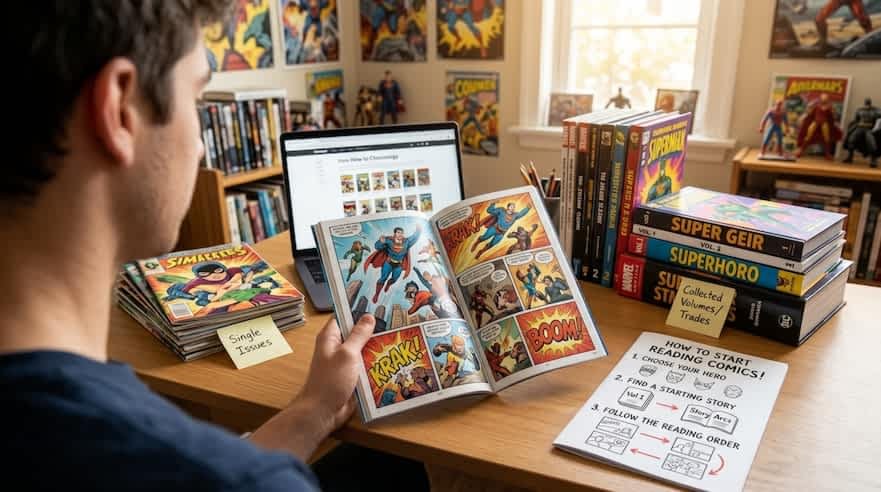
You start reading comics by choosing one character or genre you like, picking a complete story or collected volume, and reading it in order from the first page. Use an official source such as a bookshop, publisher app, or library. Finish that one book before choosing the next.
Beginners often think they must learn decades of history first. They do not, because publishers and creators write many books as entry points that assume no background.
The three-question starter filter below is Original by Shinigami AE. It turns a vague wish into a first pick.
- What do you already enjoy? Pick a character, genre, or tone, such as superheroes, horror, or adventure.
- How much time do you have? Choose a single volume for a weekend or an ongoing run for a longer habit.
- Where can you read it legally? Check print, a publisher app,p and your library before you buy.
Answer all three before you open a store page, because the answers narrow a huge catalog to a handful.
How to Start Reading Comics for Beginners: A First-Week Plan
A first-week plan keeps the start small and ends with a decision.
- Day one: apply the starter filter and pick one book.
- Days two to five: read one chapter or one issue at a time.
- Day six: note what you liked, such as art style, pacing,ng or tone.
- Day seven: use those notes to choose the next book.
The aim is one finished book, not a stack of half-read ones. A finished story teaches you more about your taste than a pile of first issues.
Comic Book Terms Beginners Meet First
Comic book terms describe formats and story structure, and seven of them cover most of what a beginner meets in a shop or on a store page. Definitions follow common usage in the English Wikipedia article on comic books and in publisher catalogs.
| Term | Plain meaning | Why it matters |
|---|---|---|
| Issue | One numbered installment of a comic, often released monthly | Single issues are small and often part of a longer story |
| Trade paperback | A book collecting several issues of one story | The easiest way to read a complete story |
| Graphic novel | A longer comic published as a book, often self-contained | Usually needs no earlier reading |
| Omnibus | A large volume collecting many issues or a long run | Costly and best for committed readers |
| Run | The stretch of issues one creative team makes on a title | Runs give natural starting and stopping points |
| Continuity | The shared history that connects a publisher’s stories | Beginners can ignore most of it at first |
| Reboot | A relaunch that restarts a title or a whole universe | Reboots mark clean places to join |
Single issues, trade paperbacks,cks and graphic novels are the three formats you will see most often. For a first read, a trade paperback or graphic novel gives a finished story with a beginning, middle,ddle and end.
How to Start Reading Marvel Comics
Start reading Marvel comics with a self-contained story or a fresh-start retelling of a character you know, not with issue one of a long-running series. Marvel’s catalog is large, so one complete book gives you a finished experience before you commit to more.
Marvel Comics is an American comic publisher whose best-known characters include Spider-Man, Iron Man and Captain America. Credits and years in this section follow Marvel’s catalog listings and the Grand Comics Database, a volunteer-run comics index.
Spider-Man, the identity of Peter Parker, debuted in 1962. He was created by Stan Lee, comic writer and editor, and Steve Ditko, comic artist.
Captain America, the identity of Steve Rogers, debuted in 1941. He was created by Joe Simon, comic writer and artist, and Jack Kirby, comic artist.
Four Marvel picks stand on their own and work as the best comics to start with Marvel:
| Title | Creators | Year | Best for |
|---|---|---|---|
| Marvels | Kurt Busiek, comic writer; Alex Ross, comic artist | 1994 | A tour of Marvel’s world through everyday eyes |
| Ultimate Spider-Man | Brian Michael Bendis, comic writer; Mark Bagley, comic artist | 2000 | A fresh-start Spider-Man needing no background |
| Captain America: The Winter Soldier run | Ed Brubaker, comic writer; Steve Epting, comic artist | 2005 | Spy-thriller readers |
| Iron Man: Extremis | Warren Ellis, comic writer; Adi Granov, comic artist | 2005–2006 | Technology and science fiction readers |
Marvel’s follows an ordinary photographer who watches a superhero world from the street. That makes it a friendly entry for readers who know the characters only from screens.
Ultimate Spider-Man began in 2000 as part of Marvel’s Ultimate line. That line retold characters in a separate continuity, so new readers needed no earlier issues.
The Winter Soldier story opens Ed Brubaker’s run on Captain America, and Extremis is a six-issue Iron Man story. Each can be read as a starting point.
Marvel also offers its comics through Marvel Unlimited, an official subscription service. Check the catalog for each title before you buy a print copy.
Choose by taste: Marvels for a tour, Ultimate Spider-Man for a modern retelling, Winter Soldier for espionage, and Extremis for technology themes.
Where to Start Reading DC Comics
Start reading DC comics with a self-contained Batman or Superman story, because DC’s shared history has been reshaped several times and the stories below need no background.
DC Comics is an American comic publisher whose best-known characters include Batman, the identity of Bruce Wayne, and Superman, the identity of Clark Kent. Credits and years here follow DC’s catalog listings and the Grand Comics Database.
DC’s continuity was reshaped after Crisis on Infinite Earths in 1985 to 1986, by the New 52 in 201,1 and by DC Rebirth in 2016, according to the English Wikipedia article on DC Comics.
Each reshaping created a joining point for new readers. A standalone story avoids the question of which continuity you are in.
| Title | Creators | Year | Best for |
|---|---|---|---|
| Batman: Year One | Frank Miller, comic writer; David Mazzucchelli, comic artist | 1987 | A grounded story of Batman’s early days |
| Batman: The Long Halloween | Jeph Loeb, comic writer; Tim Sale, comic artist | 1996–1997 | Mystery and crime-story readers |
| All-Star Superman | Grant Morrison, comic writer; Frank Quitely, comic artist | 2005–2008 | Superman as a hopeful, standalone tale |
Batman: Year One retells the character’s first year in Gotham City. It ran in Batman issues 404 to 407 in 1987, according to the Grand Comics Database.
The Long Halloween is a year-long mystery in the same crime-story tradition. All-Star Superman is a twelve-issue story that treats Superman as a hopeful figure, and both are self-contained.
DC’s official digital service is DC Universe Infinite, a subscription app. Check its catalog for each title before you buy.
After a first story, try another creator’s version of the same character to see how interpretation changes.
Top 10 Comics for Beginners
The top 10 comics for beginners below form an unranked editorial list of complete, accessible stories from Marvel, DC, and independent publishers. Order follows publisher, not quality, and no source names an official best.
- Marvels (Marvel): a tour of Marvel’s world.
- Ultimate Spider-Man (Marvel): a fresh-start Spider-Man.
- Captain America: The Winter Soldier run (Marvel): spy-thriller storytelling.
- Iron Man: Extremis (Marvel): technology-driven science fiction.
- Batman: Year One (DC): a grounded origin story.
- Batman: The Long Halloween (DC): a year-long mystery.
- All-Star Superman (DC): a hopeful, standalone Superman tale.
- Bone by Jeff Smith, comic writer and artist (Cartoon Books, 1991–2004): all-ages fantasy adventure.
- Hellboy: Seed of Destruction by Mike Mignola, comic writer and artist, and John Byrne, comic writer and artist (Dark Horse Comics, 1994): supernatural adventure.
- Maus by Art Spiegelman, American cartoonist (1986 and 1991 volumes): a nonfiction comic.
Credits and years follow publisher listings and the Grand Comics Database. Dark Horse Comics is an American comic publisher.
Bone follows three cousins from Boneville in a fantasy valley, and it suits readers who want an all-ages adventure with humor.
Hellboy: Seed of Destruction introduces a supernatural investigator and the world he works in. It fits readers who like horror-tinged adventure.
Maus is a nonfiction comic about Art Spiegelman’s father’s survival of the Holocaust, and it shows the medium’s range. It deals with a heavy subject, so it suits readers ready for serious material.
Each pick is a complete story or a clearly bounded run, so a reader can finish one without buying a long back catalog.
How to Read Comics in Order
Reading comics in order means following the panels on each page from left to right and top to bottom, then following issue or volume numbers within a story.
Manga, the Japanese comic tradition, is usually read right to left, according to the English Wikipedia article on manga. Check a book’s reading direction before you start.
Within a story, use the issue numbers or the volume number printed on the cover or spine.
The reading-order cheat sheet below is Original by Shinigami AE:
- Single story: read issues by number, or read the collected volume front to back.
- A run: read volumes in the order the publisher lists them.
- A crossover event: use the publisher’s reading list, or sort issues by cover date in the Grand Comics Database.
- A reboot: treat it as a new start and ignore earlier issue numbers.
Cover date is the date printed on an issue, and it can differ from the release date. Two sources may therefore list the same issue in slightly different places.
When two guides disagree on order, trust the publisher’s own reading list first and the database second.
Publication order is the order stories were released. Chronological order is the order events happen inside the story timeline.
In our editorial judgment, beginners should use publication order, because that is how the writers built each story.
How to Read Comics Online Legally
Read comics online through official channels: publisher subscription apps, retailer digital stores, and public library lending apps. Each channel suits a different reader.
Marvel Unlimited and DC Universe Infinite are the official digital services of their publishers. Their catalogs, prices,s and regional availability change, so check each service’s own pages.
Many public libraries also lend digital comics, so ask your library which apps it supports.
| Channel | Best for | Watch out for |
|---|---|---|
| Publisher subscription app | Browsing many titles for one fee | Catalogs change over time |
| Retailer digital store | Owning single issues or volumes | Costs add up per title |
| Library lending app | Free reading with a library card | Waiting lists and a limited catalog |
| Print from a bookshop or library | Collected editions and graphic novels | Shipping time and shelf space |
Many reading apps offer a full-page view and a panel-by-panel view. Try both, because a full page shows the art as the artist composed it.
A tablet’s larger screen shows full pages more clearly than a phone.
In our editorial judgment, unofficial sites can miss pages and get numbering wrong. Official sources also pay the creators.
How to Start Reading Comics: What Reddit and Forums Can Tell You
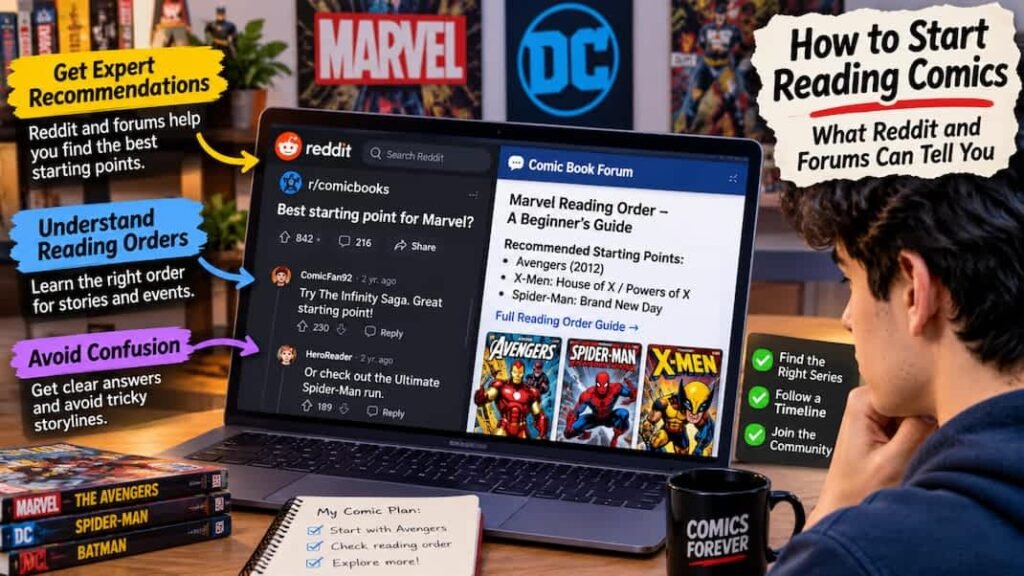
Reddit and similar forums are useful for beginner recommendations, but their answers are opinions, so treat them as leads to check, not as facts.
Comics communities on Reddit are places where readers ask for starter recommendations. Check any suggested title’s creators, year,ar and format against a publisher page or the Grand Comics Database before you buy.
A clear question gets better answers. This three-line post is Original by Shinigami AE:
- I like: one character, genre, or film.
- I have: a time budget and a format preference, such as one volume.
- I want: one self-contained pick and one next step.
Post the three lines together, then compare the replies against the starter filter above.
Disagreement is normal. When replies differ, note the titles that appear more than once and check those first.
Mistakes Beginners Make When Starting Comics
Beginners usually stumble on the same eight things, and each one is easy to avoid.
- Starting at issue one of a decades-old series. A long run assumes history you do not have, so pick a volume that stands alone.
- Buying one issue of a multi-part story. You may get the middle of a tale, so check that the product page names the whole story.
- Following a crossover without a reading list. Events jump between titles, so use a publisher list.
- Ignoring format. Omnibus editions are large and costly, so start with a trade paperback.
- Trusting one ranked “best” list. No source names an official best, so compare several.
- Using unofficial sites. Missing pages and wrong order are possible risks.
- Forcing a genre you do not enjoy. A mismatch is the fastest way to quit.
- Starting with a mature title by accident. Check the publisher’s content note first.
Worked Examples: Item > Source > Best use > Sample usage
Each example below uses the same four-part format so a reader can copy the approach.
Example 1: A standalone DC story
- Item: Batman: Year One.
- Source: DC catalog listing and Grand Comics Database issue entries.
- Best use: a first DC read.
- Sample usage: “Read Year One in a weekend, then decide whether to try The Long Halloween.”
Example 2: A Marvel collected edition
- Item: a Marvel trade paperback.
- Source: the publisher’s product page, which lists the issues collected.
- Best use: buying a complete story in one volume.
- Sample usage: “Confirm the page says issues one to six before ordering a six-part story.”
Example 3: Reading a crossover
- Item: a multi-title event.
- Source: the publisher’s reading list or the Grand Comics Database.
- Best use: reading an event without missing parts.
- Sample usage: “Sort the listed issues by cover date and read them in that order.”
Example 4: A library check
- Item: a library lending app.
- Source: the library’s own catalog page.
- Best use: reading free before you buy.
- Sample usage: “Search the catalog for Bone and place a hold if it is out.”
Use the same pattern for any pick you find. Name the item, name the source, decide the best use, then write down how you will use it.
Template: Beginner Comic Picker (Original by Shinigami AE)
The beginner comic picker scores a title in four checks, so a reader can compare options without guessing.
Formula: Picker score = Standalone + Familiar + Access + Length fit. Score each check from 1 to 5, for a maximum of 20.
| Check | Question | Score 1 | Score 5 |
|---|---|---|---|
| Standalone | Does it need earlier issues? | Needs a lot | Needs none |
| Familiar | Is it a character or genre you know? | Unknown | A favorite |
| Access | Can you read it legally this week? | Hard to find | Easy to get |
| Length fit | Does it match your time? | Too long | Fits well |
Example with hypothetical scores, shown only to demonstrate the math: Book A scores 5, 4, 5, and 4, for 18. Book B scores 2, 5, 3, and 2, for 12.
Book A wins. If two books tie, the higher Standalone score wins.
As an editorial rule of thumb, 15 or more is a strong first pick, and below 10 means look again.
Reuse the picker each time you finish a book. Score three candidates and read the highest.
Frequently Asked Questions
What is the best way to start reading comics?
The best way to start reading comics is to pick one character or genre you like and read a complete, self-contained story from it. Choose a collected volume or graphic novel, and read it through an official source. Then use what you enjoyed to pick the next book.
Do I need to read comics in order?
You need to read in order within a single story, but not across a publisher’s whole history. Self-contained stories and reboot points assume no background. Follow issue or volume numbers inside a story, and ignore wider continuity until you want more.
Is Marvel or DC easier to start with?
Neither publisher is easier overall, because the easier start is the one with a character you already know. Marvel offers fresh-start retellings such as Ultimate Spider-Man. DC offers standalone stories such as Batman: Year One and All-Star Superman. Pick by character, then by format.
How do I read comics online legally?
Use official channels: publisher subscription services, retailer digital stores, or library lending apps. Check each service’s catalog for the title and your region first. Avoid unofficial sites, which can have missing or misordered pages.
What are good beginner comics for readers who do not like superheroes?
Bone, Hellboy: Seed of Destruction, and Maus are three non-superhero starting points covering fantasy, supernatural adventure, and nonfiction. Pick by tone: Bone is all-ages and humorous, Hellboy is darker, and Maus is serious and historical.
Is Reddit a good place to ask how to start reading comics?
Reddit is a good source of leads, not facts. Ask with a clear three-line post covering what you like, your time and format, and what you want next. Then check each suggested title’s creators, year, and format against a publisher page or database.