Introduction
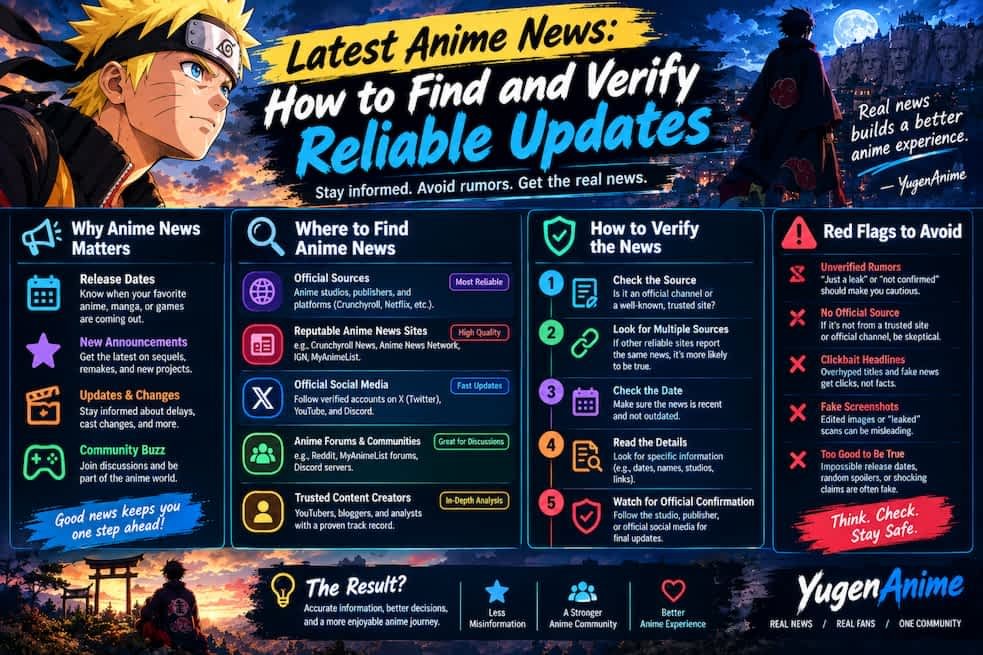
YugenAnime covers anime culture for fans who want to follow the industry without chasing down every rumor account. Latest anime news generally falls into a few categories: adaptation announcements, season and dub release dates, streaming licensing, and industry events.
Anime fans searching for this topic usually want one of two things: a live feed of what just happened, or help figuring out which anime news websites are actually reliable. This article focuses on the second need.
A genuinely live, timestamped news feed is the right format for breaking headlines. This guide instead explains how that news is categorized, which outlets to trust, and how to verify a claim before sharing it — the part most roundup articles skip.
How YugenAnime Chooses and Checks Anime News Sources
YugenAnime evaluated anime news outlets using three checks. The outlet needed a track record of citing primary sources, such as official studio or publisher statements, rather than other news sites.
It needed visible editorial accountability — named writers or an identifiable editorial team, not anonymous aggregation. And it needed a correction practice, meaning errors get updated rather than quietly left online.
Claims about specific organizations in this article (what they cover, how they’re structured) were checked against each organization’s own public description of itself, where available.
This article reports no specific “breaking” headlines, since reporting time-sensitive events accurately requires live verification that a static guide can’t provide. Anything resembling a current event has been deliberately left out rather than guessed at.
One section below, “Original by YugenAnime,” is editorial framework written for this article, not an industry fact or a third-party claim.
Categories of Anime News That Matter Most
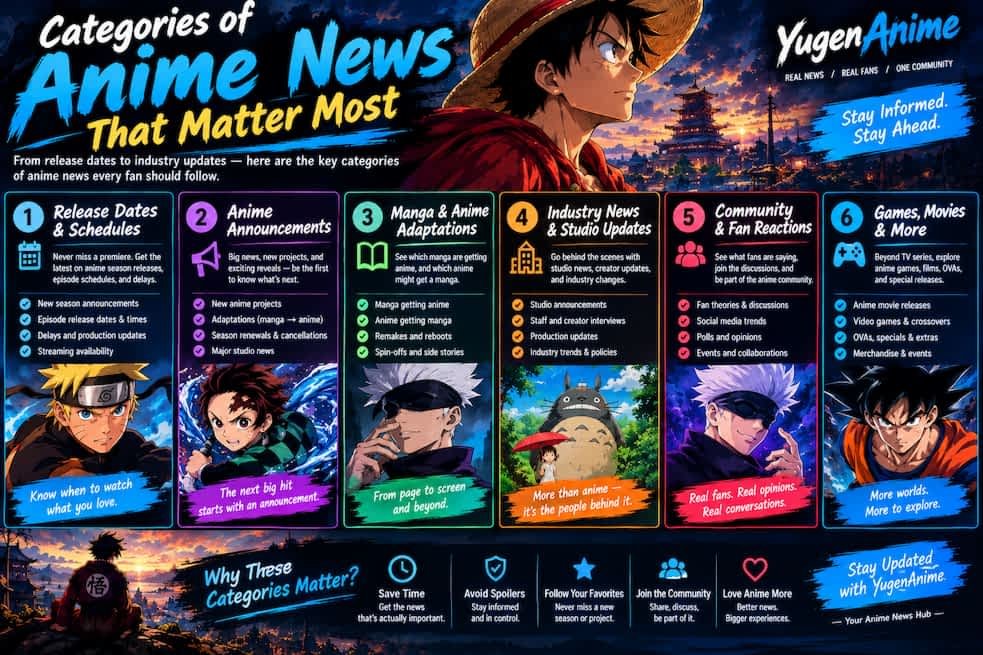
Top anime news generally sorts into four categories, and knowing which one you’re looking at helps you judge how reliable a claim is likely to be.
Production and adaptation news covers announcements that a manga or light novel is becoming an anime, studio assignments, and director credits. These usually originate from the publisher or studio directly.
Release and scheduling news covers season premiere dates, episode delays, and dub release windows. Streaming platforms and official social accounts are the most direct source here.
Licensing and streaming news covers which platform picked up a title in which region. This type of news is especially prone to confusion, since regional licensing can differ from country to country.
Industry and business news covers studio mergers, convention announcements, and publisher earnings reports. This category is the one most often supported by named organizations rather than anonymous leaks.
Latest anime updates in any of these four categories are only as reliable as the source reporting them. A claim with no named origin, in any category, should be treated as unconfirmed until an official account repeats it.
Trusted Anime News Websites
Anime news websites vary widely in how closely they verify a story before publishing it. The table below groups outlet types by what they’re generally best used for, not by ranking one above another.
| Item | Source type | Typical focus | Best for |
|---|---|---|---|
| Industry news databases | Independent anime news and database outlets | Adaptation announcements, staff/cast credits | Checking production facts |
| Platform newsrooms | Official streaming service press pages | Licensing, release dates for their own catalog | Confirming where/when a title streams |
| Publisher statements | Official manga/light novel publisher accounts | Serialization status, adaptation greenlights | Primary confirmation of a new project |
| Industry body reports | National animation industry associations | Market size, production trends | Business-level, not title-level news |
| Convention and event pages | Official convention organizer sites | Panel announcements, guest reveals | Confirming event-specific news |
Anime News Network, an independent English-language outlet focused on anime and manga industry coverage, is a commonly cited example of the first row — useful for checking who’s animating a title and which cast members are attached.
Crunchyroll, an anime streaming platform, publishes an official newsroom for announcements about its own catalog — useful specifically for licensing and release-date questions tied to that platform.
For a title-specific claim, the publisher or studio’s own statement outranks any secondhand report, no matter how popular that report is.
Japanese Anime News Sources and Why They Matter
Japanese anime news often breaks earlier than English-language coverage, since production and publishing decisions are made and announced in Japan first. English outlets frequently translate or summarize a Japanese-language announcement after the fact.
This matters most for serialization news. Weekly Shōnen Jump, a manga anthology published by Shueisha, a Japanese publishing company, regularly announces new chapters, spin-offs, or adaptations before international outlets pick them up.
Domestic Japanese entertainment and industry sites also track business-side news, such as production committee changes or studio staffing, that English coverage sometimes omits entirely.
The practical takeaway: a claim that’s “trending” in English before any Japanese source has mentioned it should be treated with more caution, since it skipped the stage where the original announcement would typically appear.
This doesn’t mean every Japanese-language claim is automatically correct. The same verification standard — named source, official statement, no unexplained leaps — still applies regardless of language.
Anime News vs. Anime Facts
Anime news and anime facts are not the same category, even though searches often blend them. News describes a current event; facts describe established background that doesn’t change week to week.
An example of a verifiable background fact: Studio Ghibli, a Japanese animation studio, was co-founded in 1985 by Hayao Miyazaki and Isao Takahata, both Japanese animators and filmmakers.
That kind of fact supports context around current news (a new Ghibli-adjacent project, for instance) but is not itself breaking news, and shouldn’t be reported as if it just happened.
Confusing the two is a common source of misleading anime content online — a genuine historical fact gets reshared with a “breaking” framing it never had, which misleads readers about how current the information actually is.
Finding Anime News and Events Near You
Searches for anime news “near” a specific area usually mean local conventions, regional screenings, or a particular country’s streaming and licensing situation, rather than global headlines.
For convention and event news, the organizer’s own official site is the most reliable source for guest lists, schedules, and ticketing — third-party roundups can lag behind or misreport changes.
For regional licensing questions (which platform carries a title in your country), the streaming platform’s own regional catalog page is more reliable than a general global news article, since licensing can differ by territory.
If a local fan event or screening isn’t listed on an official convention or venue page, treat secondhand claims about it as unconfirmed until the organizer posts it directly.
A Note on “Latest Anime News 2026” and Future-Dated Searches
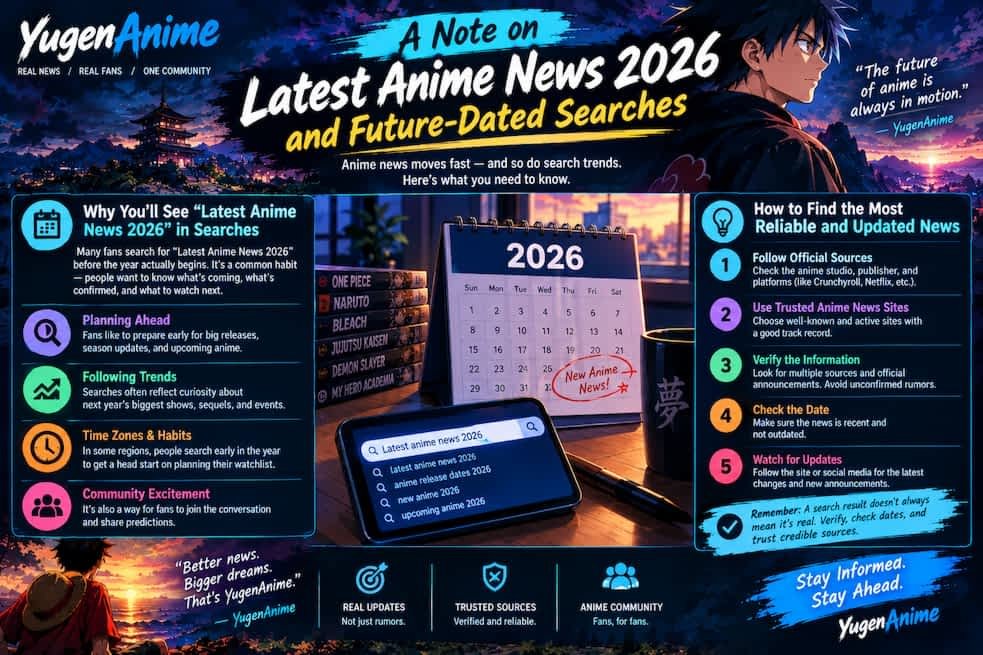
Searches that include a specific future year, such as 2026, are usually looking for whatever is currently happening then. A static guide like this one cannot responsibly claim to know those specific headlines in advance.
What this guide can do is explain the method that stays accurate regardless of the year: check the category of news, trace it to a named source, and confirm it against an official statement before treating it as settled.
Readers specifically looking for current 2026 headlines should check a live-updated outlet directly rather than relying on any static article, including this one, for time-stamped claims.
A Verification Template: The 4-Check Method
Use this four-step check before sharing any anime news claim, regardless of where you saw it first:
- Source — who originally reported this, and is it a named outlet or an anonymous account?
- Category — is this production news, release news, licensing news, or business news? (See the categories above.)
- Confirmation — has the studio, publisher, or platform involved said anything official yet?
- Timing — is this claim recent, or is older news being reshared as if it’s new?
Original by YugenAnime: Red Flags in Anime News
This checklist is an original editorial framework written for this article, not a third-party claim or a reported fact. Use it to spot likely misinformation before sharing a story:
- No named outlet or writer attached to the claim.
- The claim only cites “sources say” with no organization named.
- A screenshot with no link back to an original post.
- A date-less claim being shared as if it just happened.
- A claim that contradicts the official studio or publisher’s own recent statement.
Mistakes to Avoid When Following Anime News
- Treating fan theories as confirmed news. A popular theory thread is not the same as an official announcement, no matter how widely it’s shared.
- Assuming English coverage is first. Japanese-language sources often carry an announcement before it’s translated or summarized elsewhere.
- Confusing regional licensing. A title streaming in one country doesn’t mean it’s confirmed for every region.
- Reporting old news as current. Resurfaced old announcements are a common source of confusion during slow news weeks.
- Skipping the primary source. If a studio or publisher has made an official statement, that statement outranks any secondhand summary of it.
- Citing anonymous leak accounts as fact. An unconfirmed leak should be labeled as a leak, not reported as settled news.
Key Takeaways
- Latest anime news sorts into four categories: production, release/scheduling, licensing, and industry/business news.
- Anime news websites vary in reliability; prioritize outlets that cite official studio or publisher statements.
- Japanese-language sources often carry announcements earlier than English coverage.
- Anime “facts” are stable background information, not current events — don’t confuse the two.
- Use the Source → Category → Confirmation → Timing check before sharing any anime news claim.
FAQs
Is it true that anime news sites always get announcements first?
No. This is a common misconception — Japanese-language publisher and studio statements often come first, and English-language outlets typically translate or summarize them afterward.
Which anime news source should I check for a title’s streaming availability?
Check the streaming platform’s own regional newsroom or catalog page directly, since licensing availability can differ by country and third-party roundups can lag behind.
What’s the difference between anime news and general anime facts?
Anime news describes something that just happened, such as a new season announcement, while anime facts are stable background information, like a studio’s founding year, that doesn’t change with the news cycle.
How can I tell if a piece of “latest anime news” is actually confirmed?
Check whether the studio, publisher, or platform involved has made an official statement; if the claim only cites anonymous “sources,” treat it as unconfirmed.
Where can I find a list of reliable anime news websites?
The table in this article groups outlet types by focus — industry databases, platform newsrooms, publisher statements, industry bodies, and convention pages — rather than ranking individual sites.
Why can’t this article show specific 2026 anime headlines?
A static guide can’t responsibly report future or current breaking headlines without live verification; readers searching for 2026-specific news should check a live-updated outlet directly.
How do I find anime news or events happening near me?
Check the official site of the specific convention, venue, or streaming platform’s regional page directly, since local event details change often and secondhand roundups can be out of date.