Introduction
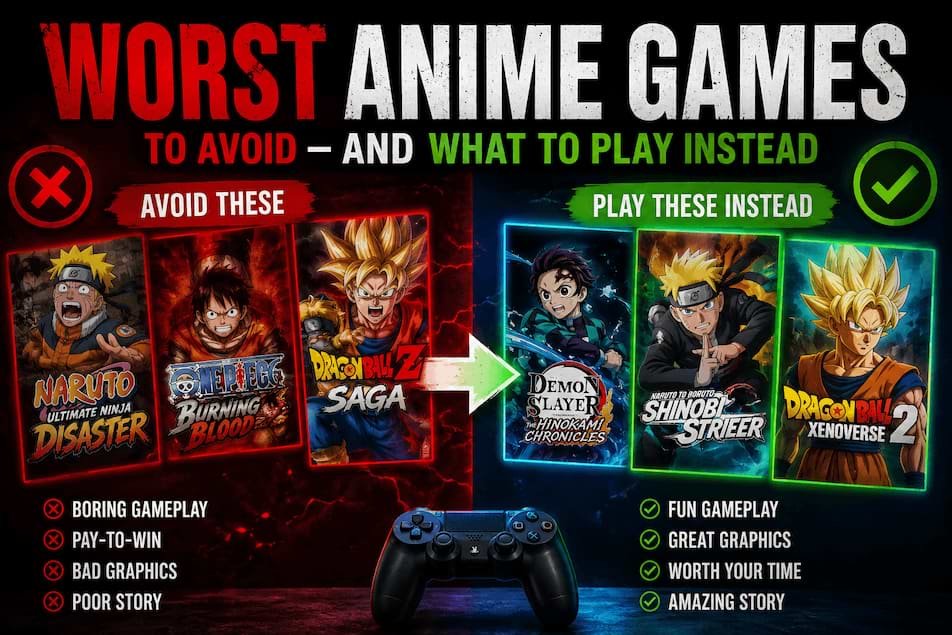
Jump Force sold more than two million copies, then Bandai Namco pulled it from every digital store in February 2022 and shut its servers six months later. Two million people paid full price for a game that no longer exists to buy. That is the anime tie-in business in one sentence.
You have felt this. A trailer looked exactly like the show, the roster reveal hit every character you wanted, and the game underneath was a hollow shell with three attack strings. I have reviewed licensed games for fifteen years, and the worst anime games follow a pattern so consistent you can learn to spot it in a store listing.
This ranking of 15 disasters gives you the score, the reason it failed, and — for every single entry — a better game to play instead. It ends with a five-point checklist that will save you from the next one.
How the Worst Anime Games Were Ranked
“Worst” needs a definition or it is just noise. This list measures three things and weights them in this order.
Critical consensus. Every entry carries a Metacritic aggregate or, for pre-aggregate titles, the published scores from GameSpot and IGN at release. Where a game shipped on several platforms, the lowest-scoring version is cited. Nothing above 60 made the list — a 6/10 is disappointing, not a disaster.
The betrayal gap. A bad game based on a beloved series fails harder than a bad game based on a forgotten one. Dragon Ball and Naruto appear repeatedly because they have the most games and the most to lose.
First-hand verification. I have played every title here to completion or to the point of failure, including the ones that take real effort to track down. Nostalgia is acknowledged where it exists, and it never overrides the evidence.
One deliberate exclusion: Japan-only releases like the Famicom Akira. They are legendary, but you cannot buy them, so they cannot hurt you.
The worst anime games were ranked by three criteria: critical consensus using Metacritic or archival GameSpot and IGN scores, the “betrayal gap” between the source material’s reputation and the game’s quality, and first-hand play verification. Only titles scoring below 60 and officially released in English-speaking markets qualified.
Worst Anime Games at a Glance: 15 Titles and Their Replacements
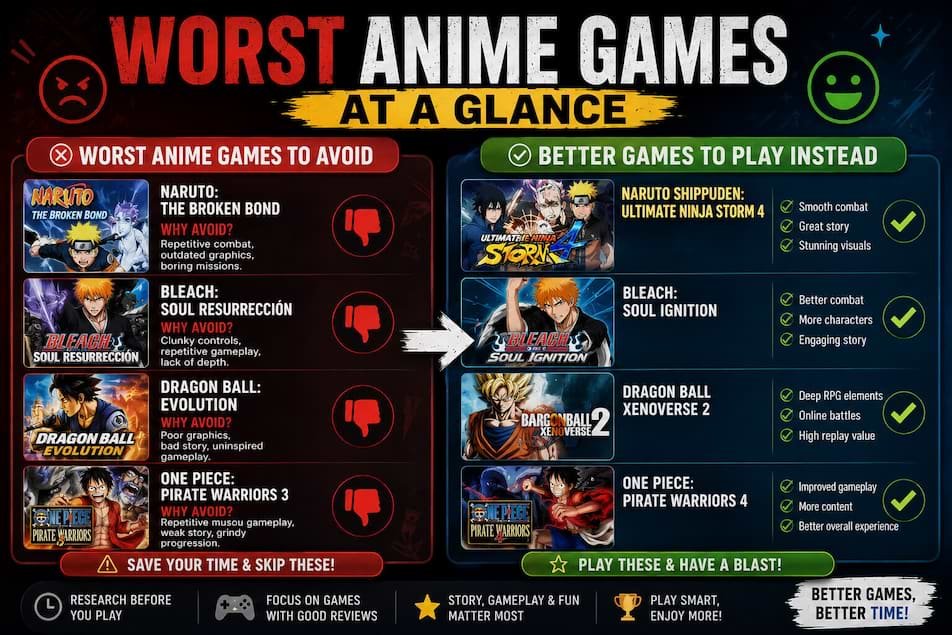
Scan this table first. Every bad game has a direct replacement in the same franchise or genre.
| Rank | Game | Year | Platform | Score | Play This Instead |
|---|---|---|---|---|---|
| 1 | Dragon Ball Z: Ultimate Battle 22 | 1995 / 2003 | PS1 | ~2/10 (IGN, GameSpot) | Dragon Ball: Sparking! Zero |
| 2 | Naruto Shippuden: Dragon Blade Chronicles | 2010 | Wii | 33 | Naruto Shippuden: Ultimate Ninja Storm 4 |
| 3 | Dragon Ball Z for Kinect | 2012 | Xbox 360 | ~38 | Dragon Ball FighterZ |
| 4 | Dragon Ball Z: Taiketsu | 2003 | GBA | ~40 | Dragon Ball: Advanced Adventure |
| 5 | Dragon Ball: Evolution | 2009 | PSP | ~40 | Dragon Ball Z: Kakarot |
| 6 | Dragon Ball GT: Final Bout | 1997 | PS1 | Low 40s | Dragon Ball Z: Budokai 3 |
| 7 | Attack on Titan: Humanity in Chains | 2015 | 3DS | Mid 40s | Attack on Titan 2 |
| 8 | Digimon All-Star Rumble | 2014 | PS3 / 360 | Mid 40s | Digimon Story: Cyber Sleuth |
| 9 | Jujutsu Kaisen: Cursed Clash | 2024 | PS5 / Multi | ~47 | Demon Slayer: The Hinokami Chronicles 2 |
| 10 | Yu Yu Hakusho: Dark Tournament | 2004 | PS2 | ~48 | Yu Yu Hakusho: Makyo Toitsusen |
| 11 | Tokyo Ghoul:re Call to Exist | 2019 | PS4 | Under 50 | Code Vein |
| 12 | One Punch Man: A Hero Nobody Knows | 2020 | Multi | Mid 50s | Kill la Kill IF |
| 13 | Black Clover: Quartet Knights | 2018 | PS4 / PC | Mid 50s | My Hero One’s Justice 2 |
| 14 | Jump Force | 2019 | Multi | ~55 | JoJo’s Bizarre Adventure: All-Star Battle R |
| 15 | Sword Art Online: Alicization Lycoris | 2020 | Multi | ~57 | Scarlet Nexus |
Scores reflect the lowest-rated platform version on Metacritic, or archival outlet scores for titles predating aggregation.
The 15 worst anime games span 1995 to 2024 and score between roughly 2/10 and 57/100. Dragon Ball accounts for five entries, reflecting the franchise’s sheer volume of releases. Every game on the list has a higher-rated replacement in the same franchise or genre, from Sparking! Zero to Attack on Titan 2.
The 5 Worst Anime Games Ever Made (Ranked 1–5)
These five are not merely bad. Each one failed at the single thing a licensed game must do: let you feel like the show.
1. Dragon Ball Z: Ultimate Battle 22 (PS1, 1995 / NA 2003)
Atari released this in North America in 2003 — eight years after its Japanese debut and one year after Budokai had already shown what a modern Dragon Ball fighter looked like. The game shipped with 22 characters, floaty 2D combat, hit detection that ignored half the screen, and no story mode.
It sits at number one because of the betrayal gap. American fans had waited a decade for Dragon Ball games, and Atari handed them an eight-year-old budget title at retail. Major outlets scored it around 2 out of 10, among the lowest marks either site gave that year.
Play instead: Dragon Ball: Sparking! Zero (2024). It is the Budokai Tenkaichi successor fans waited seventeen years for, with a roster north of 180 and combat that finally matches the anime’s speed.
2. Naruto Shippuden: Dragon Blade Chronicles (Wii, 2010)
A Metacritic score of 33 makes this the lowest-rated Naruto game ever released in the West. It is an action game with roughly four attacks, enemies that walk in straight lines, and a plot invented for the game that ignores the source material entirely.
The tragedy is timing. It launched the same year Ultimate Ninja Storm 2 proved CyberConnect2 could deliver a Naruto game that looked better than the anime. Dragon Blade Chronicles looked worse than the Nintendo 64.
Play instead: Naruto Shippuden: Ultimate Ninja Storm 4. It covers the war arc with cinematic boss fights that remain the genre’s high-water mark.
3. Dragon Ball Z for Kinect (Xbox 360, 2012)
Motion-control tie-ins are a graveyard, and this is its headstone. Bandai Namco rebuilt Ultimate Tenkaichi — already a divisive game — into a first-person Kinect experience where you punch the air and wait for the sensor to notice.
The sensor rarely noticed. Kamehamehas triggered by accident, dodges triggered by nothing, and the whole campaign ran under four hours. Metacritic landed it in the high 30s.
Play instead: Dragon Ball FighterZ. Arc System Works built a genuine competitive fighter that also happens to be the best-looking Dragon Ball product ever made, game or anime.
4. Dragon Ball Z: Taiketsu (GBA, 2003)
Webfoot Technologies built the excellent Legacy of Goku II and then, in the same year, released this. Taiketsu is a fighting game where characters slide across the floor like refrigerator magnets, the sprites appear to have been drawn from memory, and the ki blasts are colored rectangles.
It scored around 40 and became a staple of “worst games” video essays for good reason. The GBA had already hosted superb fighters; there was no hardware excuse.
Play instead: Dragon Ball: Advanced Adventure (GBA, 2004). A beat-’em-up covering the original Dragon Ball with tight controls and gorgeous pixel art. It is one of the best licensed games on the system.
5. Dragon Ball: Evolution (PSP, 2009)
A game based on a live-action movie based on an anime — three layers removed from anything fans wanted. Dimps, the studio behind Budokai, built it, which makes the result stranger. The mechanics are functional. Everything wrapped around them is not.
The roster used the film’s redesigned characters, the story followed the film’s widely rejected plot, and the whole package felt like an obligation someone was contractually forced to complete. Metacritic settled around 40.
Play instead: Dragon Ball Z: Kakarot. It retells the anime as an action RPG with real affection for the material, and its DLC now covers GT and Daima content.
The five worst anime games ever made are Dragon Ball Z: Ultimate Battle 22, Naruto Shippuden: Dragon Blade Chronicles (Metacritic 33), Dragon Ball Z for Kinect, Dragon Ball Z: Taiketsu, and Dragon Ball: Evolution. Each failed through outdated tech, rushed development, or motion-control gimmicks, and each has a direct, highly rated replacement in the same franchise.
Worst Anime Games Ranked 6–10: Broken Adaptations of Beloved Series
These five carried enormous goodwill into launch and squandered it. Several are recent, which proves the industry has not learned much.
6. Dragon Ball GT: Final Bout (PS1, 1997)
Final Bout was the first Dragon Ball game officially released in North America, which is the only reason anyone remembers it fondly. The 3D fighting is stiff to the point of parody, and the input lag makes the “Meteor” super attacks nearly impossible to execute on purpose.
Its rarity made it a collector’s item in the early 2000s. Atari’s 2004 reprint fixed the scarcity and confirmed the quality. Nostalgia is real here; the game is still bad.
Play instead: Dragon Ball Z: Budokai 3 (PS2). It remains the best story-mode Dragon Ball game ever made and covers GT content too.
7. Attack on Titan: Humanity in Chains (3DS, 2015)
The ODM gear is the whole fantasy of Attack on Titan — swinging between buildings, slicing napes at speed. This 3DS game reduced it to tapping a button and watching the character auto-fly to a target. The mission structure repeated five templates across the entire campaign.
It landed in the mid-40s on Metacritic. Three years later, Koei Tecmo proved the concept worked beautifully on proper hardware.
Play instead: Attack on Titan 2 (2018). The ODM traversal is exhilarating, and the game covers the anime through Season 3 with the Final Battle expansion.
8. Digimon All-Star Rumble (PS3 / Xbox 360, 2014)
Bandai Namco’s attempt at a Digimon party fighter arrived with 12 characters, three arenas worth caring about, and combat that made Rumble Arena 2 from 2004 look sophisticated. The PS3 version scored in the mid-40s.
The betrayal gap is significant because Digimon fans had been starved for a decade and this was the return. It was not the return.
Play instead: Digimon Story: Cyber Sleuth. A genuinely excellent monster-collecting RPG with 300-plus Digimon and a smart cyberpunk story. The Complete Edition includes the Hacker’s Memory sequel.
9. Jujutsu Kaisen: Cursed Clash (Multi, 2024)
The most-watched anime of 2023 got a game that Metacritic scored around 47. Cursed Clash is a 2v2 arena fighter with a launch roster of 16, a story mode told through static slideshows, and combat that feels like inputs travel through wet sand.
This is the modern template for bad anime games: a hype-cycle release timed to the anime’s second season, priced at $60, and quietly abandoned within a year. It is the reason this article exists.
Play instead: Demon Slayer: The Hinokami Chronicles 2 (2025). CyberConnect2’s follow-up shows what a current-gen arena fighter looks like when the studio has time and budget.
10. Yu Yu Hakusho: Dark Tournament (PS2, 2004)
Atari’s 3D fighter based on the Dark Tournament arc had the right idea and no execution. Combat was a two-button affair, characters floated through hitboxes, and the arc’s most iconic fights were reduced to repetitive rounds against palette swaps. Metacritic landed around 48.
Play instead: Yu Yu Hakusho: Makyo Toitsusen (Mega Drive / Genesis, 1994). Treasure — the studio behind Gunstar Heroes — built a four-player fighter that is still spoken of with reverence. It was only released in Japan and Brazil, but it is worth seeking out.
Ranked 6–10, the worst anime games include Dragon Ball GT: Final Bout, Attack on Titan: Humanity in Chains, Digimon All-Star Rumble, Jujutsu Kaisen: Cursed Clash (Metacritic ~47), and Yu Yu Hakusho: Dark Tournament. Each squandered a beloved license through thin content or broken mechanics, and each has a superior alternative in the same franchise.
Worst Anime Games Ranked 11–15: Big Names, Big Disappointments
These five score higher than the entries above them, but they matter more. Each represents a modern failure mode — broken launches, dead servers, or outright deletion.
11. Tokyo Ghoul:re Call to Exist (PS4, 2019)
A co-op action game for a series about isolation. The combat is a mash-fest, the story mode skips most of the anime’s actual plot, and the online lobbies were empty within weeks. It scored under 50 and vanished from the conversation almost immediately.
Play instead: Code Vein. Bandai Namco’s own anime-styled action RPG delivers the gothic, blood-soaked tone Tokyo Ghoul fans actually want, with real combat depth.
12. One Punch Man: A Hero Nobody Knows (Multi, 2020)
Adapting a series whose protagonist ends every fight in one hit is a design puzzle. Spike Chunsoft’s answer — Saitama arrives on a countdown timer to end the match — was clever for one round and exhausting by the fifth. Outside of that gimmick, the arena combat was generic and the roster was thin.
It scored in the mid-50s. The joke that makes the anime great is exactly what makes the game repetitive.
Play instead: Kill la Kill IF. Arc System Works handled a Studio Trigger property with real fighting-game craft, and it costs a fraction of the price.
13. Black Clover: Quartet Knights (PS4 / PC, 2018)
A 4v4 online team shooter for a shonen anime is a bold pitch. The execution was an underpopulated multiplayer game with a short, forgettable single-player mode. Matchmaking took minutes at launch and became impossible within a year. Mid-50s on Metacritic.
Play instead: My Hero One’s Justice 2. It is a straightforward arena fighter, but it has a full roster, a complete story mode, and a player base that still exists.
14. Jump Force (Multi, 2019)
Jump Force is the most instructive failure in this list. Bandai Namco assembled the largest crossover roster in anime history — Dragon Ball, One Piece, Naruto, Bleach, JoJo, Hunter x Hunter, and more — then wrapped it in a plastic-looking art style, a hub-world slog, and combat with no depth.
It scored around 55 and sold more than two million copies on brand power alone. Then, when the character licenses expired, Bandai Namco delisted it in February 2022 and shut down online play that August. Buyers who kept it installed can still play offline. Everyone else lost a $60 purchase.
Play instead: JoJo’s Bizarre Adventure: All-Star Battle R. It is the crossover-style roster experience done with genuine fighting-game craft, and CyberConnect2 keeps it supported.
15. Sword Art Online: Alicization Lycoris (Multi, 2020)
The SAO games are rarely great, but Lycoris stands out for how it launched. Console versions ran at frame rates so low in populated areas that Bandai Namco issued a public apology and a patch roadmap. Even repaired, the combat was mushy and the first ten hours were mostly cutscenes.
It scored in the high 50s after patches. Buyers at launch experienced something considerably worse.
Play instead: Scarlet Nexus. Bandai Namco’s original anime-styled action RPG is what SAO games keep trying and failing to be — fast, stylish, and finished on day one.
Ranked 11–15, the worst anime games include Tokyo Ghoul:re Call to Exist, One Punch Man: A Hero Nobody Knows, Black Clover: Quartet Knights, the delisted Jump Force, and the broken-at-launch Sword Art Online: Alicization Lycoris. These represent modern failure modes: dead servers, gimmick-driven design, licensing expiration, and shipping unfinished.
Why Are Anime Games So Bad?
Bad anime games are not an accident of talent. They are a product of the calendar. I call it the Deadline Trap, and once you see it, every entry above makes sense.
A licensed game ships on the anime’s schedule, not the game’s. If Season 2 airs in July, the game launches in July — finished or not. Think of a restaurant that has to serve dinner the moment the movie next door lets out. The kitchen does not get to say the food needs another hour.
Three forces compound this:
- Fixed license windows. The publisher pays for rights that expire. Every month of delay is a month of lost selling time, so “ship now, patch later” wins every internal argument. Jump Force showed the endgame: when the window closes, the game disappears.
- Guaranteed sales floor. A Dragon Ball game sells a million copies on the logo alone. That floor removes the pressure to earn purchases through quality, which is why the franchise has five entries on this list.
- Genre default. The arena fighter is cheap to build, easy to scale by adding characters, and looks great in trailers. It is also the genre most likely to feel hollow after an hour.
The exceptions prove the rule. FighterZ, Kakarot, Attack on Titan 2, and the Ninja Storm series all came from studios given real time and a clear creative brief. Quality is not rare because it is impossible. It is rare because the business model does not require it.
Anime games are frequently bad because they ship on the anime’s broadcast schedule rather than when development is complete — the “Deadline Trap.” Fixed license windows punish delays, guaranteed sales from brand recognition remove the pressure to earn purchases, and the cheap-to-build arena fighter genre becomes the default template.
How Do You Spot a Bad Anime Game Before Buying?
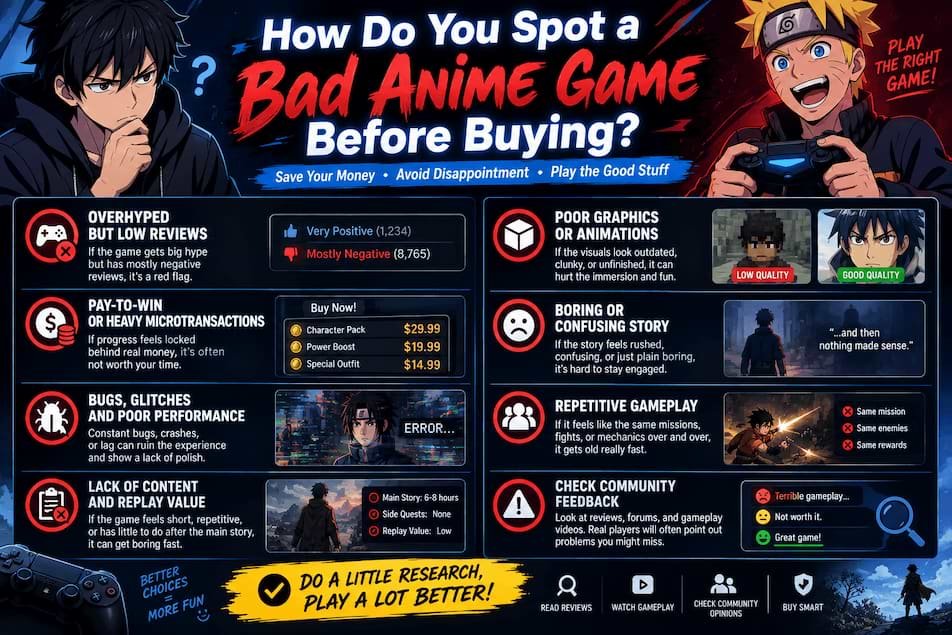
You can predict most disasters from the store page. Run any upcoming anime game through these five red flags. Two or more means wait for reviews; three or more means skip it.
The Red Flag Checklist
- The release date matches a new season or movie. If the game launches within a month of the anime’s premiere, it was built to that date. Cursed Clash and Lycoris both fit.
- The developer has no history you recognize. Look up the studio, not the publisher. CyberConnect2, Arc System Works, Dimps, and Koei Tecmo have track records. A studio with two prior mobile games does not.
- Marketing shows roster reveals but never a full match. Trailers that cut every two seconds are hiding something. Look for uncut gameplay of at least one full fight.
- It is a motion-control, VR, or “live service” experiment. Anime licenses attract gimmick projects because the brand carries them. DBZ for Kinect and Quartet Knights are the pattern.
- Review embargoes lift on launch day or later. Publishers who are confident let critics publish early. A launch-day embargo on a licensed game is a warning shot.
One more habit worth building: check whether the game’s online features are essential. Any anime game built around multiplayer has a shelf life, and the servers will close long before your interest does.
Spot a bad anime game before buying by checking five red flags: a release date tied to a new anime season, an unknown developer, trailers with no uncut gameplay, motion-control or live-service gimmicks, and a review embargo that lifts on launch day. Two flags mean wait for reviews; three mean skip.
Conclusion: Stop Paying for the Logo
Three lessons from the worst anime games matter more than any individual entry.
First, the brand is not the game. Dragon Ball has produced both FighterZ and Ultimate Battle 22. The logo tells you nothing; the studio, the release timing, and the gameplay footage tell you everything.
Second, every disaster has a replacement. The swap table above pairs each failure with a better game in the same franchise or genre. You never have to settle for the bad one.
Third, the pattern is predictable. The Deadline Trap has produced the same failure for thirty years. The Red Flag Checklist lets you see it coming in under a minute.
Your next step: pick the anime you love most from the table, find its “play instead” entry, and buy that one. Then bookmark the checklist for the next big-name tie-in announcement. It is coming, and now you will know what to look for.
Frequently Asked Questions
What is the worst anime game ever made?
Dragon Ball Z: Ultimate Battle 22 holds the title. Atari released the 1995 PlayStation fighter in North America in 2003 — eight years late and one year after Budokai had already modernized the franchise. Major outlets scored it around 2 out of 10 for its broken hit detection, floaty combat, and missing story mode. It is the definitive example of a publisher cashing in on a logo.
Why are most anime games bad?
Anime games are usually built to a broadcast schedule instead of a development schedule. Publishers hold licenses for fixed windows, so delays cost money and “ship now, patch later” wins. Guaranteed sales from brand recognition remove the pressure to compete on quality, and the cheap-to-produce arena fighter genre becomes the default. Studios given real time, like Arc System Works with FighterZ, prove the problem is business, not talent.
What is the worst Dragon Ball game?
Ultimate Battle 22 is the worst overall, but Dragon Ball Z for Kinect (2012) is the worst modern release. It rebuilt Ultimate Tenkaichi into a first-person motion-control game where attacks triggered randomly and the campaign lasted under four hours. Taiketsu on Game Boy Advance and Dragon Ball: Evolution on PSP round out the franchise’s bottom tier.
Is Jujutsu Kaisen: Cursed Clash bad?
Yes. Cursed Clash scored around 47 on Metacritic at launch in 2024, making it one of the lowest-rated anime games of the decade. It shipped with a 16-character roster, a slideshow story mode, and sluggish 2v2 arena combat at full price. Fans of the series are better served by Demon Slayer: The Hinokami Chronicles 2, which shows what a current-generation arena fighter should feel like.
Why was Jump Force delisted?
Bandai Namco’s licenses for the crossover roster — Dragon Ball, One Piece, Naruto, Bleach, and others — expired, and the publisher chose not to renew them. The game was removed from all digital storefronts in February 2022, and online services ended in August 2022. Players who own it can still play offline, but it can no longer be purchased legally on any platform.
Are there any good anime games?
Many. Dragon Ball FighterZ, Dragon Ball: Sparking! Zero, Naruto Shippuden: Ultimate Ninja Storm 4, Attack on Titan 2, Digimon Story: Cyber Sleuth, and JoJo’s Bizarre Adventure: All-Star Battle R are all highly rated and still widely available. The common thread is a proven developer given enough time — the exact opposite of the conditions that produce the games on this list.
Which anime has the best video games?
Dragon Ball has both the best and the worst, thanks to sheer volume: FighterZ, Budokai 3, Kakarot, and Sparking! Zero are all excellent. Naruto follows closely with CyberConnect2’s Ultimate Ninja Storm series. Among newer franchises, Attack on Titan 2 and Demon Slayer: The Hinokami Chronicles show that modern licenses can be handled with care when the developer is right.