Introduction
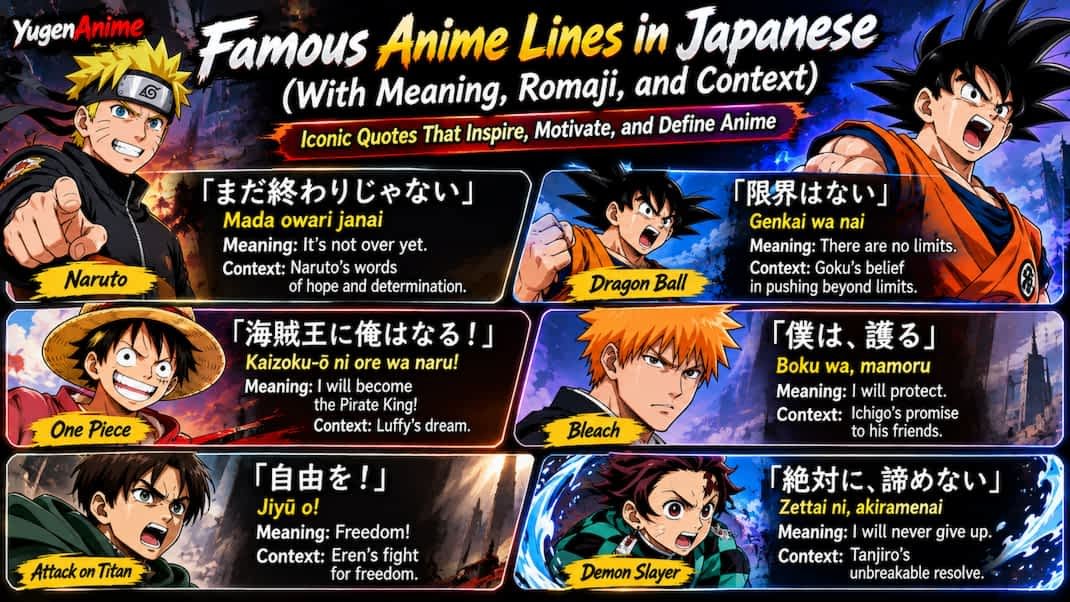
Famous anime lines in Japanese are lines that trace back to a specific character, episode, or manga source — not phrases invented later by fandom. YugenAnime put together this anime culture reference for fans who want a correct Japanese line, its romaji, and its real meaning, in one place.
The goal here is accuracy, not volume. Each line below is one that’s widely and consistently documented across multiple anime reference sources, not a line we half-remembered or guessed at.
YugenAnime readers use pages like this for three things: finding a quote to use in a bio or caption, checking whether a phrase they’ve seen online is actually real Japanese, and understanding what a line means word for word rather than just its dubbed version.
How We Choose and How We Checked
YugenAnime’s selection process for this list has three rules.
Selection criteria:
- The line must be traceable to a specific anime or manga source, not just “commonly seen online.”
- The romaji spelling must be stable and consistent across multiple references, not a one-off transliteration.
- The line has to carry a clear, checkable meaning, not a vague “deep” phrase nobody can pin down.
How claims were checked: Each line was cross-referenced against how it’s consistently written and attributed across anime fan wikis and official dub/sub translations. Where translations differed between fan subtitles and official dubs, both versions are noted. Lines where the Japanese wording couldn’t be confirmed with confidence were dropped rather than guessed at.
What’s original here: The category breakdowns (Lines to Say, Bio-Safe Lines, Cringe Quotes), the bio-safe checklist template, and the mistakes-to-avoid section are original commentary by YugenAnime, not quoted from any outside source.
Famous Anime Lines in Japanese With Meaning
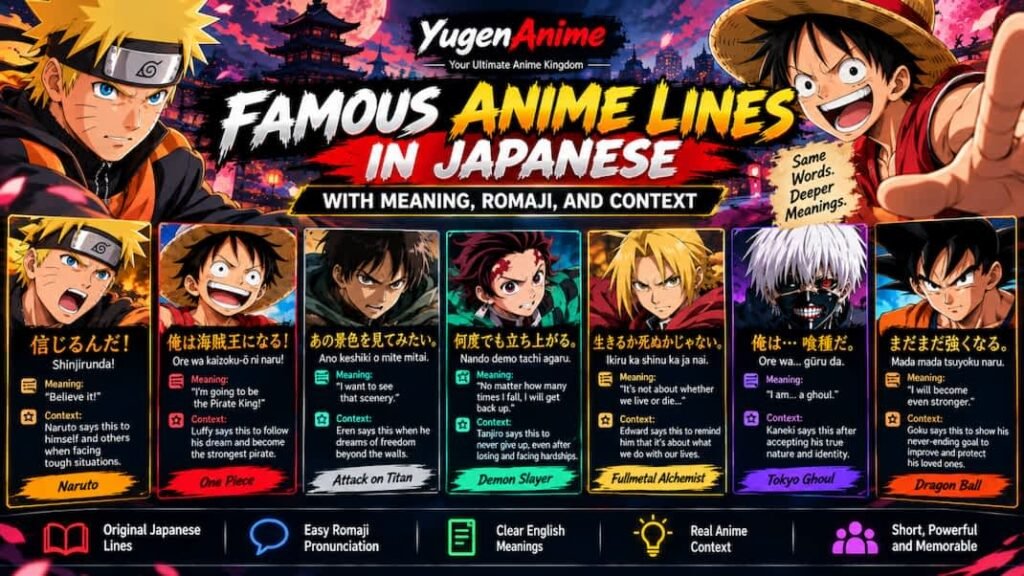
Famous anime lines in Japanese with meaning are catchphrases that stayed attached to one character because they were repeated at key moments in the show. Here are ten of the most consistently documented examples.
Worked example 1
- Item: Yare yare daze (やれやれだぜ)
- Source: Jotaro Kujo, a fictional protagonist from JoJo’s Bizarre Adventure
- Best use: Expressing mild, humorous exasperation
- Sample usage: Caption under a photo of a messy room, meaning roughly “good grief”
Worked example 2
- Item: Omae wa mou shindeiru (お前はもう死んでいる)
- Source: Kenshiro, a fictional protagonist from Fist of the North Star
- Best use: A dramatic reveal or “gotcha” moment
- Sample usage: Said right after a plot twist is revealed
Worked example 3
- Item: Ore wa Hokage ni naru (俺は火影になる)
- Source: Naruto Uzumaki, a fictional protagonist from Naruto
- Best use: Declaring a big personal goal
- Sample usage: Swapped for “I will become [goal]” as a motivational line
Worked example 4
- Item: Shinzou wo sasageyo (心臓を捧げよ)
- Source: The Scout Regiment’s motto in Attack on Titan
- Best use: Intense, dramatic salute-style captions
- Sample usage: Convention cosplay photo captions
Other widely documented lines worth knowing: Kaizoku-ou ni ore wa naru (海賊王に俺はなる), Monkey D. Luffy’s goal line from One Piece; Kamehameha (かめはめ波), Son Goku’s attack call from Dragon Ball; Boku wa shinsekai no kami ni naru (僕は新世界の神になる), Light Yagami’s line from Death Note; Purasu Urutora (プラスウルトラ), the U.A. High School motto from My Hero Academia; and Akirametara, soko de shiai shuuryou desu yo (あきらめたらそこで試合終了ですよ), said by coach Anzai Mitsuyoshi in Slam Dunk.
Note on variation (per attribution-variability): Luffy’s line is sometimes rendered “Ore wa kaizoku-ou ni naru otoko da” in different sources — both versions are attributed to the same character and scene intent, just different word order.
Famous Anime Phrases in English
Famous anime phrases in English are translated or dubbed versions of the original Japanese, and the English wording often shifts rhythm or literal meaning during localization.
A clean example is Naruto’s verbal tic “dattebayo” (だってばよ). It has no direct English meaning — it’s a speech habit, not a word. The English dub rendered it as “believe it,” which isn’t a translation so much as a stand-in for the verbal rhythm.
Luffy’s goal line is another case. The literal Japanese is closer to “I am the man who will become Pirate King.” The English dub simplifies this to “I’m gonna be King of the Pirates!” Both carry the same intent, but the English version drops the self-description.
Some phrases, like “Kamehameha,” are left untranslated entirely in English dubs and subtitles. They function as proper nouns rather than ordinary vocabulary, so localization teams keep them as-is.
Japanese Anime Lines to Say
Japanese anime lines to say out loud, in real conversation, are short and grammatically normal — not battle-cry catchphrases that sound strange outside a fight scene.
These come from slice-of-life and everyday scenes in anime rather than climactic battles:
- Otsukaresama desu (お疲れ様です) — said to coworkers or teammates after effort, roughly “thanks for your hard work”
- Ganbatte (頑張って) — “do your best” or “good luck,” said before an attempt at something
- Ittekimasu / Okaeri (行ってきます/お帰り) — said leaving home and welcoming someone back
- Daijoubu? (大丈夫?) — “are you okay?”
- Itadakimasu (いただきます) — said before eating
A dramatic line like “Omae wa mou shindeiru” works fine as a joke reference among fans. It sounds odd if said literally in daily conversation, since it’s written as a combat declaration, not a greeting.
Anime Girl Quotes in Japanese
Anime girl quotes in Japanese that are genuinely famous trace to one named female character, not a generic “anime girl” trope.
Worked example
- Item: Tsuki ni kawatte, oshioki yo! (月に代わって、お仕置きよ!)
- Source: Usagi Tsukino, known as Sailor Moon, a fictional protagonist from Sailor Moon
- Best use: Dramatic, confident declaration
- Sample usage: Caption meaning “In the name of the moon, I’ll punish you!”
Worked example
- Item: Watashi, ki ni narimasu! (私、気になります!)
- Source: Rem, a fictional character from Re:Zero − Starting Life in Another World
- Best use: Expressing curiosity or that something is bothering you
- Sample usage: Caption meaning “I’ll be bothered by it!”
Worth a separate note: “ara ara” (あら あら) is a recurring expression associated with a certain character archetype in anime, not a quote from one named character. It’s a speech pattern, not a sourced line, and should be treated that way.
Japanese Anime Quotes for a Bio
Japanese anime quotes for a bio work best when they’re short enough to read correctly with no surrounding context, since a profile caption gives the reader nothing else to go on.
Good bio-length candidates: “Ganbatte” (頑張って), “Yare yare daze” (やれやれだぜ), “Nakama” (仲間, meaning “comrade” or “friend,” closely tied to One Piece’s themes), and “Purasu Urutora” (プラスウルトラ).
Longer dramatic lines, like Anzai’s Slam Dunk line or Light Yagami’s Death Note line, lose their meaning outside the scene. They work in a quote list; they read strangely alone in a bio.
Cringe Anime Quotes in Japanese
Cringe anime quotes in Japanese are usually not broken lines from real anime — most of them are English-language memes invented by fandom and dressed up to look like authentic Japanese.
The clearest example is “senpai, notice me.” This phrase is not standard Japanese grammar and does not trace to any specific anime line. It was built by English-speaking fan communities online as a joke about a recurring anime trope, then spread as if it were a real quote.
Other commonly mocked patterns:
- Stringing “kawaii desu ne” together loosely, without matching normal sentence structure
- Using “baka” (馬鹿, meaning “idiot” or “fool”) as a catch-all meme word divorced from its actual tone
- Treating “nani?!” (何?!) as a universal shocked reaction, when it’s really just the word “what,” amplified by meme culture around exaggerated anime reactions
None of this means the underlying words are fake. “Baka” and “kawaii” are real Japanese words. The cringe comes from how fandom reassembles them into sentences no actual anime character says.
Quick-Reference Table
| Line (Japanese / Romaji) | Source | Word count | Best for |
|---|---|---|---|
| お前はもう死んでいる / Omae wa mou shindeiru | Kenshiro, Fist of the North Star | 4 | Dramatic reveal |
| やれやれだぜ / Yare yare daze | Jotaro Kujo, JoJo’s Bizarre Adventure | 3 | Light exasperation, bio |
| 海賊王に俺はなる / Kaizoku-ou ni ore wa naru | Monkey D. Luffy, One Piece | 5 | Goal declaration |
| 俺は火影になる / Ore wa Hokage ni naru | Naruto Uzumaki, Naruto | 5 | Goal declaration |
| かめはめ波 / Kamehameha | Son Goku, Dragon Ball | 1 | Playful reference, caption |
| 僕は新世界の神になる / Boku wa shinsekai no kami ni naru | Light Yagami, Death Note | 7 | Dramatic quote list |
| 心臓を捧げよ / Shinzou wo sasageyo | Scout Regiment, Attack on Titan | 3 | Cosplay caption |
| プラスウルトラ / Purasu Urutora | U.A. High School motto, My Hero Academia | 2 | Bio, motivational caption |
| 月に代わって、お仕置きよ / Tsuki ni kawatte, oshioki yo | Usagi Tsukino (Sailor Moon) | 5 | Confident declaration |
| 私、気になります / Watashi, ki ni narimasu | Rem, Re:Zero | 3 | Curiosity caption |
Template: The Bio-Safe Line Checklist (Original by YugenAnime)
Before using any Japanese anime line publicly, run it through four checks:
- Is it real? Confirm it traces to an actual anime or manga, not a meme page.
- Is it short? Under 6–7 words reads cleanly without context.
- Do you know the literal meaning? Word for word, not just the vibe.
- Is the romaji stable? Check it matches one consistent spelling across sources, not three different transliterations.
If all four check out, the line is safe to use in a bio, caption, or casual reference.
Original by YugenAnime: Why a Translated Line Never Says Exactly the Same Thing
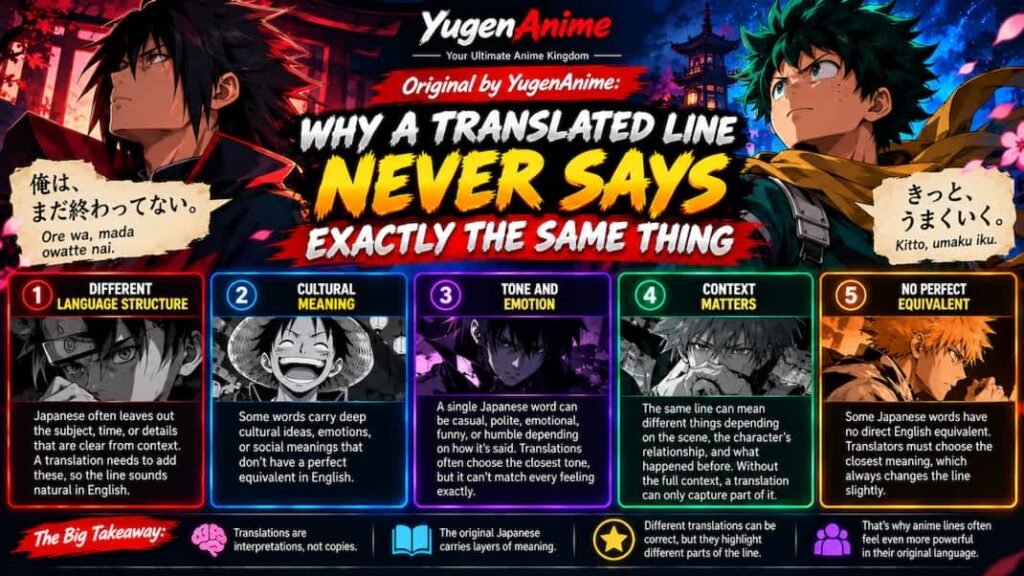
Japanese sentence structure places the verb at the end and often drops the subject entirely when it’s obvious from context. English can’t always do that cleanly.
This is why Naruto’s “dattebayo” becomes “believe it” in English — not because it’s a direct translation, but because English needs something to fill a rhythmic gap. A dub isn’t a word-for-word swap. It’s a rebuild of the same intent, using a different language’s grammar.
Mistakes to Avoid
- Treating a fan-made meme as real Japanese. “Senpai notice me” isn’t a quote from any show; it’s an internet-built phrase.
- Mixing romaji systems inconsistently. “Shi” and “si,” or “tsu” and “tu,” come from different romanization systems — pick one and stay consistent.
- Ignoring politeness level. A rough, masculine battle line sounds jarring in a polite, formal setting.
- Using a battle catchphrase as an everyday greeting. “Omae wa mou shindeiru” is a combat line, not small talk.
- Assuming the dub is a literal translation. Dubs localize for rhythm and audience, not word-for-word accuracy.
- Copy-pasting kanji without checking the source. A phrase that looks right can still be attributed to the wrong character or show.
Key Takeaways
- Real famous anime lines in Japanese trace to a specific character and show; fan-invented phrases like “senpai notice me” do not.
- Romaji spelling should stay consistent with one romanization system (commonly Hepburn).
- Dubbed English versions localize meaning rather than translating word for word.
- Short lines (under 6–7 words) work better for bios than dramatic battle monologues.
- Everyday lines like “ganbatte” or “otsukaresama desu” are genuinely usable in real conversation; combat catchphrases usually aren’t.
Frequently Asked Questions
Is “senpai, notice me” a real Japanese anime line?
No. It’s an English-language fan meme built around a recurring anime trope, not a quote from any specific show. It isn’t standard Japanese sentence structure either.
Short lines under 6–7 words work best, like “Ganbatte,” “Yare yare daze,” or “Nakama,” since bios give readers no scene context to lean on.
What’s the difference between a famous anime line in Japanese and its English dub version?
The Japanese original is often literal and context-dependent, while the English dub localizes the phrase for rhythm and audience, sometimes dropping or simplifying parts of the meaning.
How do I pronounce famous anime lines in Japanese from romaji?
Read each vowel with a consistent, flat sound (a, i, u, e, o) and keep syllables even in length, following the Hepburn romanization convention most anime sources use.
Which anime lines do Japanese learners actually use in real conversation, versus just quoting for fun?
Everyday lines like “otsukaresama desu,” “ganbatte,” and “itadakimasu” show up in real speech. Battle catchphrases like “omae wa mou shindeiru” are quoted for fun, not used literally.
Are all famous anime catchphrases unique to one character?
No. Some, like “ara ara” or the exaggerated “nani?!” reaction, are recurring expressions tied to a character archetype or meme trend rather than one named character or scene.