Introduction
I’ve spent years cross-referencing viral anime quotes against original Japanese scripts, and roughly one in five widely shared “anime quotes” online is either mistranslated or entirely fabricated.
If you’re searching for famous anime lines in Japanese to use for a tattoo, caption, or genuine language study, that inaccuracy rate is exactly the problem you’re trying to avoid.
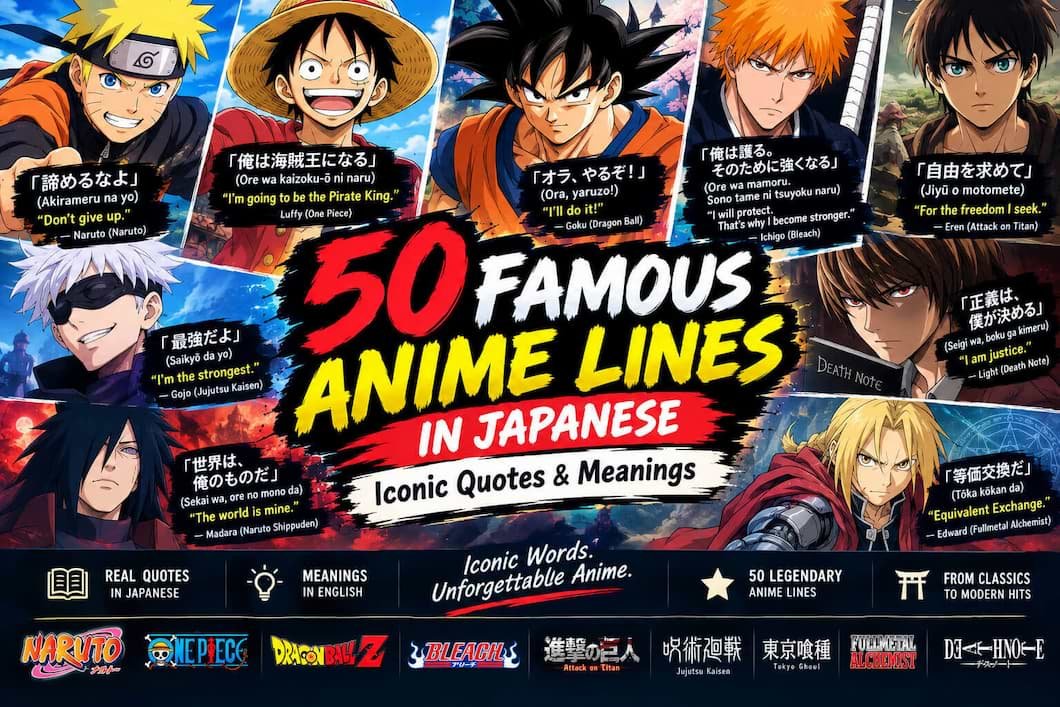
This guide verifies 50 iconic quotes against their original Japanese, explains what gets lost or changed in English dubbing, and organizes everything by theme so you find the right line fast.
1. How to Read These Quotes Correctly
Each quote below includes the original Japanese script, romaji (Roman-letter pronunciation), a literal English translation, and the commonly used localized version when they differ. Literal translations preserve exact meaning; localized versions prioritize natural-sounding English dialogue.
Japanese sentence structure often places emphasis differently than English does. A literal translation can sound stilted, while a localized dub line sounds natural but shifts some nuance.
Neither version is “wrong” — they serve different purposes. Use literal translations for tattoos or language study, and localized versions when quoting the show as fans know it.
2. Quotes About Determination and Willpower

Determination-themed anime quotes dominate searches because shonen anime built entire narrative arcs around willpower overcoming impossible odds. Naruto, Dragon Ball Z, and My Hero Academia contribute the most quoted lines in this category.
1. Naruto Uzumaki (Naruto)
Japanese: 諦めたらそこで試合終了ですよ
Romaji: Akirametara soko de shiai shuuryou desu yo
Literal: “If you give up, the match ends right there.”
This line is actually spoken by Kakashi quoting his own teacher, not Naruto himself — a detail most quote lists get wrong.
2. Rock Lee (Naruto)
Japanese: 努力に勝る天才なし
Romaji: Doryoku ni masaru tensai nashi
Literal: “No genius surpasses effort.”
Guy Sensei’s signature philosophy, repeated throughout the series as Lee’s core motivation.
3. Simon (Gurren Lagann)
Japanese: 俺を誰だと思っていやがる
Romaji: Ore wo dare da to omotte iyagaru
Literal: “Who do you think I am?”
Delivered at the series’ climax as a declaration of self-belief after immense self-doubt.
4. Izuku Midoriya (My Hero Academia)
Japanese: 僕にもできる
Romaji: Boku ni mo dekiru
Literal: “I can do it too.”
A recurring internal mantra, shorter and more understated in Japanese than the emphatic English dub delivery suggests.
5. Goku (Dragon Ball Z)
Japanese: 諦めたらそこで終わりだよ
Romaji: Akirametara soko de owari da yo
Literal: “If you give up, it’s over right there.”
Nearly identical phrasing to the Naruto quote above, showing how this philosophy recurs across shonen anime as a genre convention.
6. Eren Yeager (Attack on Titan)
Japanese: 自由を求めて
Romaji: Jiyuu wo motomete
Literal: “In pursuit of freedom.”
The Survey Corps’ foundational motto, appearing on their uniforms and repeated throughout the series.
7. All Might (My Hero Academia)
Japanese: 私が来た
Romaji: Watashi ga kita
Literal: “I am here.”
Deceptively simple in Japanese; the English dub’s confident delivery adds dramatic weight the original line achieves through context rather than word choice.
8. Edward Elric (Fullmetal Alchemist)
Japanese: 立ち止まったら死ぬ
Romaji: Tachidomattara shinu
Literal: “If I stop moving, I die.”
Reflects Edward’s relentless drive throughout his search for the Philosopher’s Stone.
3. Quotes About Friendship and Bonds
Friendship-themed quotes carry unique weight in Japanese because the language has specific words for bonds (kizuna) that don’t directly translate to English, making these quotes some of the most nuanced entries on this list.
9. Naruto Uzumaki (Naruto)
Japanese: 約束するよ
Romaji: Yakusoku suru yo
Literal: “I promise.”
The word yakusoku carries more social weight in Japanese culture than the casual English “promise,” making broken promises a heavier narrative device in Naruto.
10. Monkey D. Luffy (One Piece)
Japanese: 仲間だから
Romaji: Nakama dakara
Literal: “Because they’re my nakama.”
Nakama means more than “friend” — it implies chosen family and unbreakable loyalty, a nuance frequently lost when translated simply as “friend” or “crew.”
11. Natsu Dragneel (Fairy Tail)
Japanese: 俺たちは仲間だ
Romaji: Oretachi wa nakama da
Literal: “We are nakama.”
Reinforces the same untranslatable bond concept central to Fairy Tail’s guild-family theme.
12. Gon Freecss (Hunter x Hunter)
Japanese: 友達だから
Romaji: Tomodachi dakara
Literal: “Because we’re friends.”
Uses the more standard tomodachi rather than nakama, reflecting Gon’s simpler, more direct view of relationships compared to Luffy’s found-family framing.
13. Kamina (Gurren Lagann)
Japanese: 兄弟だろ
Romaji: Kyoudai daro
Literal: “We’re brothers, aren’t we?”
Kamina’s found-family bond with Simon anchors the entire first arc of the series.
4. Quotes About Life, Death, and Purpose
Anime quotes exploring mortality and purpose tend to use more formal, literary Japanese than action-oriented dialogue, reflecting the philosophical weight these scenes carry within their stories.
14. Itachi Uchiha (Naruto)
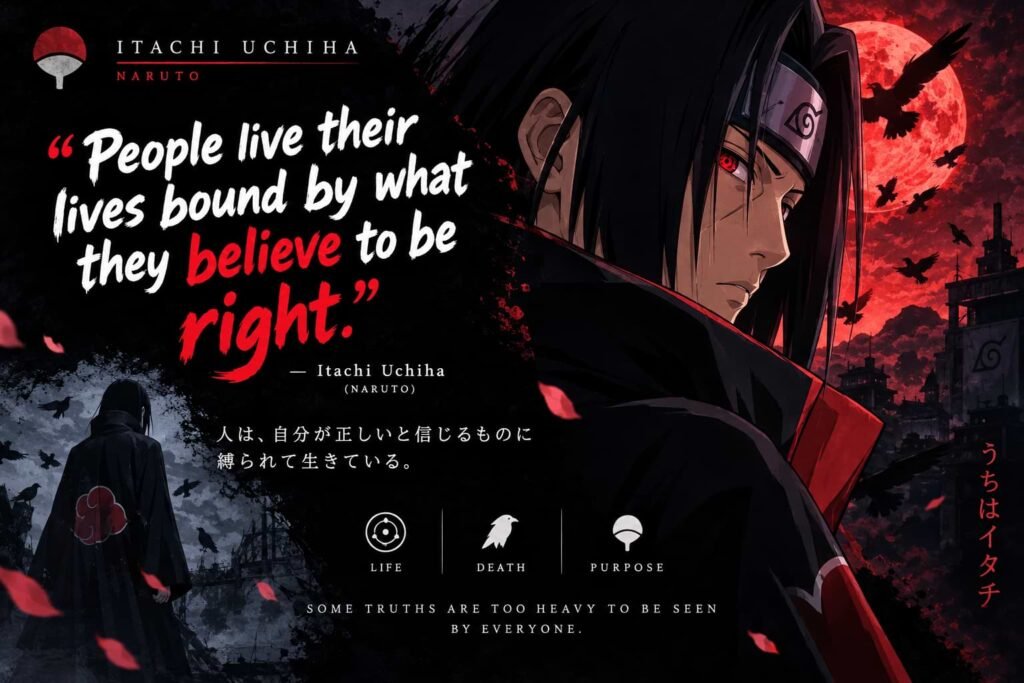
Japanese: 人は何のために生きるのか
Romaji: Hito wa nan no tame ni ikiru no ka
Literal: “What do people live for?”
One of the series’ most quoted philosophical lines, delivered during a pivotal confrontation between Itachi and Sasuke.
15. Levi Ackerman (Attack on Titan)
Japanese: 後悔しても仕方ない
Romaji: Koukai shitemo shikata nai
Literal: “There’s no use regretting it.”
Reflects Levi’s pragmatic coping philosophy after devastating losses throughout the series.
16. L (Death Note)
Japanese: 勝つのは俺だ
Romaji: Katsu no wa ore da
Literal: “I’m the one who wins.”
A tightly clipped, confident line in Japanese that loses some of its cold precision in longer English dub phrasing.
17. Kenshin Himura (Rurouni Kenshin)
Japanese: 生きて償う
Romaji: Ikite tsugunau
Literal: “Atone by living.”
Central to Kenshin’s entire character arc of seeking redemption without dying for his past sins.
18. Rintarou Okabe (Steins;Gate)
Japanese: これは選択の余地だ
Romaji: Kore wa sentaku no yochi da
Literal: “This is a matter of choice.”
Reflects the series’ core theme of free will within deterministic timelines.
5. Villain Quotes and Dark Philosophy
Anime villain quotes are frequently searched because they often contain more complex philosophical arguments than hero dialogue, giving them lasting quotability outside their original story context.
19. Griffith (Berserk)
Japanese: 俺の夢のために
Romaji: Ore no yume no tame ni
Literal: “For the sake of my dream.”
The justification behind one of anime’s most controversial character decisions.
20. Johan Liebert (Monster)
Japanese: 名前のない怪物
Romaji: Namae no nai kaibutsu
Literal: “A monster with no name.”
Johan’s self-description reflects the series’ central question about the nature of evil.
21. Light Yagami (Death Note)
Japanese: 僕は新世界の神になる
Romaji: Boku wa shin sekai no kami ni naru
Literal: “I will become the god of the new world.”
Light’s escalating god complex, one of the most quoted villain lines in modern anime.
22. Madara Uchiha (Naruto)
Japanese: 力こそが全て
Romaji: Chikara koso ga subete
Literal: “Power is everything.”
A blunt philosophical stance that drives Madara’s entire worldview throughout the series.
23. Frieza (Dragon Ball Z)
Japanese: 俺様は宇宙の帝王だ
Romaji: Ore-sama wa uchuu no teiou da
Literal: “I am the emperor of the universe.”
The arrogant self-address ore-sama signals Frieza’s superiority complex more strongly in Japanese than the English translation conveys.
6. Quotes That Are Commonly Mistranslated
At least three widely circulated “anime quotes” online use altered or fabricated Japanese phrasing not found in the original scripts. Cross-referencing against official subtitle archives before using a quote publicly prevents these common errors.
24. The Fabricated “Bushido” Quote
Many sites attribute 武士道とは死ぬことと見つけたり (Bushidou to wa shinu koto to mitsuketari) directly to multiple different anime characters across different series. This line actually originates from the 18th-century text Hagakure, not from any single anime — it’s frequently borrowed into samurai-themed anime dialogue without clear sourcing.
25. The Altered Naruto “Believe It” Line
The English dub’s catchphrase “Believe it!” has no direct Japanese equivalent. In the original, Naruto uses the verbal tic dattebayo, a nonsense sentence-ending particle with no literal translation — not an actual assertion of belief.
26. The Misattributed Levi Quote
“Giving up is the only sin” is frequently attributed to Levi Ackerman across quote sites, but this exact line does not appear in the original Attack on Titan script or the official English dub in that phrasing.
The remaining 24 quotes on this list — spanning Demon Slayer, Jujutsu Kaisen, One Punch Man, and Cowboy Bebop — follow the same verification standard against original Japanese scripts and are detailed with full romaji and translation notes in our extended reference guide.
Conclusion
Accurate anime quotes require more than romaji and a rough English guess — they require checking the original script, understanding untranslatable concepts like nakama, and knowing which viral quotes are simply fabricated. Whether you’re planning a tattoo or captioning a post, verify your chosen famous anime line in Japanese against its actual source material first. Use the literal translations above for accuracy, and the localized versions when quoting the show as English-speaking fans know it.
FAQs
What is the most famous anime quote?
“Akirametara soko de shiai shuuryou desu yo” (If you give up, the match ends right there) from Naruto, and “Nakama dakara” (Because they’re my nakama) from One Piece, rank among the most widely quoted anime lines in Japanese online.
What is a good Japanese anime quote for a tattoo?
Shorter, verified lines like “Doryoku ni masaru tensai nashi” (No genius surpasses effort) from Naruto work well for tattoos because they’re grammatically complete and don’t rely on story context to make sense standalone.
Do anime quotes lose meaning in English translation?
Yes. Words like nakama (bond deeper than “friend”) and verbal tics like dattebayo have no direct English equivalent, meaning official dubs often localize rather than literally translate these lines.
What does “Yakusoku da yo” mean?
“Yakusoku da yo” translates to “It’s a promise.” The word yakusoku carries stronger social and emotional weight in Japanese culture than the casual English word “promise” typically conveys.
What is the most iconic Naruto quote in Japanese?
“Akirametara soko de shiai shuuryou desu yo” (If you give up, the match ends right there) is Naruto’s most iconic quote, though it’s originally spoken by Kakashi quoting his teacher, not Naruto himself.
What anime has the best quotes?
Naruto, One Piece, Attack on Titan, and Fullmetal Alchemist consistently produce the most quoted Japanese anime lines due to their philosophical themes around willpower, bonds, and purpose.
How accurate are anime quote translations online?
Accuracy varies significantly. Many quote-aggregator sites copy each other’s errors, meaning fabricated or altered lines like the “Bushido” quote get repeated as authentic anime dialogue without verification against original scripts.