
Introduction
Naruto Uzumaki started as the kid nobody in his village wanted to sit next to. More than two decades later, he’s one of the most recognized characters in anime history.
If you’ve tried starting Naruto recently, you know the problem already. Two series, hundreds of episodes, and a timeline that jumps around make it hard to know where to begin.
This guide sorts out the full Naruto story, the characters worth tracking, and the villains that actually matter. It also covers the fights fans still argue about years later.
Naruto follows an orphaned ninja chasing recognition and the title of Hokage. He fights enemies tied to his village’s darkest secrets, and the emotional core never changes even as the stakes grow.
This article covers spoilers for the full Naruto and Naruto Shippuden run. Whether you’re new to the series or filling in gaps from years ago, you’ll leave with a clear map of the story.
What Is Naruto’s Story Actually About?
Naruto is the story of an outcast ninja who turns rejection into fuel. Underneath the fights and the jutsu, it’s a two-decade arc about found family and earned trust.
Naruto follows Naruto Uzumaki, an orphan sealed with a destructive fox spirit at birth, as he fights to become Hokage, his village’s leader. The series splits into two halves: the original Naruto, covering his childhood training, and Naruto Shippuden, covering his teenage years battling the terrorist group Akatsuki.
The Original Series Setup Explained
Naruto is born with the Nine-Tailed Fox sealed inside him after it attacks his village. Most adults in Konoha fear and avoid him, except for his teacher Iruka, who treats him like a person rather than a weapon.
The story properly starts when Naruto graduates the ninja academy and joins Team 7, alongside Sasuke Uchiha and Sakura Haruno. Their sensei, Kakashi Hatake, pushes them through missions that test teamwork over raw talent.
Early arcs build the world through the Chunin Exams and an invasion of the Hidden Leaf Village. The original series closes with Sasuke abandoning Konoha to chase power from the criminal Orochimaru.
The Shippuden Time Skip Explained
Naruto Shippuden opens two and a half years later. Naruto returns from training with Jiraiya, one of his village’s legendary ninja, visibly stronger and more focused on his goal.
Akatsuki becomes the central threat during this stretch. The group hunts tailed beasts like the one sealed inside Naruto, which puts him directly in their path for the rest of the series.
The back half of Shippuden builds toward the Fourth Great Ninja War. Nearly every surviving character and villain gets pulled into that final conflict, which is where most long-running threads resolve.
How to Watch the Series Without Getting Lost
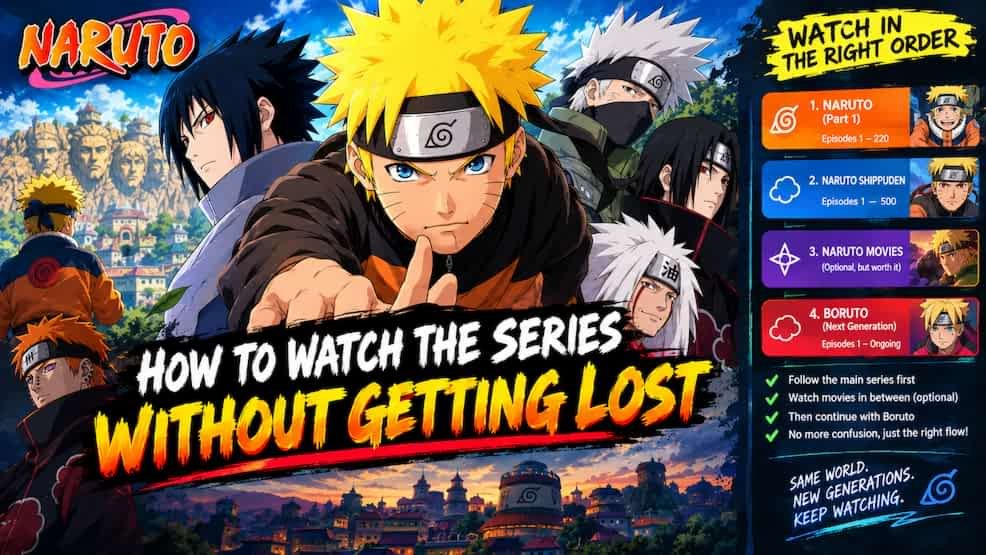
Naruto’s biggest barrier for new viewers isn’t the story. It’s the sheer number of episodes and knowing which ones you can safely skip.
Watch Naruto (2002) first, then move directly into Naruto Shippuden (2007) — they’re a single continuous story, not separate shows. Skip filler arcs using an episode guide, since they don’t affect the main plot.
Naruto vs Naruto Shippuden Watch Order
Naruto and Naruto Shippuden are not separate franchises you can pick between. Shippuden is a direct continuation, picking up Naruto’s story after the time skip with no reboot or retelling involved.
The original Naruto runs roughly 220 episodes, and Shippuden runs roughly 500. That combined length is the single biggest reason new viewers stall out before reaching the strongest arcs.
There’s no legitimate shortcut that skips straight to Shippuden. Early character relationships, especially between Naruto and Sasuke, only land emotionally if you’ve watched them form first.
Canon Episodes vs Filler You Can Skip
Filler episodes are anime-original content not drawn from Masashi Kishimoto’s manga. They exist mainly to let the anime catch up to the slower-releasing source material.
A good rule: if an episode title references a character or mission you’ve never heard of in the main plot, it’s probably filler. Fan-maintained episode guides list these clearly, and skipping them removes dozens of hours without losing story.
Not all filler is pointless, though. A handful of arcs flesh out side characters fans genuinely like, so treat skip guides as optional rather than mandatory.
Who Are the Main Characters and Team 7?
Naruto’s cast is large, but most of what matters funnels through one original team. Everyone else orbits their relationships in some way.
The core cast centers on Team 7 — Naruto Uzumaki, Sasuke Uchiha, Sakura Haruno, and their sensei Kakashi Hatake. Around them sits the Konoha 11, a wider group of ninja the same age who get their own arcs, plus mentors like Jiraiya and Tsunade who shape Naruto’s growth directly.
Team 7 and the Konoha 11 Explained
Naruto, Sasuke, and Sakura start as mismatched genin whose friction drives most of the early series. Naruto wants recognition, Sasuke wants revenge, and Sakura spends years figuring out where she fits between them.
The Konoha 11 is the broader group of same-age ninja, including Shikamaru Nara, Hinata Hyuga, and Rock Lee. Each gets dedicated arcs exploring their own families, abilities, and personal stakes outside the main trio.
Hinata’s arc matters more than casual viewers expect. Her quiet admiration for Naruto becomes one of the series’ more grounded relationships by the time Shippuden ends.
Naruto’s Mentors and Family Ties
Jiraiya, one of the three legendary Sannin, trains Naruto directly and becomes the closest thing he has to a father figure. His death partway through Shippuden is one of the series’ most-cited emotional turning points.
Naruto’s actual parents, Minato Namikaze and Kushina Uzumaki, are revealed gradually rather than upfront. Minato’s identity as a former Hokage reframes several early plot decisions once viewers learn it.
Tsunade, the Fifth Hokage, rounds out Naruto’s support system as both a healer and a reluctant mentor. Her relationship with Naruto gives the series one of its clearest father-daughter-adjacent dynamics without either role being literal.
Who Are the Franchise’s Most Dangerous Villains?
Naruto’s villains escalate deliberately, from personal rivals to world-ending threats. Ranking them by actual narrative impact tells a different story than ranking them by raw power.
Akatsuki, led by Pain and later Obito Uchiha, is the franchise’s central villain organization. The true final antagonist is Kaguya Otsutsuki, though Madara Uchiha causes more direct, personal devastation and is the villain most fans remember first.
Akatsuki Members Ranked by Threat Level
Pain, revealed as Nagato, delivers Akatsuki’s most consequential single attack by destroying the Hidden Leaf Village outright. His philosophy around pain and peace also gives the group a motive beyond simple villainy.
Itachi Uchiha occupies a strange space as both villain and tragic hero. The massacre of his own clan is reframed later as a sacrifice made to protect the village, which recontextualizes nearly everything before it.
Obito Uchiha becomes Akatsuki’s true mastermind once his identity is revealed. His grief-driven plan to trap the world in an illusion connects directly to the series’ final war.
Final Arc Villains Explained
Madara Uchiha returns from apparent death to pursue a plan centuries in the making. His raw combat power and history with the Hidden Leaf’s founder make him the villain most new viewers find genuinely frightening.
Kaguya Otsutsuki is introduced late as the origin point of chakra itself. She functions more as a cosmic threat than a character, which some fans find less satisfying than Madara’s personal arc.
The jump from grounded ninja conflict to god-tier cosmic battle is the series’ most debated shift. It’s worth knowing going in, so the tonal change doesn’t feel jarring.
What Are the Best Fights in the Series?
Naruto’s best fights work because they’re built on history between characters, not just choreography. The animation quality also varies a lot depending on which studio handled the episode.
The most consistently praised fights are Naruto vs. Sasuke at the Valley of the End, Naruto vs. Pain during the Leaf Village invasion, and Sasuke vs. Itachi. Each closes a long-running emotional arc, which is why they land harder than later large-scale battles.
The first Valley of the End fight closes out the entire original series and sets up years of unresolved tension between Naruto and Sasuke. It’s less about power and more about two friends failing to reach each other.
Naruto vs. Pain is frequently cited by fans as the series’ best-animated sequence, thanks to a dedicated animation team handling that arc. It also marks the moment Naruto starts thinking like a leader instead of a kid chasing approval.
Sasuke vs. Itachi resolves years of mystery around Itachi’s true motives. Watching it again after learning the full truth about the Uchiha massacre changes how the entire fight reads.
A few other fights deserve mention without needing their own section, including Rock Lee vs. Gaara, Naruto vs. Sasuke at the final valley rematch, and Might Guy vs. Madara during the war arc.
How Does the Chakra and Jutsu System Work?
Every power in Naruto traces back to chakra, a combined physical and spiritual energy every ninja trains to control. Understanding it makes fight scenes far easier to follow.
Chakra is the energy source behind every jutsu, or technique, in Naruto. Ninja combine hand seals with chakra control to perform elemental attacks, illusions called genjutsu, and physical enhancements, with chakra reserves and control determining how strong and sustainable a fighter is.
Jutsu split into three broad categories: ninjutsu for elemental and physical techniques, genjutsu for illusions that manipulate perception, and taijutsu for hand-to-hand combat that uses little to no chakra. Most characters specialize in one while using the others situationally.
Naruto’s own fighting style leans heavily on shadow clones, a ninjutsu technique that splits his chakra into independent copies of himself. It’s a clever workaround for his famously poor chakra control early in the series.
The Sharingan, Sasuke’s signature ability, works differently by copying opponents’ techniques and later casting powerful genjutsu. Understanding these systems early makes later power-ups, like Naruto’s Nine-Tails chakra mode, feel earned rather than arbitrary.
How Does Naruto Compare to Its Sequel, Boruto?

Boruto picks up a generation after Naruto ends, following Naruto’s son navigating a changed ninja world. It’s a direct sequel, not a reboot or spin-off in a different continuity.
Boruto: Naruto Next Generations follows Naruto’s children and their peers as new ninja, with Naruto himself now serving as Hokage. Reception has been more divided than the original series, largely due to pacing and tonal shifts.
The core difference is stakes. Naruto builds slowly toward war and world-ending threats, while Boruto starts in a more peaceful era, which changes the kind of conflict the story can tell.
Fan reception for Boruto has been notably more split than it was for Naruto. Some praise its willingness to explore new themes, while others feel it lacks the original’s emotional stakes.
If you’re finishing Naruto for the first time, there’s no obligation to continue into Boruto immediately. The original series resolves its main arcs cleanly enough to stand alone.
Common Mistakes New Viewers Make
Most people who quit Naruto partway through make one of a few predictable mistakes. Avoiding them makes the whole experience smoother.
The biggest mistakes new viewers make are watching filler episodes in order without skipping, judging the series by its slower early arcs, and skipping Shippuden’s emotional buildup to reach big fights faster. Each of these causes people to quit before the story’s strongest stretches.
Watching every filler episode in sequence is the fastest way to lose momentum. It’s not that filler is poorly made; it’s that it interrupts pacing right when the main plot is building tension.
Judging the whole series from its first dozen episodes is another common error. Naruto takes time establishing its world, and the payoff for that patience doesn’t fully arrive until later arcs.
Skipping ahead to famous fights without the buildup around them is tempting but backfires. Naruto’s fights are built on history, and watching them out of context strips out most of what makes them memorable.
Frequently Asked Questions
What is the story of Naruto about?
Naruto follows an orphaned ninja fighting for recognition and the title of Hokage, while confronting enemies connected to his village’s hidden history. The series splits into two continuous parts: Naruto and Naruto Shippuden, covering his childhood and teenage years respectively.
Who is the strongest villain in Naruto?
By raw power, Kaguya Otsutsuki and Madara Uchiha are typically ranked highest. By narrative impact and fan attachment, Madara and Pain are more frequently cited as the series’ most memorable antagonists.
What order should I watch Naruto in?
Watch the original Naruto series first, then move directly into Naruto Shippuden. They form one continuous story, and Shippuden assumes you’ve already watched the first series in full.
Is Naruto Shippuden a sequel or continuation?
Naruto Shippuden is a direct continuation, not a separate sequel series. It picks up the same characters and plot roughly two and a half years after the original series ends.
What are the best fights in Naruto?
Fan-favorite fights include Naruto vs. Sasuke at the Valley of the End, Naruto vs. Pain, and Sasuke vs. Itachi. Each resolves long-running emotional tension rather than existing purely for spectacle.
Does Naruto have filler episodes I can skip?
Yes, both Naruto and Naruto Shippuden contain substantial filler content not based on the manga. Fan-maintained episode guides identify these clearly, and skipping most of them doesn’t affect the main plot.
Conclusion
Naruto works because it never loses sight of its emotional core, even across hundreds of episodes and increasingly large-scale battles. The fights matter because the relationships behind them were built carefully first.
If you’re starting from scratch, watch the original series before Shippuden, and use a filler guide from the beginning. That one decision prevents most of the frustration new viewers run into.
Pay attention to Itachi, Pain, and Obito specifically. Their arcs carry more of the series’ actual thematic weight than the final cosmic-scale villain does.