
Introduction
Ask ten anime fans to name their favorite anime character, and you’ll get ten different answers. Most come with a passionate, slightly defensive explanation attached.
Here’s the problem: most “best character” lists just rank favorites. They never explain what actually makes a hero, villain, or rival work on a storytelling level.
This guide breaks that pattern. You’ll get a working framework for sorting any anime character by narrative job, not just by popularity.
Whether you’re new to anime or you’ve watched for years, you’ll walk away able to explain why Vegeta works as a rival, but Frieza works as a villain. That distinction matters more than most fans realize.
We’ll also cover the tropes writers lean on, the mistakes fans make when analyzing characters, and how a well-built character changes across a series. Let’s start with what actually makes an anime character memorable.
What Makes an Anime Character Iconic?
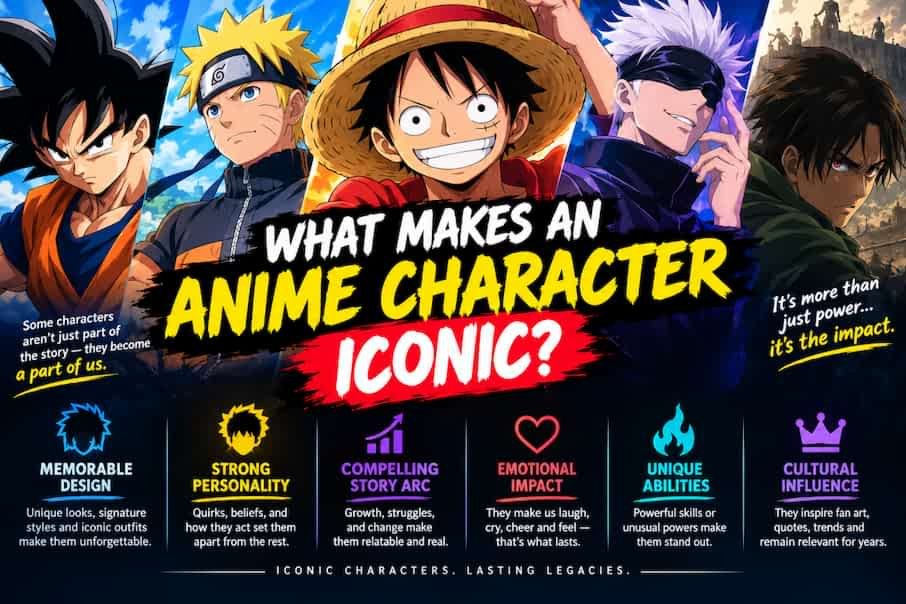
Iconic status isn’t an accident. It comes from a handful of design and writing choices that repeat across decades of anime, no matter the genre.
An anime character becomes iconic through a distinct visual silhouette, a clear core motivation, and a voice performance fans recognize instantly. Characters like Goku or Lelouch stick in memory because every element — design, dialogue, and arc — reinforces the same idea about who they are.
Visual Design and Memorability
Character designers build silhouettes you can identify in the dark. Goku’s spiky hair, Luffy’s straw hat, and Light Yagami’s notebook each double as a storytelling shortcut.
Color palettes matter too. Villains often get darker, sharper color schemes, while heroes lean toward brighter, rounder shapes, though plenty of great anime break this rule on purpose.
Consider Itachi Uchiha. His design stays subdued and controlled for most of Naruto, which mirrors how much he hides from everyone around him.
Even minor characters get this treatment in well-produced shows. A one-episode antagonist with a memorable design can outlast characters who appeared across entire seasons.
Voice Acting and Catchphrases
A character’s voice does more work than most viewers notice. Japanese voice actors, called seiyuu, often define a role so completely that recasting feels wrong to longtime fans.
Catchphrases work the same way. “Believe it” for Naruto or “Plus Ultra” for My Hero Academia’s Deku aren’t just marketing — they condense a character’s entire philosophy into a few words.
This repetition isn’t laziness. It’s reinforcement, the same technique advertisers use to make a slogan stick.
English dub actors face real pressure here too. Fans compare performances constantly, and a mismatched voice can hurt how a character lands with Western audiences.
The Core Hero Archetypes in Shonen and Beyond
Not every hero fits the loud, optimistic shonen mold. Anime draws from several hero archetypes, each built around a different relationship with power and responsibility.
The main anime hero archetypes include the shonen protagonist driven by friendship and growth, the reluctant hero pulled into conflict against their will, and the anti-hero who pursues good outcomes through morally grey methods. Each type changes how a story builds and resolves tension.
Shonen Protagonists Explained
Shonen heroes like Naruto, Luffy, and Izuku Midoriya share a formula. They start weak, get knocked down repeatedly, and improve through visible effort rather than natural talent.
This formula works because it mirrors real struggle. Readers and viewers root for effort they can relate to, not raw power they can’t.
The risk is repetition. When every arc follows the same beat — training, setback, breakthrough — even devoted fans start predicting the next twist before it happens.
Reluctant and Anti-Heroes
Reluctant heroes get pulled into conflict instead of choosing it. Shinji Ikari from Neon Genesis Evangelion is the clearest example — a teenager forced into a war he never wanted.
Anti-heroes operate differently. Guts from Berserk or Gintoki from Gintama pursue good outcomes but ignore the rulebook most traditional heroes follow.
This archetype appeals to older audiences specifically. It reflects a more complicated view of morality than younger-skewing shonen shows typically offer.
Vegeta sits somewhere between anti-hero and rival, which is exactly why fans argue about his category more than almost any other Dragon Ball character.
What Villain Types Define a Great Anime Story?
A flat villain can sink an otherwise great anime. The best antagonists give heroes something to push against that feels earned, not just evil for its own sake.
Great anime villains generally fall into a few types — the ideological villain who believes they’re right, the tragic villain shaped by circumstance, and the chaotic force who exists to test the hero. Each type demands a different kind of writing to stay believable across a full series.
The Ideological Villain
Ideological villains believe they’re the hero of their own story. Light Yagami in Death Note genuinely thinks a world without criminals justifies killing thousands of people.
This type works because the audience understands the logic even while rejecting the conclusion. Good writing makes you briefly see their point before you reject it.
Pain from Naruto and Griffith from Berserk follow the same pattern. Both have grievances that make sense on paper, which makes their actions harder to dismiss outright.
The Tragic or Sympathetic Villain
Tragic villains earn sympathy through backstory without losing their threat. Scar from Fullmetal Alchemist: Brotherhood kills out of genuine grief and cultural genocide, which complicates any simple reading of him as “the bad guy.”
The danger for writers is overcorrection. Give a villain too much sympathy,y and the story loses tension, because the audience stops wanting the hero to win.
Shows that balance well keeps the villain’s actions clearly harmful even while explaining the pain behind them. Attack on Titan’s Reiner Braun is a strong example of walking that line.
How Do Anime Rivals Differ From Villains?
Rivals and villains get confused constantly, but they serve completely different story functions. A rival pushes the hero to improve; a villain tries to stop them entirely. An anime rival challenges the hero toward growth and often shares mutual respect, while a villain actively works against the hero’s goals and safety. Vegeta and Goku exemplify rivalry, while Frieza and Goku exemplify a villain-hero relationship with no shared respect involved.
The Childhood Rival Dynamic
Childhood rivals grow up alongside the hero, often starting as friends or classmates. Katsuki Bakugo and Izuku Midoriya in My Hero Academia built their entire relationship on this dynamic.
This setup works because history adds weight. Every confrontation carries years of shared context that a brand-new villain simply can’t match.
The format risks feeling repetitive if the writer never lets the relationship evolve. Bakugo’s arc works specifically because his attitude toward Deku actually changes over time.
The Respect-Based Rival
Respect-based rivals start as enemies and slowly become something closer to allies. Vegeta’s entire arc across Dragon Ball Z follows this exact path, from genocidal invader to reluctant ally.
Sasuke and Naruto follow a messier version of the same idea. Their rivalry blends villain-level conflict with the emotional weight of a broken friendship.
This blend is part of why their relationship gets debated so much. It doesn’t fit neatly into either the rival or villain box, and that ambiguity is the point.
Why Supporting Cast Members Matter More Than You Think
Main characters get the spotlight, but supporting casts carry most of an anime’s emotional weight. Without them, even a great protagonist has no one to bounce off of.
Supporting characters in anime provide comic relief, emotional grounding, and exposition that would feel clunky coming from the protagonist directly. Characters like Sakura in Naruto or Robin in One Piece often carry subplots that deepen the main story without slowing it down.
Comic relief characters do more than add jokes. They control pacing, giving the audience a breather between heavier emotional beats.
Usopp in One Piece is a great example. His humor doesn’t undercut tension — it resets it, so the next serious moment lands harder.
Mentor figures serve a different function entirely. Jiraiya in Naruto or All Might in My Hero Academia exist to hand off wisdom and then, often, exit the story at a pivotal moment.
That exit matters narratively. Losing a mentor forces the protagonist to apply lessons without guidance, which is usually when real character growth shows up.
Weak supporting casts usually fail in one of two ways. Either every side character sounds identical, or they exist purely to praise the main character without adding anything of their own.
Common Tropes Behind Every Memorable Anime Role
Tropes get a bad reputation, but they’re not automatically lazy writing. A trope only becomes a problem when a show leans on it instead of building an actual character.
Common anime character tropes include the tsundere, who hides affection behind hostility, the kuudere, who stays emotionally distant until trust is earned, and the genki girl, whose relentless energy drives a group dynamic forward. These patterns work when writers add specific detail on top of the formula.
Tsundere characters like Asuka from Evangelion or Taiga from Toradora start cold or combative, then slowly reveal warmth. The trope works because the shift feels earned through specific events, not a flipped switch.
Kuudere characters stay calm and withdrawn, which can read as coldness until the audience understands why. Rei Ayanami is the clearest early example of this type done well.
The genki trope brings pure, often chaotic energy into a cast. Luffy technically fits here too, blending genki energy with full protagonist status.
The mistake writers make is treating a trope as a finished character. A tsundere with no backstory beyond “hits the hero when embarrassed” gets old within a few episodes.
The best anime use tropes as a starting point, then layer in specific motivations and flaws. That layering is usually what separates a beloved character from a forgettable one.
How Characters Evolve Across a Long-Running Series

A character who ends a series exactly where they started usually signals weak writing. Growth, or the deliberate lack of it, should always feel intentional.
Anime characters typically evolve through escalating stakes, loss, and shifting relationships rather than sudden personality changes. Writers signal growth through small behavioral shifts — how a character reacts differently to a familiar situation — rather than announcing change directly through dialogue.
Look at how Gon Freecss’s speech patterns shift during the Chimera Ant arc of Hunter x Hunter, well before his rage fully surfaces. Small cues often telegraph internal change before the plot catches up.
Long-running shonen series face a specific challenge here. A hundred-plus episode run needs multiple growth arcs, not one single transformation stretched too thin.
One Piece handles this by giving nearly every crew member their own arc instead of funneling all growth through Luffy. That distributes character development across the whole cast.
Static characters aren’t automatically bad writing, though. Some characters work specifically because they stay consistent while the world around them changes.
Saitama from One Punch Man is a deliberate example. His refusal to change is the joke and the point, not a writing failure.
Mistakes Fans Make When Analyzing Anime Characters
Fan debates about characters get heated fast, and a lot of that heat comes from a few recurring analytical mistakes. Spotting them makes every character discussion sharper.
The most common mistakes fans make are confusing popularity with good writing, judging a character by a single arc instead of their full journey, and assuming darker automatically means deeper. Avoiding these traps leads to more useful, less circular character debates.
Popularity bias is the biggest trap. A character can be meme-worthy or visually striking without being well-written, and conflating the two derails a lot of online debate.
Judging characters mid-series is another common error. Zuko looked irredeemable for an entire season before his arc resolved — judging him there would have missed the point entirely.
The “darker equals deeper” assumption causes real problems too. Grimdark aesthetics don’t automatically add complexity; plenty of lighthearted characters carry more genuine depth than edgy ones with tragic backstories slapped on.
Finally, fans often ignore structural role when comparing characters across different shows. Comparing a main character’s development time to a side character’s is an unfair comparison from the start.
Frequently Asked Questions
What are the main types of anime characters?
Most anime characters fall into four broad categories: heroes, villains, rivals, and supporting cast. Each category breaks down further into specific archetypes like the shonen protagonist or the ideological villain.
Some frameworks add a fifth category, the mentor, though mentors often function as a subtype of supporting cast. Understanding which category a character occupies helps explain their narrative function before you analyze personality.
What makes a good anime villain?
A good anime villain has a clear, understandable motivation, even if the audience rejects their methods. The strongest villains also force the hero to grow to beat them.
Light Yagami and Griffith remain popular examples because their logic, while twisted, stays internally consistent throughout their stories. Weak villains exist only to be defeated, with no real philosophy behind their actions.
What is a foil character in anime?
A foil character contrasts sharply with the protagonist to highlight specific traits by comparison. Vegeta works as Goku’s foil because his pride-driven approach to power contrasts directly with Goku’s simpler love of fighting.
Sasuke also functions as a foil to Naruto, representing the isolation Naruto could have fallen into without his support system. Foils don’t have to be villains or rivals specifically.
Who are some of the most iconic anime heroes?
Goku, Naruto Uzumaki, Luffy, and Izuku Midoriya consistently rank among the most recognized anime heroes globally.
Newer heroes like Tanjiro Kamado from Demon Slayer are rapidly joining that list as the franchise’s global audience keeps growing. Their recognition comes from decades of continuous media presence, not strong writing alone.
What is a tsundere character?
A tsundere character hides affection or vulnerability behind hostility or coldness, usually softening as trust builds. The trope originated in visual novels before becoming a staple across anime genres.
Taiga from Toradora and Asuka from Evangelion are considered two of the clearest examples of the archetype done with real depth. Well-written tsundere characters earn their shift in attitude through specific plot events rather than time alone.
How do anime rivals differ from villains?
Rivals push the hero toward growth and often share mutual respect, even during active conflict. Villains work against the hero’s safety or goals without that underlying respect.
A rival can become an ally over time, while a true villain rarely does without a complete redemption arc. Vegeta’s decades-long shift from villain to rival to ally remains one of the clearest examples of this in anime history.
Conclusion
Anime characters work because every design choice, line of dialogue, and plot beat serves their narrative role. Heroes earn growth through struggle, villains need believable motivation, and rivals thrive on mutual respect.
The next time you watch a new series, try sorting each character by function before judging their personality. You’ll likely notice writing patterns you missed before, and understand why some arcs land harder than others.
Three things to remember: popularity doesn’t equal good writing, judging mid-arc is unfair to incomplete character journeys, and tropes aren’t inherently bad when writers add specific detail on top of them.